Thanks to America’s dark embrace of Israeli fascism and Lebensraum policies, the Israeli nuclear arsenal continues to represent an existential strategic nightmare to hundreds of millions of Muslims in the Middle East and beyond. This is why responsible Muslim leaderships must explore every conceivable option to deliver our people from this gargantuan peril.
Israeli officials, addicted to bamboozling gullible Western media by saying Israel wouldn’t be the first country to introduce nuclear weapons to the Middle East, would not spell out the real goals of possessing at least 90 nuclear warheads. It is certainly not to prevent a recurrence of the Holocaust or as an ultimate insurance policy against a prospective destruction of Jews by an extremely powerful enemy.
Sinister Goals
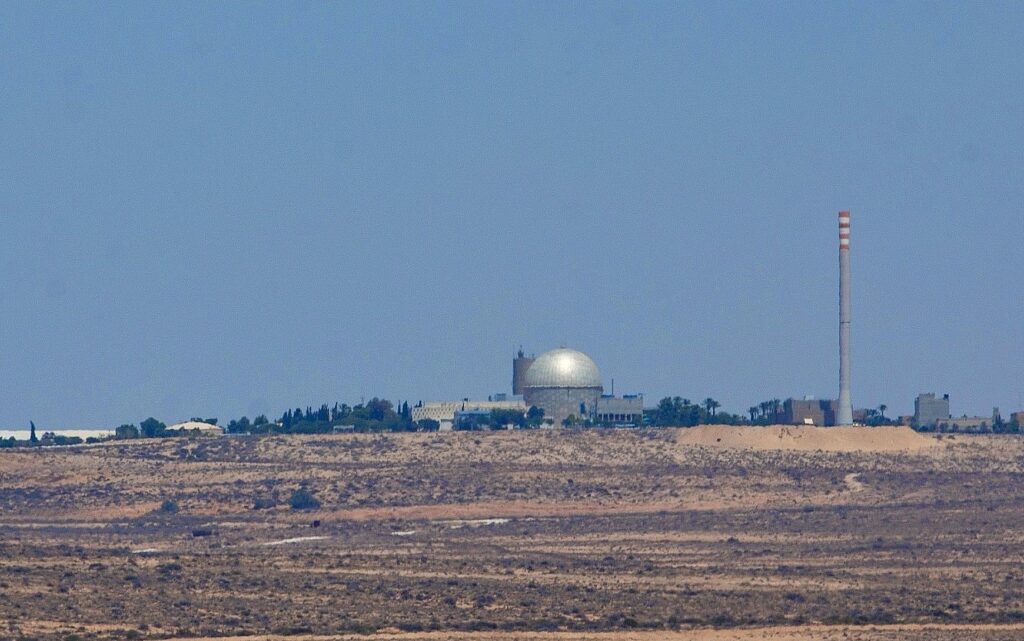
A picture taken on March 8, 2014 show a partial view of the Dimona nuclear power plant in the southern Israeli Negev desert [JACK GUEZ/AFP via Getty Images]
There are several sinister goals Israel is trying to achieve or has already achieved by virtue of possessing a sizeable nuclear arsenal, along with the required delivery systems. These goals include the following:
1. Achieving perpetual strategic superiority over the entire Arab world as well as regional non-Arab Muslim countries such as Turkey and Iran. Which amounts to forcing the Arab-Muslim Middle East into a strategic inferiority vis-à-vis the apartheid Jewish state.
2-Fortifying the Zionist scheme by adopting unprecedented draconian measures against Palestinians in Israel itself and the Occupied Territories (already over 50% of the total population).
Such exceptionally harsh measures might involve, inter alia, a partial genocide, carried out under the guise of a disingenuous civil war, concocted by the Zionist leadership as a pretext, which would trigger a massive flight by Palestinians similar to the Syrian or Ukrainian scenarios.
This is not a fantastic scenario as some observers might be tempted to think. Israel has already decapitated all remaining possibilities for the establishment of an independent and territorially contiguous Palestinian state.
Moreover, the US seems either utterly unable or unwilling or both, to force a recalcitrant Israel to dismantle or abandon its illegal settlements in the West Bank.
Hence, Israel might eventually reach the conclusion that ethnic cleansing of Palestinians, even one carrying the hallmarks of a real genocide, is the only solution for the worsening demographic crisis facing the Jewish state.
A few years ago, Jewish settler leaders expressed their hope that Palestinians would flee without a lot of bloodshed!
“But in case they don’t, we will have to do the job by hook or crook.”
This writer heard one settler from the settlement of Kiryat Arba near al-Khalil saying “ I wouldn’t mind killing a few thousand Palestinians if that would trigger the departure of a million or 2 million Arabs.”

Menachem Begin; a former terrorist Prime Minister of Israel, in his Book, the “Revolt, ” described the expulsion of the bulk of Palestinians following major Jewish massacres of Palestinian villagers in 1948, such as Dir Yasin, as a miraculous breakthrough since Israel would not have been created without it. Hence, present Zionist leaders pray that the “miracle” be repeated and millions of Palestinians would leave, admitting though that “no feat like this would be bloodless.”
The reason I specifically mentioned Egypt, Saudi Arabia, and Turkey has to do with Israel’s Talmudic ambitions to occupy large chunks of these countries “when the opportunity arises.”
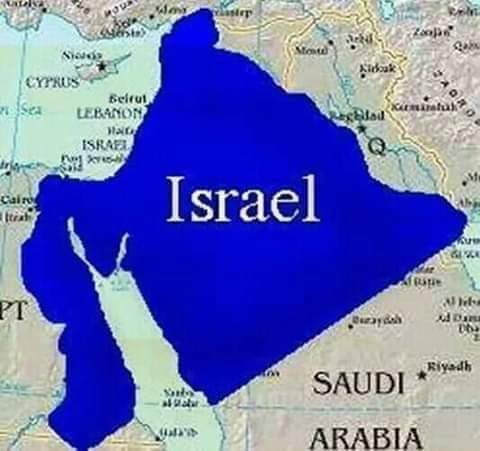
According to Jewish History, Jewish Religion, The Weight of Three Thousand years” by Israel Shahak, Israel’s Talmudic borders are as follows: “In the south, all of the Sinai Peninsula and a part of northern Egypt up the environs of Cairo; in the East, all of Jordan a large chunk of Saudi Arabia, all of Kuwait, and a large part of Iraq up to the Euphrates; in the north, all of Lebanon, all of Syria and a large part of southern Turkey up to Lake Van, and in the West, Cyprus.”
Jewish History, Jewish Religion, The Weight of Three Thousand years” by Israel Shahak. It’s one of the best books ever written on Orthodox Judaism. The author is Israel Shahak, a historian, human rights activist and Holocaust survivor who was subjected to persecution by the Israeli intelligence establishment for his progressive and anti-racist ideas which constituted a kind of antithesis of the prevailing zionist discourse ever since the creation of Israel in Palestine in 1948.
These ambitions are not abstract or far-fetched notions that belong to the realm of the impossible as far as powerful Talmudic circles are concerned.
According to Shahak, “an enormous body of research and learned discussion, based on these borders, embodied in atlases, books, articles and more popular forms of propaganda is being published in Israel.
What can be done to rectify this unbearable anomaly?
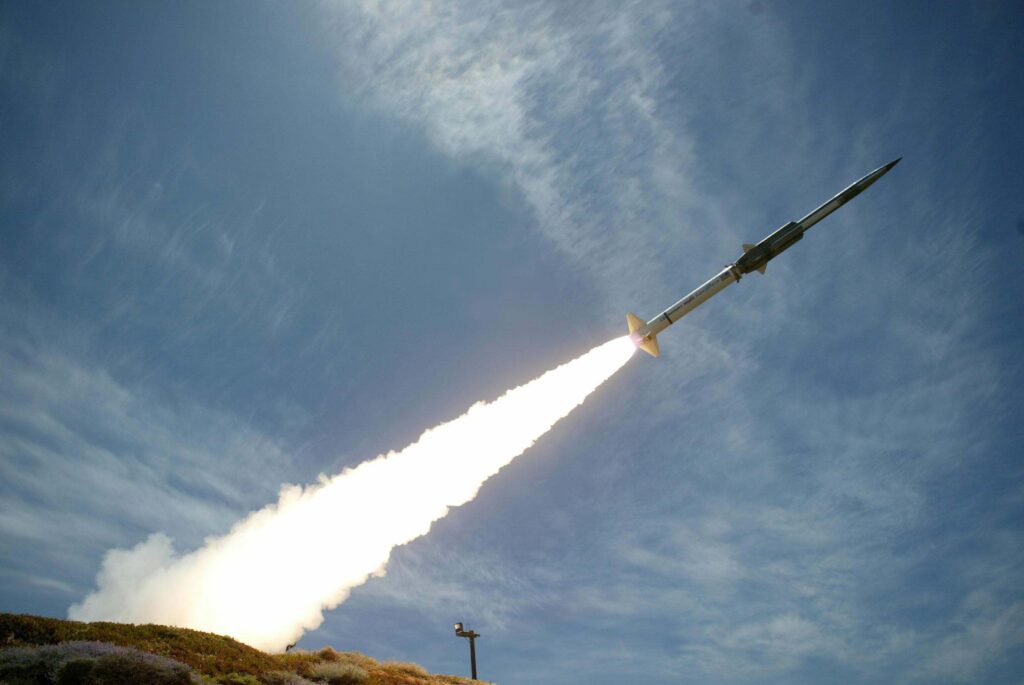
The US is committed to Israel’s military superiority in the entire Middle East.
I think treating this matter begins with renewing and reinforcing our realization that this strategic aberration cannot be allowed to linger forever since its continuation is tantamount to perpetuating and consolidating Jewish hegemony and supremacy over one-third of the world’s Muslims.
Yes, we do realize that without a submissively pliant America, Israel is a little more than a Kosher idle wind. But for the bulk of the Zionist clique effectively controlling the American government, Israel must always come first, even before America itself.
I don’t believe in the Protocols of the Elders of Zion, and I absolutely despise the silly antics of anti-Semites, past and present. None the less, we as Muslims must have enough rectitude and moral honesty to call the spade a spade.
Moreover, we shouldn’t go too far by indulging in infinite absurdity like babbling about defeating “American imperialism!” as a prelude to defeating Israel. In fact, destiny and history are evidently more able to defeat America. True, America is not a lame duck yet, but it is no longer the omnipotent superpower it once was as we have seen the limitations of its powers ever since the outbreak of the Ukrainian crisis.
We certainly are not seeking to achieve the Mutual Assured Destruction equation with America. We, too, have to be aware of our own limitations.
However, in a world where brutal force has the loudest voice, we can’t be like helpless orphans awaiting rescue from a bunch of thieves, rapists and child killers. After all who will help us if we don’t help ourselves?
I am not alluding to the little men reclining in Israel’s lap!
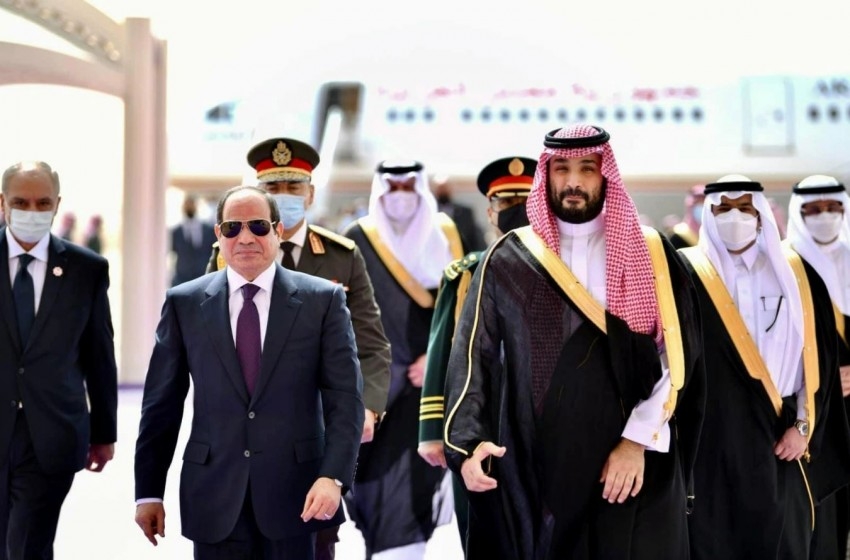
Two major quislings in the Arab world, Sisi of Egypt and MBS of Saudi Arabia
“When I say “We,” I am not thinking of this Sheikh, or that king or Emir. These mentally-retarded “little men” are more than just part of the problem. They are the problem itself. They are a huge burden upon themselves and their peoples as the strategic preoccupation of most of them doesn’t really exceed a woman’s underwear. They are a cancer upon the collective conscience of the Muslim Umma.
In the Muslim world, there are success stories and the overall strategic outlook is not that gloomy. None the less, I believe a close nuclear cooperation between certain Muslim countries must be ensured and cemented.
It is really shameful and quite embarrassing that a country such as Egypt, with a population of over a hundred million people, remains without a nuclear deterrent. But Egypt has only itself to blame.
The ruling Arab dynasties are a medieval kind of tyrannical dictatorships whereby the unelected king is viewed, de facto at least, as a sort of god, with absolute and unlimited authority
In the final analysis, a country whose masses cannot freely elect their rulers cannot really be independent and truly sovereign.
But we are talking about contemptible rulers who value the “legitimacy” that comes from the powerful Jewish lobby in America more than that which comes from their own peoples’ acceptance of them.
Unfortunately, this is the case in virtually all Arab countries from Manama to Casablanca. We all know that rectifying the nuclear imbalance with Israel is a paramount duty, though an exceptionally arduous task.
However, if a duty cannot be carried out unless certain requirements are secured, securing these requirements becomes a paramount duty itself. I can only say that much about this extremely sensitive subject.
I do care about my Umma, which ought to be one Umma, not 55 states, Sheikhdoms and fiefdoms with conflicting loyalties, depending on the mood of their mostly unelected ignorant leaders.
A few weeks ago, I was asked about my happiest day in life and my sadist. The happiest day was when Pakistan, a country I love but have never been to, succeeded in detonating its first nuclear device. And the Sadist day was when Israel’s man in Egypt, Abdul Fattah Sissi, in a bloody coup backed by Israel, Saudi Arabia and UAE, and, of course, the US, toppled Professor Muhammed Mursi, the first ever and last democratically-elected president in Egypt’s 7000-year-history.
The situation in Sudan is now more than just another news story. The conflict, which broke out in April 2023, is now in its fourth year and has left tens of thousands dead, more than 14 million people displaced (nearly a quarter of the population), and pushed the country to the brink of famine. But beyond Sudan’s borders, the war is barely making headlines.
What started as an internal power struggle between two generals has descended into a bloody impasse, rending communities, decimating hospitals, and weaponizing food. Behind the conflict, there’s a bigger story: how this overlooked war is revealing the ugly divisions in the Muslim world. Rather than solidarity, we witness vested interests, selective muteness, and an idealised concept of Muslim unity replaced by geopolitics.
Sudan War 2026: What’s Happening?
The Sudanese war is a battle between two armies:
General Abdel Fattah al-Burhan’s Sudanese Armed Forces (SAF)
General Mohamed Hamdan Dagalo’s Rapid Support Forces (RSF), also known as “Hemedti.”
The RSF controls most of Darfur and Kordofan, and has solidified its control in most of Khartoum and its surroundings. Contrarily, the SAF controls the north and some of the east, and recently began counterattacks in Omdurman. Both sides are far from victory and the peace table. Humanitarian assistance is being looted and stolen. Furthermore, rape is being reported at a “catastrophic” rate.
There are more than 4.4 million refugees in neighbouring nations like Chad, South Sudan, and Egypt.
Over 21 million people are in need of humanitarian aid because of famine or malnutrition in areas such as El Fasher and Kadugli.
Hospitals and humanitarian assistance are also heavily affected by the conflict with the World Health Organization (WHO) reporting over 200 hospital attacks during the war.
What Caused the Civil War in Sudan?
There are three primary causes behind this unfortunate crisis as follows:
Competition and Conflict among Factions
The military forces in Sudan removed President Omar al-Bashir from power and established a transitional government council made up of two opposing armies, as mentioned earlier. The leaders of these two forces colluded to delay power to a civilian government in 2021, staging a coup.
Political Instability after Regime Change
A short-lived democracy ensued after the revolution of 2019. There were no leaders, parties were torn, and the international community was silent. When Bashir was pushed aside, institutions were filled with armed groups with guns and money.
Economic and Regional Inequalities
Sudan has a long history of disparities. There have been instances of discrimination and attacks on regions, such as Darfur. The poor areas suffered from inflation and a resource war, which ultimately divided Sudan.
Sudan has many resources, such as gold in Darfur and a beautiful Nile Valley. RSF had support in Darfur, whereas SAF in the north and east, as previously highlighted.
Who’s Financing the Conflict?
The other question is who finances the war in Sudan. This is a mixture of domestic and international sources. Funding sources include:
Natural resource funding: The RSF owns many of the gold mines that give it enough resources to fight.
Regional Powers: Some states are secretly helping SAF against the massive forces of RSF.
In short, the RSF is suspiciously linked with the United Arab Emirates, which is allegedly involved in arms and gold smuggling in Darfur. However, the UAE denies military aid, but is being sued by Sudan in the International Court of Justice. The RSF has mining profits and a government of the occupied territory. On the other hand, SAF has Egypt, the Nile, and the border. The legitimate government has the backing of Saudi Arabia and others.
Sudan and the Muslim World in Crisis
The Muslim world has been facing a multi-faceted crisis for the past two years that has similar patterns. There has been international intervention on a scale, wars for resources, failed or failing states, and the international community is divided to tackle the crises. Rather than consensus, there is disunity and division.
The nature of these crises is different, but the common thread is that there is no unity among Muslim-majority countries and organisations.
Israel is currently involved in genocidal activities like bombing and starving Gaza. The agreement between Lebanon and Israel was supposed to be kept, yet Lebanon remains vulnerable to attacks and is displaced from reconstruction.
Iran is recovering from the war with Israel and the US. It is suffering economically from sanctions, attacks, and trade issues.
Yemen and Syria continue to suffer from war, while Pakistan and Bangladesh have experienced political upheaval.
However, the Organisation of Islamic Cooperation has been unable to respond significantly to any of these events.
The Way Forward
Peace involves putting an end to combat and the cessation of fighting between opponents and allowing them to embrace reconciliation. The international community must adopt a new approach to the problem that would involve fewer arms and increased humanitarian aid.
Gaza and Sudan represent a case of uneven consensus among the Muslims. It is therefore the need of the hour to tackle all the challenges with the strong and practical notion of the Muslim Brotherhood.
It was supposed to be a ceasefire, but Gaza is still suffering. Since the ceasefire began at the end of 2025, UN agencies, independent observers, and even aid workers working to bring food to those in need have noted that aid is being blocked, and distribution points for food items are being deliberately targeted. Additionally, fuel and other essential items are being prevented from entering the state.
One-third of the population goes without food for days at a time, while more than 500,000 people are experiencing extreme famine conditions, and the remaining ones are facing emergency hunger conditions.
What is Engineering Starvation in Gaza?
Starving innocent civilians of food, water, and basic necessities for survival is a War Crime under international humanitarian law. An International Famine Review Committee report has reported that Gaza has been experiencing Famine (Phase 5) since August 2025.
Israel controls the flow of goods into Gaza. It also controls the basic infrastructure required for food systems to operate. Vehicles are restricted from entering certain points. The amount of humanitarian aid entering Gaza today is far less than the level needed to address basic humanitarian needs.
For instance, at least 500-600 trucks per day are required for their humanitarian needs. The lack of fuel is affecting the baking, cold storage, and water industries. They are unable to find suppliers that can meet their needs to keep their businesses running.
Moreover, farmland, greenhouses, and access to fishing have been destroyed or left inaccessible. Gaza’s internal food distribution network has been severely damaged.
Children Bear the Worst of It
Unfortunately, one in five children screened by UNICEF in August 2025 was acutely malnourished, and that number continues to rise.
Children fail to gain weight because their mothers are malnourished too and therefore unable to breastfeed them adequately. They live in a food-deprived environment where tea and bread are the only food available. A single biscuit has to be split into three pieces to survive the hunger crisis in Gaza.
A Fabricated Ceasefire
Apparently, the bombing slowed down, but the policy of starvation did not. There are restrictions on crossings, fuel, and other essentials, and the amount of aid into the Gaza Strip.
Deliberate starvation is being used as a weapon of war
The Reasons Behind These Atrocities
Israel is blatantly going against the norms of International Law, and it is not alone. The United States is also supporting it in doing these heinous atrocities. There are multiple checks to ensure this engineering starvation as follows:
Ultra-Restricted Crossings
The only crossing that is left is Rafah, which is also not completely operational. It is only being used for medical emergencies.
Deliberate Fuel Shortages
Fuel powers the whole food system, and when it remains unavailable:
Bakeries stop
Transport halts
Food rots before it reaches the market.
Damaged Infrastructure Due to the Genocide
Warehouses, roads, and storage facilities are either completely or partially damaged. Agricultural land has also been destroyed and is inaccessible. Moreover, fishing space is limited as well.
Complete Market Collapse
When supply falls, prices definitely go up. The food becomes unaffordable for the innocent Palestinians and their children.
The Human Cost
In many parts of Gaza, three meals are replaced with one meal, and even some families haven’t had food for days.
Children are malnourished, while parents make trade-offs every day:
Going without food so children can eat
Splitting a small piece amongst many
Waiting for hours for bread or aid
Health services are also under pressure, as malnutrition weakens the immune system. Disease spreads more easily, and people with chronic illnesses struggle to survive. Even after the ceasefire, 1.6 million people are still severely hungry.
Under the Scope of International Humanitarian Law
It is illegal under international law to even starve an enemy. The reports of UN experts and human-rights organisations have pointed out that blocking food and aid breaches the line.
The deliberations go on at the political and legal levels. The end effect is the same: civilians starve.
As per the data analysis:
Over 500,000 people are facing famine.
640,000 have been in catastrophic hunger
A third have gone for days without food.
Rates of child malnutrition have grown rapidly, doubling in months.
This will Go Beyond Gaza
Engineering Starvation will lead to a large hunger crisis in the state, and people will be dying due to famine. If we do not stop the starvation in Gaza, starvation will be used as a weapon in all other battles, and civilians will be viewed as “legitimate targets” caused by famine in the future.
While the ceasefire in Gaza may have apparently come to an end, hunger has certainly not, as the means to get food to the genocidal zone remain difficult. Israel and the United States, which advocate democracy and human rights, should realize the fact that even the life of a single child is important, and their policies will soon turn out to be unsuccessful.
What began with joint US-Israeli strikes on Iran on Feb 28, 2026, quickly spread across the region, linking Gaza, Iran, and Lebanon into a single, expanding, and unwanted conflict.
This is a series of the most volatile events of contemporary times. While a temporary ceasefire with Iran has opened the door for talks, the reality on the ground tells a different story. Gaza remains under genocidal devastation, while Lebanon is under heavy bombardment.
Resultantly, regional tensions are at their highest in years. However, this is not something happening in isolation but a large-scale genocide being unfolded across multiple fronts.
Gaza: The Genocide That Never Stopped
Even as attention shifted toward Iran, Gaza never saw even a bit of relief. More than 2 million Palestinians remain trapped, with the majority displaced internally. Entire neighborhoods have been flattened, and basic services, like water, electricity, and healthcare, have vanished.
Despite diplomatic developments elsewhere, Israeli strikes in Gaza have continued, reinforcing a central reality. The genocide in Gaza did not pause; rather, it became the foundation for a wider assault.
So, Gaza is not separate from the current regional crisis. It is where it began and where it continues.
The Iran Strikes That Changed the Region
On February 28, 2026, U.S. and Israeli forces carried out coordinated and unprovoked airstrikes targeting Iran. These strikes marked a significant shift from indirect confrontation to direct engagement. Even a primary school for girls was hit by the Israeli and US-led airstrikes in Iran, resulting in the deaths of hundreds of innocent lives.
In response to Israel’s act of aggressionand the United States’ Operation Epic Fury, Iran launched Operation True Promise IV. It also launched ballistic missiles and drones to retaliate.
After putting the entire region into flames, Israel declared a state of emergency, while regional airspace disruptions and security alerts spread across neighboring countries.
This heavy exchange transformed the conflict. What had been contained within Gaza now extended into a broader regional confrontation involving a major state actor.
Lebanon: The Expansion No One Could Ignore
If Gaza was the starting point and Iran the escalation, Lebanon became the clearest sign of expansion. So, even after a ceasefire announcement by the US, Israeli airstrikes across Lebanon resulted in:
Over 250 to 300 people killed within 24 to 48 hours
More than 1,000 injured
Dozens of strikes hit densely populated urban areas, including Beirut
These were among the deadliest attacks on Lebanon in decades. Crucially, these strikes continued despite the ceasefire framework announcement with Iran. Israeli leadership made it clear that they are not going to halt their heinous operations in Lebanon despite the long-awaited peace talks.
A Ceasefire That Did Not Bring Calm
The ceasefire announcement between the United States and Iran was presented as a step toward de-escalation. It opened the door for talks in Islamabad, raising hopes of stabilizing the situation.
However, events on the ground contradicted those expectations. Some of these events include:
Lebanon continued to face severe and unprovoked bombardment
Gaza remained under genocidal attacks
Regional military readiness stayed elevated
This created a fragile and uncertain environment in which diplomacy and escalation coexisted. A temporary ceasefire on paper did not translate into peace across the region.
The Strait of Hormuz: A Global Risk Point
Beyond the immediate Middle Eastern battle zones, the conflict has placed critical global infrastructure at risk.
The Strait of Hormuz, through which nearly 20% of the world’s oil supply passes, has become a central pressure point. Iran has signaled its ability to restrict or disrupt traffic through the strait if escalation continues.
This is to pressurize the US and Israel to think about what they are doing at least twice. So, even the possibility of disruption has:
Increased volatility in global oil markets
Triggered economic concerns far beyond the Middle East
This underscores a key reality that the conflict is not confined to borders, but its consequences are global.
A Connected Battlefield and The Muslim World
What is happening across Gaza, Iran, and Lebanon is not coincidental but a reflection of a wider ideology. This ideology has roots in Islamophobia, too, but the primary driver here is Israel, supported by the United States.
Each front reflects a different dimension of the same conflict:
Gaza: Genocide, humanitarian devastation, and mass displacement
Iran: Unprovoked and Imposed War
Lebanon: Expansion of active military operations by Israel
Although some countries are trying to help de-escalate the situation, such as Turkiye, Qatar, Pakistan, and Egypt, most have complex responses.
Especially the US military bases in Gulf countries such as Saudi Arabia, Oman, Bahrain, and Qatar are being attacked by Iran as a counter-strike.
Rather than observing these events in isolation, using a broader lens makes everything clear.
The future scenario could be a temporary stabilization as Iran brought their 10 points, while the U.S. brought 15 points for the ceasefire to be agreed.
While the efforts to make peace are underway, Israel is still involved in one of the deadliest assaults on Lebanon. The Muslim World should unite at this difficult time, not only for regional stability but also for global peace and prosperity.