Connect with us

Crimes Against Humanity

Winter Without Shelter: How Floods Are Turning Gaza’s Camps Into Swamps of Despair

Published

on

Winter-without-Shelter

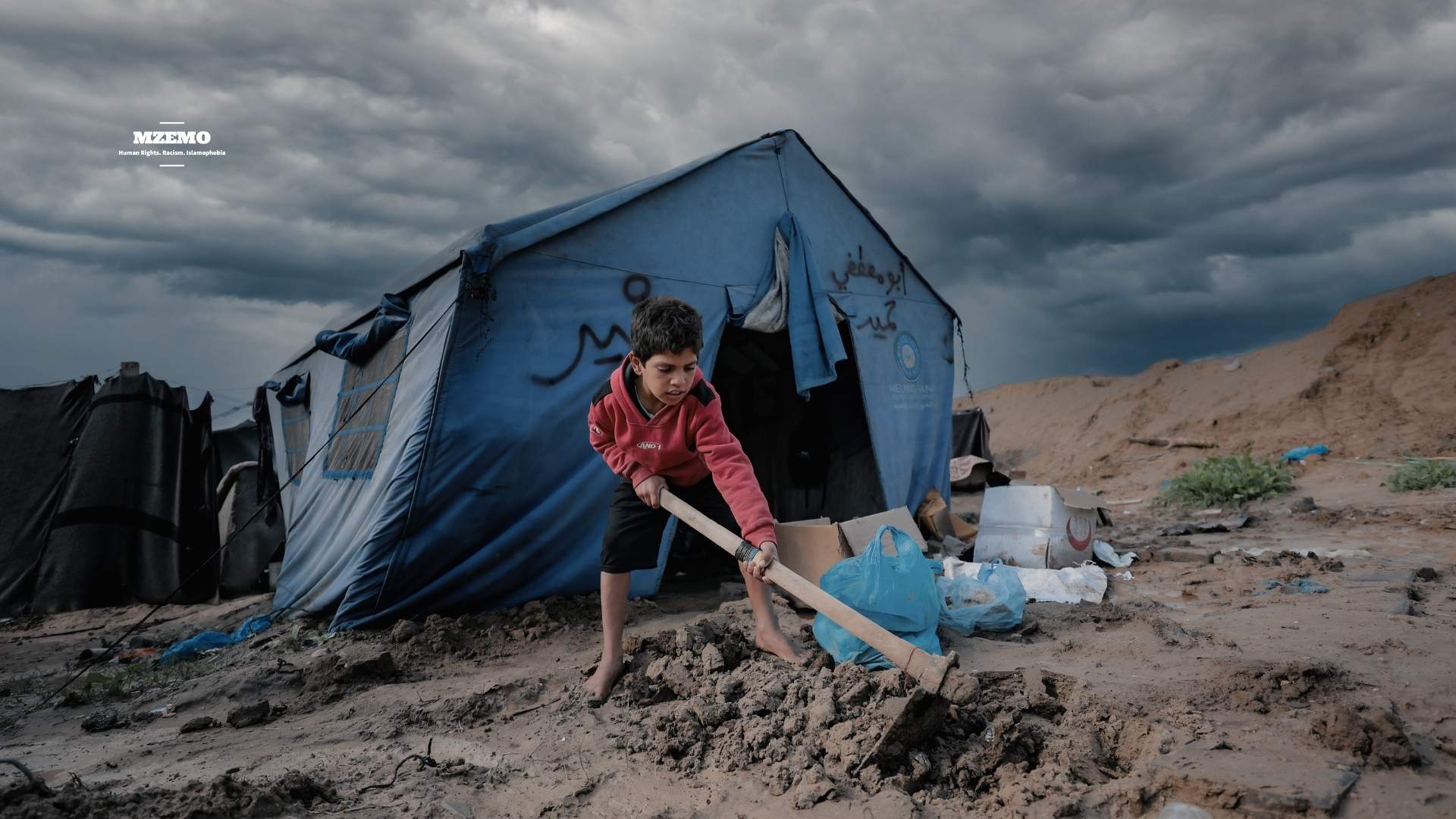
In a series of unfortunate events in the history of Gaza, the late-November storm arrived without preparations. In one of Gaza’s sprawling camps, children stood ankle-deep in freezing brown water inside their dismal tents. Their tiny feet sank into a mix of mud and sewage. Parents used plastic bowls to scoop out filthy floodwater, while battling a storm that swallowed everything they once owned. Moreover, in several low-lying areas, flood levels rose to around 40 to 50 centimeters. Resultantly, it swamped thousands of makeshift shelters and even forced one field hospital to shut down operations.

Specifically, for Gaza’s innocent families, who already fled more than two years of severe bombardment, the arrival of winter feels like a new kind of war. It was reported that a large majority of Gaza’s more than 2 million population have been displaced at least once. Furthermore, many now live in fragile tents or shacks on unstable, sandy ground. When it comes to local authorities, they estimate that around 70,000 people have been killed and more than 171,000 are injured since October 2023. The survivors now face a second catastrophe in the shape of a winter that strikes the homeless first.

Gaza After Two Years of War

After relentless airstrikes and heinous ground invasions, whole districts of Gaza lie flattened. Housing stock has been decimated, while water networks, sewage pipelines, and electrical systems have been destroyed. According to humanitarian assessments, 1.5 million people now depend entirely on emergency shelter materials, but the majority live in informal tents, unfinished buildings, or overcrowded UNRWA facilities.

Reports shared by the Norwegian Refugee Council confirm that displacement has reached historic levels. Meanwhile, UNOCHA notes that 500,000 internally displaced people attempted to return to northern Gaza in early 2025, only to find ruins of homes without doors, windows, or roofs. Gaza is no longer merely war-torn, but a mass of homelessness entering the coldest months of the year.

Floods in the Camps

This new storm has transformed whole camps into rivers of mud. It is documented how heavy rain overwhelmed Gaza’s already shattered terrain, turning roads into streams and sinking tents in minutes.

UN and aid agencies estimate that around 13,000 tents were damaged or destroyed, impacting more than 13,000 households. For families who have fled bombing, displacement, and hunger, seeing their last sheet of plastic ripped away by the storm is a cruelty that no one can prepare for.

A Desert of Tents

Local authorities and international NGOs agree that Gaza needs around 300,000 tents or prefabricated units to shelter roughly 1.5 million displaced Palestinians.

Shelter Cluster and UN assessments show that 1.5 million people urgently require winter-appropriate shelter materials, yet almost none have arrived. UNOCHA noted that at one point in early 2025, only 72 high-performance tents had been approved for entry into Gaza due to severe restrictions. Though the scale of need is immense, the world’s response has been minimal.

Why the Tents Aren’t Coming?

The bottleneck at Gaza’s crossings is not incidental but largely structural. It is reported that Israel classifies essential shelter materials, like tent poles, wooden beams, thick plastic sheets, pipes, and tools, as “dual use,” subjecting them to intense restrictions. These delays mean that even the most basic winterization efforts become impossible.

Shelter Cluster and frontline NGOs accuse Israeli authorities of arbitrary rejections, slow approvals, and constantly changing paperwork. It is making winter preparation “negligible compared to the scale of needs.” The International Rescue Committee adds that the recent storms flooded the majority of the makeshift tents, leaving families literally sleeping in the open. The winter suffering in Gaza is not a natural disaster alone, but is shaped by policy and prolonged siege.

Children, the Elderly, and the Most Vulnerable at Breaking Point

It is reported that children wearing nothing but thin shirts and flip flops, shivering in the cold. Their blankets are often wet, and their clothing rarely dries. Hunger weakens their bodies, while the cold attacks whatever strength remains.

On the other hand, many elderly people and people with disabilities cannot move quickly when tents flood, becoming stranded in freezing mud until family members can carry them to safety. UNRWA notes that around 79,000 displaced Palestinians are sheltering in 85 overcrowded schools, many of which also suffer from leaks and flood damage.

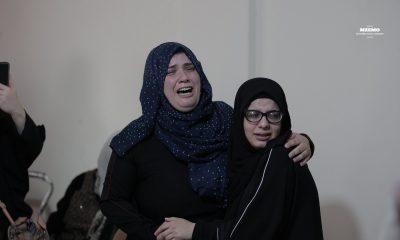
These are the faces of winter’s cruelty. Children are trembling in soaked clothes, elderly men and women unable to rise from muddy ground, and parents helpless in the face of the cold they cannot keep out.

“Ceasefire” Without Safety

Despite a ceasefire being announced in mid-October, aid flows remain far below the levels promised under the truce framework. People continue to die from exposure, untreated infections, and the compounded effects of hunger and cold.

The winter crisis reveals a fundamental truth that ending airstrikes does not end the war when siege, deprivation, and structural violence continue. For Gaza’s displaced population, winter is proof that the occupation’s harms extend far beyond bombs.

International Law and the Crime of Leaving People to Freeze

International law is explicit that denying adequate shelter or exposing civilians to deadly conditions can constitute inhuman treatment and may qualify as part of the “conditions of life” element in genocide determinations. Reports from humanitarian monitors, OCHA, and global legal experts warn that Gaza’s winter crisis is not just mismanagement, but a grave violation of human rights on a catastrophic scale.

UN rapporteurs and shelter advocacy groups continue urging states to pressure Israel to allow winterization supplies into Gaza. However, until pressure becomes action, statements remain hollow.

Conclusion

Winter storms are natural, but children sleeping in sewage-soaked clothes are not. That suffering is political, but a result of choices about what to bomb, what to blockade, and what to deny.

Gaza does not need sympathetic headlines about bad weather. It needs homes, infrastructure, open crossings, and accountability. It needs the world to stop treating winter misery as an inevitable tragedy and instead recognize it as a policy-driven crisis that can be changed.

Until Palestinians have the right to warmth, shelter, and stability, every storm will be another form of violence, and every winter will be a renewed assault on a people already fighting to survive.

Continue Reading
Click to comment

Leave a Reply

Your email address will not be published. Required fields are marked *

Crimes Against Humanity

Shockwaves Across the Gulf: How the US–Israel Strike on Iran Could Redraw the Region

Published

on

Shockwaves-Across-the-Gulf-How-the-US–Israel-Strike-on-Iran-Could-Redraw-the-Region

The clouds of a full-scale war are hovering over the Middle East amidst the Gaza genocide. The US-Israel unprovoked strike on Iran has sent political, military, and economic shockwaves across the region. Ultimately, it pushed the region into one of its most dangerous moments in decades. What Washington and Tel Aviv describe as a “preemptive defensive operation” is a direct assault on national sovereignty. It has become a dramatic escalation that risks engulfing the Guld in prolonged instability.

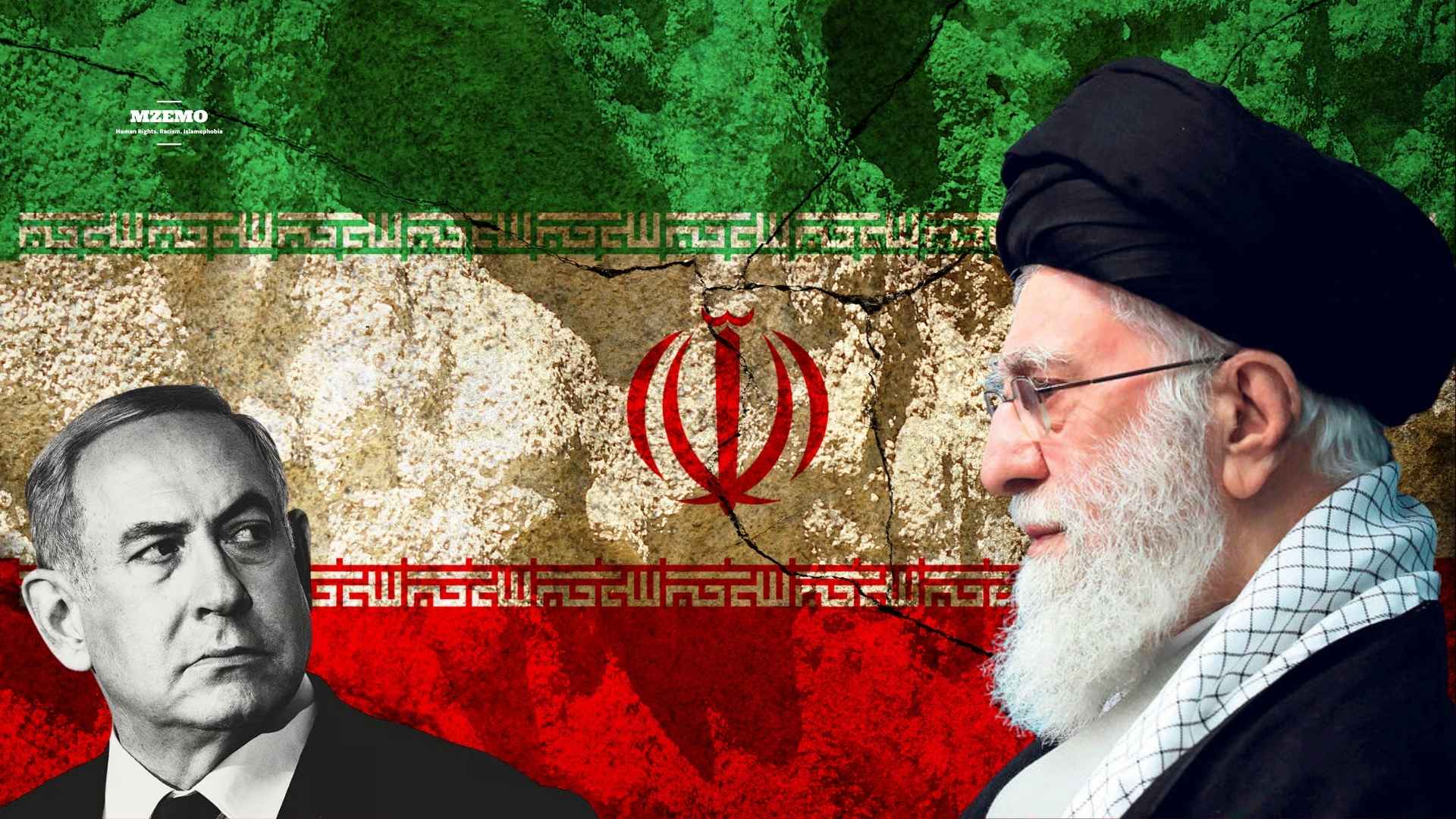
During the early hours of 28 February 2026, coordinated American and Israeli air operations struck multiple targets inside Iran, including military infrastructure as well as a couple of girls’ schools. Within hours, Iranian state media confirmed the death of Supreme Leader Ayatollah Ali Khamenei, along with senior security officials. Hundreds of coordinated strikes were carried out in the opening phase by Israel and the United States against Iran.

Washington termed the operation as necessary to neutralize an imminent threat. Israel also justified it as eliminating what it calls an “existential danger.” However, these attacks are unprovoked acts of aggression and severe violations of international law.

A Leadership Assassination with Structural Consequences

The attack on Iran’s Supreme Leader was not a usual casualty. Ayatollah Khamenei had led the Islamic Republic for over 35 years, shaping its strategic doctrine, regional alliances, and military posture. Removing such a figure represents a direct strike at the political and religious core of the Muslim states.

Decapitation strategies like targeting top leadership in the name of deterrence carry profound consequences. They do not end conflicts but often intensify them. Resultantly, Iran announced a 40-day national mourning period and vowed retaliation. Senior officials signaled that the response would extend beyond symbolic gestures.

Iran’s Retaliation and Gulf Vulnerability

Retaliatorily, Iran launched missile and drone strikes toward Israeli territory and toward strategic locations in states hosting US military infrastructure. Gulf capitals responded with emergency security consultations, temporary airspace closures, and heightened defense readiness.

The Gulf’s dilemma is acute as numerous Gulf countries host the US bases. While these facilities are described as stabilizing forces, they simultaneously transform host nations into potential targets during escalation cycles.

The Strait of Hormuz, through which roughly 20 percent of global oil supply transits, became an immediate focal point of concern. Even limited disruptions threaten global energy markets. This sustained instability could push oil prices sharply upward, intensifying economic strain worldwide.

Gaza: The Overlooked Consequence

The escalation comes while Gaza remains devastated by months of genocide. Humanitarian agencies have repeatedly warned of extreme infrastructure collapse, medical shortages, and displacement levels affecting the entire population. Large portions of Gaza’s housing stock and essential services have been destroyed or severely damaged.

Heightened regional conflict often leads to tightened border controls and reduced humanitarian access, justified by security concerns. Aid corridors become entangled in broader military calculations.

This shift in focus carries real consequences. When diplomatic bandwidth is redirected toward containing a wider war, reconstruction plans, ceasefire monitoring, and accountability processes in Gaza may stall.

Thus, the connection is evident – escalation elsewhere reduces urgency for justice in Palestine.

Economic and Strategic Fallout

The economic reverberations are already visible. Energy markets are getting volatile, and regional investors are recalibrating exposure to Middle Eastern assets.

Conflict in the Gulf does not remain confined to the battlefield. It translates into global price pressures, supply chain disruptions, and political uncertainty.

Strategically, the precedent of targeting a sitting supreme leader introduces a new threshold. It signals that regime leadership itself is no longer beyond direct military targeting. Such normalization raises questions about future conflicts and global stability norms.

The Muslim World at a Crossroads

Public anger across Muslim-majority countries has intensified. Protests, political debates, and social mobilization reflect deep concern about sovereignty and double standards in global governance.

This moment tests whether regional powers will push collectively for de-escalation and accountability or remain constrained by strategic alliances.

What Comes Next?

Several scenarios are emerging:

  1. Controlled retaliation followed by backchannel diplomacy.
  2. Escalation cycles involving proxy actors across multiple fronts.
  3. Strategic realignment in which new regional blocs consolidate in response to perceived aggression.

The direction will depend not only on Tehran and Washington, but on Gulf capitals, Beijing, Moscow, and European governments navigating between confrontation and containment.

A Dangerous Threshold

The US–Israel strike on Iran marks a decisive turning point. By targeting Iran’s Supreme Leader, the conflict crossed a political and psychological threshold that reshapes regional calculations, as it was a “Red Line” that had been crossed.

Whether framed as defensive or aggressive, the outcome is the same: the Gulf is more exposed, Gaza’s crisis risks being overshadowed, and the Muslim world faces renewed instability. History shows that wars justified as preventive often expand beyond their stated objectives. The coming weeks will determine whether diplomacy reenters the equation, or whether the Middle East moves into a prolonged era of open confrontation.

Continue Reading

Crimes Against Humanity

Ramadan Under Rubble: Gaza’s Holy Month in a Landscape of Destruction

Published

on

Ramadan-Under-Rubble-Gazas-Holy-Month-in-a-City-Still-in-Ruins

In a series of three consecutive Ramadan arrivals in Gaza, this one hits different for the people, as many of them have lost almost half of their families.

There are no lantern-lit balconies in neighborhoods, nor crowded markets layered in the scent of spices and frying bread. In fact, in most of the Gaza Strip, entire residential blocks remain flattened. Where homes once stood, families are now forced to gather inside UN-run school buildings, sleeping behind makeshift curtains that attempt to create privacy in classrooms built for thirty children, not thirty displaced relatives.

Ultimately, this Ramadan is not taking place in a city recovering from genocide, but it is unfolding in a territory still broken from inside and out.

A Holy Month in a Shattered Urban System

Although the numbers are staggering, they are not abstract. Satellite assessments and international damage reports estimate that over 320,000 housing units across Gaza have been damaged or destroyed. In a territory barely 365 square kilometers in size, that scale of destruction has erased entire neighborhoods.

Moreover, a joint international assessment has placed Gaza’s reconstruction needs at more than $53 billion, with approximately $20 billion required in the first three years alone just to restore essential infrastructure and housing.

Meanwhile, UN humanitarian situation updates continue to reference Gaza health authorities’ figures reporting over 70,000 deaths since October 2023, alongside mass injury and displacement.

This is the environment in which this Ramadan has begun.

A month meant for spiritual reflection now intersects with broken sewage networks, damaged desalination plants, fractured electricity grids, and hospitals functioning far below pre-war capacity.

Fasting in a Water Crisis

Fasting in Ramadan requires abstaining from water and food from dawn to dusk. However, in Gaza, the people fast for even longer, without any certainty of getting something to drink at Iftar.

Clean water remains limited in many areas. Residents rely on trucked deliveries or small-scale desalination output. Long queues form daily at water distribution points. During Ramadan, those queues stretch into fasting hours, turning a religious act of discipline into a period of patience.

Furthermore, Wudu, which is a ritual washing before prayer, becomes difficult when each liter of water is rationed.

Sanitation networks, heavily damaged during the genocide, remain only partially restored. In crowded displacement shelters, maintaining hygiene during a month of fasting is not simply about devotion, but about survival in confined conditions[OBH1] .

Iftar Without Homes

Before the genocide, Ramadan evenings in Gaza were intimate and loud at the same time. Families used to gather, extended relatives moved between homes, and kitchens were operated at full capacity.

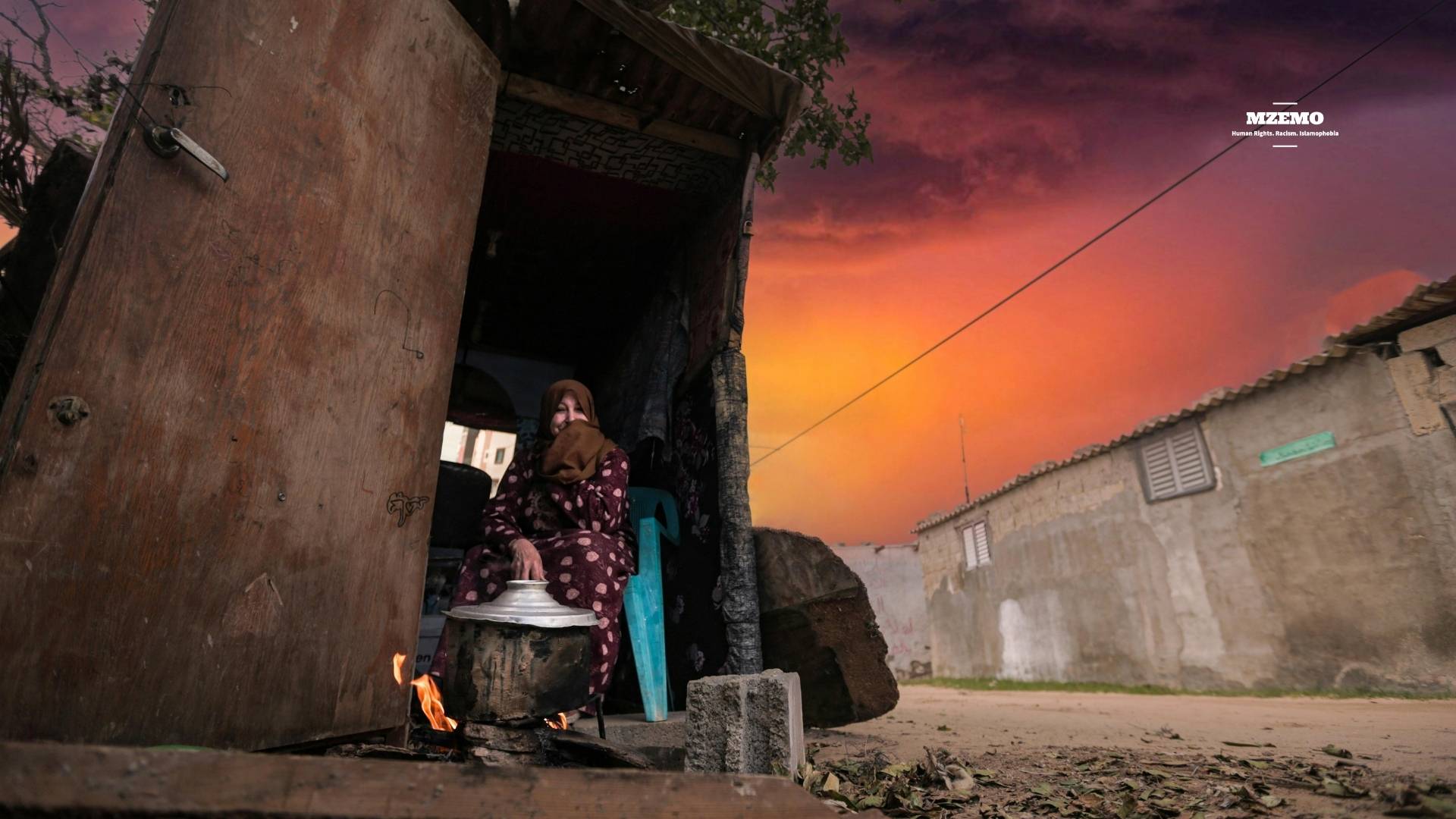
This year, many families broke their fast under fluorescent classroom lights or in tent encampments erected beside damaged buildings. Meals are often prepared in communal kitchens operated by humanitarian agencies and local volunteers.

The humanitarian system reports the entry of hundreds of thousands of aid pallets into Gaza during ceasefire windows and negotiated access periods. Yet the presence of aid shipments does not automatically translate into the actual presence of aid and normal consumption patterns.

Damaged roads limit transport, while import restrictions on certain materials, often categorized under security frameworks, slow reconstruction. Employment opportunities remain scarce in large parts of the Strip.

In practical terms, Ramadan in Gaza has shifted from household-based consumption to aid-dependent distribution.

Charity replaces commerce, and communal pots have replaced private kitchens.

Mosques Without Minarets

Many mosques across Gaza sustained damage, and most of them have completely obliterated. However, some are partially operational. Where structures are unsafe, congregational prayers move into open spaces or shelter corridors.

The special Ramadan prayer – Taraweeh – although continued, is offered under emergency lighting, and sometimes outdoors.

Ramadan is traditionally a month of collective rhythm. However, in Gaza, that rhythm competes with displacement patterns that separate families across districts and temporary shelters.

Internal displacement reporting from humanitarian agencies shows that the vast majority of Gaza’s population has experienced at least one displacement cycle since the genocide began.

So, Ramadan, which usually strengthens communal bonds, now unfolds across fragmented social networks.

Children and the Weight of This Ramadan

For children, Ramadan often carries excitement due to special meals, extended nights, and anticipation of Eid.

But this year in Gaza, childhood is shaped by trauma exposure, interrupted schooling, and crowded shelter life.

Education facilities across the Strip sustained heavy damage. In this context, many school buildings continue to function as displacement shelters. Learning remains inconsistent, while psychological support services partially operate under immense strain relative to need.

This Ramadan does not offer a distraction from hardship. It intensifies it because children understand that the environment around them has changed in ways that feel permanent.

Faith in a Managed Reality

Despite all this, fasting continues. The Holy Qur’an is recited in shelters. Charity circulates among families who have little to give, and neighbors share what they receive.

However, resilience should not be romanticized. Spiritual endurance does not remove the need for sovereignty over rebuilding.

Ramadan this year reveals something deeper than devotion. It reveals a population practicing its faith inside a humanitarian crisis rather than a functioning civic structure.

It reveals that survival and worship are unfolding simultaneously, in a landscape where reconstruction plans are debated far beyond Gaza’s borders.

Ramadan in Gaza is not silent. It is disciplined, restrained, and carried out under the weight of destruction that remains visible in every damaged skyline. In a nutshell, the holy month has arrived, but the people are forced to live in abysmal conditions for life.

Continue Reading

Crimes Against Humanity

Frozen to Death: How Israel’s Blockade Turns Gaza’s Winter into a Killing Field

Published

on

Frozen-to-Death-How-Israels-Blockade-Turns-Gazas-Winter-Into-a-Killing-Field

In an unfortunate series of events in Gaza, some deaths arrive without the sound of missiles. It’s just a tent that fails in wind and rain, a baby whose body can’t hold sufficient heat, and a clinic that can’t keep a neonatal ward warm due to fuel scarcity.

This winter, cold is not an “act of nature” in Gaza, but a predictable outcome of mass displacement into makeshift shelters. Additionally, aid restrictions further exacerbate the situation.

On January 10, 2026, the death of Mahmoud Al-Aqraa, a seven-day-old infant in Deir el-Balah, was reported. Medical sources attributed his death to extreme cold. The same report highlighted nighttime temperatures in Gaza dropping as low as 9°C (48°F) in recent days.

Apparently, nine degrees sounds survivable, but only in a home with a roof, dry bedding, electricity, and heat. But when it comes to Gaza’s displacement camps, it is fatal.

The Numbers Behind the “Winter Crisis”

People in their blankets are unable to realize the heart-trembling cries of the innocent children of Gaza. The UN’s humanitarian coordination office (OCHA) documented that since 10 December, more than 42,000 tents or makeshift shelters were estimated to have sustained full or partial damage across 320 displacement sites, affecting at least 235,000 people.

However, that is not a handful of torn tents, but a shelter system collapsing in real time, over weeks, repeatedly, during storms.

OCHA also warned that winter storms are heightening the risk of cold-related illnesses and preventable deaths, particularly among children under five.

Some of them are documented as follows:

  • Gaza’s Ministry of Health recorded three children who died of hypothermia, including a two-month-old who died on 29 December.
  • OCHA also cited Médecins Sans Frontières (MSF) reporting that a 29-day-old infant died on 18 December shortly after admission to Nasser Medical Complex.

So, these are not just weather tragedies, but deaths occurring inside a controlled environment of deprivation by Israel.

How Blockade Turns Cold into An Executioner

Cold kills fastest when three protections are removed, namely: shelter, fuel, and medical capacity.

In a series of genocidal events, Israel continues to limit the number of tents and sustainable shelters entering Gaza, and also blocks mobile homes and materials used to fix damaged tents.

This matters because winter deaths aren’t random, but followed by a mechanical chain:

  1. Storm hits: Tents rip, flood, and are destroyed by a catastrophe
  2. Families move: Often to beaches or low-lying areas with poor drainage
  3. Bedding stays wet: Children sleep cold and damp for days
  4. Respiratory infections surge: Especially among infants
  5. Hospitals struggle: Cold wards are facing power/fuel instability, resulting in a higher mortality risk

Moreover, OCHA recorded that storms have inundated tents with seawater in places like Al Mawasi in Khan Younis. It rendered many shelters uninhabitable, forcing families to move again. The world knows what’s happening there, but is not paying heed to these innocent lives.

Aid Access is Being Choked at The Exact Moment Winter Demands Speed

To add fuel to the fire, Israel barred the entry to Gaza of foreign medical and humanitarian aid linked to organizations facing suspension unless they comply with new registration rules. Resultantly, it affected 37 international NGOs.

Reports also quote an MSF coordinator describing how missing key staff creates “a gap” in aid service, and notes UN concerns that registered groups would meet only a fraction of what’s required.

It is evident that aid is being deliberately blocked at a time when it is most needed. Winter is the worst time for gaps, and when tents are destroyed, the timeline isn’t “next month.” It’s tonight.

What Gaza’s Winter Proves: Deprivation Can Kill Without Airstrikes

If a population is forced into tents, storms repeatedly destroy those tents, and the entry of winter protection is restricted while aid capacity is squeezed, then winter becomes more than weather.

It undoubtedly becomes a predictable tool of attrition. Even Gaza’s Civil Defence spokesman rejected the framing of a “weather crisis,” saying the disaster results from genocidal events still going on, leaving people in torn tents and cracked houses without safety.

What Would Stop These Deaths?

Preventing these innocent lives from disease and death is the need of the hour. There are a few steps that need to be taken at an immediate scale:

  • Firstly, aid should be completely allowed to come along with relevant items for winter protection.
  • Secondly, people of Gaza must be given reliable fuel supplies, food, electricity, and healthcare services.
  • Thirdly, the bloodshed should stop, as hundreds of thousands of innocent lives have been lost by now.

To be specific, as per the OCHA reports, shelter partners have distributed 37,740 tents, 127,860 tarpaulins, and 94,980 bedding items since early December. These are far below the needs of over two million people requiring urgent shelter assistance.

In a nutshell, a winter night of 9°C should not kill a newborn.

It kills when shelter is shredded by storms, when bedding stays wet, when fuel and materials are restricted, and when humanitarian systems are squeezed.

Gaza is being forced to live outdoors through winter, and then blamed when the weather does what weather always does. Ultimately, the cold is not the killer, but the siege is.

Continue Reading
Advertisement

Trending