Featured
Will India Ban Hijab in Educational Institutions?

The row about Hijab in Educational institutions took the state of Karnataka by storm. We praise our country for being so diverse in religion. But sometimes, it is the very same religion that separates us from our fellow country people.
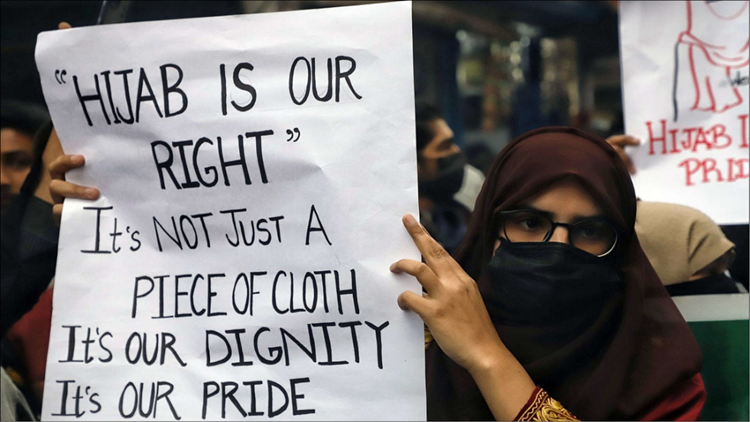
An incident that happened on 3rd February in Kondapur Government PU College in Karnataka surprised everyone. A college did not allow Hijab wearing girls to enter the premises.
Court’s Say on Hijab in Educational Institutions
It didn’t take long for this matter to reach the notice of the High Court of Karnataka. Several Muslim students filed their petitions. They believed that this incident was violating their rights. However, the court announced that the hijab is not a “necessity’’ for people who practice Islam, even though Muslims believe the Hijab to be a major part of their religion.
Also Read: Hijab and Modesty in the true light of Islam
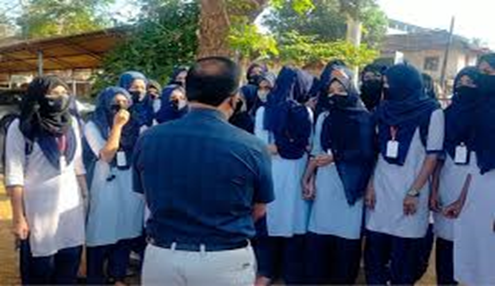
This decision by the High Court directly violates Article 25, which boldly states that any citizen of India could practice any religion they want without interference from anyone. The court brushed it off and said that any piece of clothing that is disturbing the peace and harmony in educational institutions is a cause of concern. And Hijab in Educational Institutions is doing the same – according to the court at least.
This decision ignited a fire among the hijab-wearing students. Various protests took place in several parts of Karnataka. To counter-protest, the hijab protests, a group of Hindu college students came to school wearing saffron scarves. They announced that if girls turn up in Hijab, other students will come with saffron shawls.
The government received immediate reports if anyone showed up wearing Hijab or saffron clothing. This issue started getting popularity and attention in other states. Police soon involved themselves to prevent any communal riots. This situation led the Karnataka government to impose a 3-day holiday for every educational institute in the state.
Arrests and Disturbances
In Shivamogga and Bagalkot districts, police arrested five people from around the state for disturbing the peace in public areas. The Hijab in Educational institutions debate raised mixed opinions in the minds of people. The Karnataka government gave a strict order to not let any student wear anything religious such as hijab, saffron shawls, etc within classrooms till further notice.
Karnataka’s education department asks educational premises to create a separate sector for girls to remove their hijab inside the campus while abiding by the decision of the High Court of Karnataka. The High Court later clarified that these limitations to wearing poise clothes would imply only to state colleges where formal uniforms are compulsory to wear. The High Court also made it clear that the rule is for students and not the teachers.
Also Read: Islamophobia in India: The Hostile Treatment Against Muslims
The Rules and Regulations for Peace and Harmony
Soon after that, the infamous Section 144 of the Code of Criminal Procedure was inflicted in various parts of Karnataka. Gatherings, protests and any social events started getting restricted in the city of Bengaluru from March 15 to 21. Nothing in the name of protests for Hijab in Educational Institutions.
The government decided to not entertain that anymore. The Karnataka High Court still abides by its decision to ban the hijab in educational institutions. All these judicial decisions were taken by the full bench of the High Court comprising Chief Justice Ritu Raj Awasthi, Justice Krishna S Dixit, and Justice J M Khazi.
Political Angle to the Cause
Many people have started speculating that this is a tactic from The Bhartiya Janta Party whose main aim is to strengthen Hinduism and gain votes in the southern part of the country. Former Jammu and Kashmir Chief Minister, Mehbooba Mufti and Omar Abdullah didn’t like the sentence ‘’hijab is not an essential part of Islam’’ and they termed the ban on hijab as ‘’disappointing’’.
Other political parties like Congress also made their opinions public. Congress’ Siddaramaiah, who is the leader of the opposition of the Karnataka Legislative Assembly, on the behalf of all Congress’ Muslim leaders stated that they support the Muslim girls in their struggle.
Even Rahul Gandhi stated that letting hijab in educational institutions hinder education will rob the future of the daughters of India.
Related Article: Hijab Controversy in India: A Dent on Education Right of Muslim Girls
Are these parties genuinely concerned about the situation in Karnataka? Or is this just a political agenda? That is out for public opinion.
There are always two sides to a coin…
Now, let’s look at the other side of the coin, people who are against the appeal of the hijab. They believe that some women are forced to wear hijab against their wishes. Some others bring up the idea that the idea of wearing hijab in schools and colleges violates their uniform dress code.
But people made many counter-arguments challenging these statements. ‘’If the government is banning hijab for the peace of the states, why are Sikhs still wearing a Patka or Dastar?’’ These items are very similar to wearing hijab in educational institutions, then why are Sikhs not getting the lecture on peace and harmony? Some have come out with the argument that favoring one religion over other is going to create a divide within the society.
This controversy has done nothing but divide the people of India. Should a hijab really come before one’s education? During the time of British rule, Hindus and Muslims were inseparable. They ate together, drank together, and even fought together against their mutual enemy.
Scenario Changed, So Should People
Today, students who were classmates sharing notes, pens, and tiffin not so long ago have now become foes. Are we still going to discriminate against someone who doesn’t chant ‘’Jay Shree Ram’’, are we still going to beat someone who prays in a masjid instead of a temple? ‘’God has no religion’’ a popular phrase said by the father of our nation. Would the people who sacrificed their lives so that we may breathe today be truly happy with the world we have directly or indirectly created today? If we can’t learn to be good humans, how will we ever find enlightenment? Is this just a fight for Hijab in educational institutions or a political infliction with the agenda of a divide?
‘’Unity in diversity’’ is a term we have learned and studied in our textbooks since childhood, we all like to say that ‘’India has so much unity among every religion’’ but after recent events, can we really say that with a straight face? Education is one of the only things that should NEVER be mixed with religion. Regardless of whatever religion a student might have, they should be given equal and fair opportunities for learning, as they are the future our country is depending on.
“For great men, religion is a way of making friends; small people make religion a fighting tool.”





Featured
Gaza on the Brink Again: How the Rafah Border Closure Is Pushing 2 Million People Toward Extreme Hunger


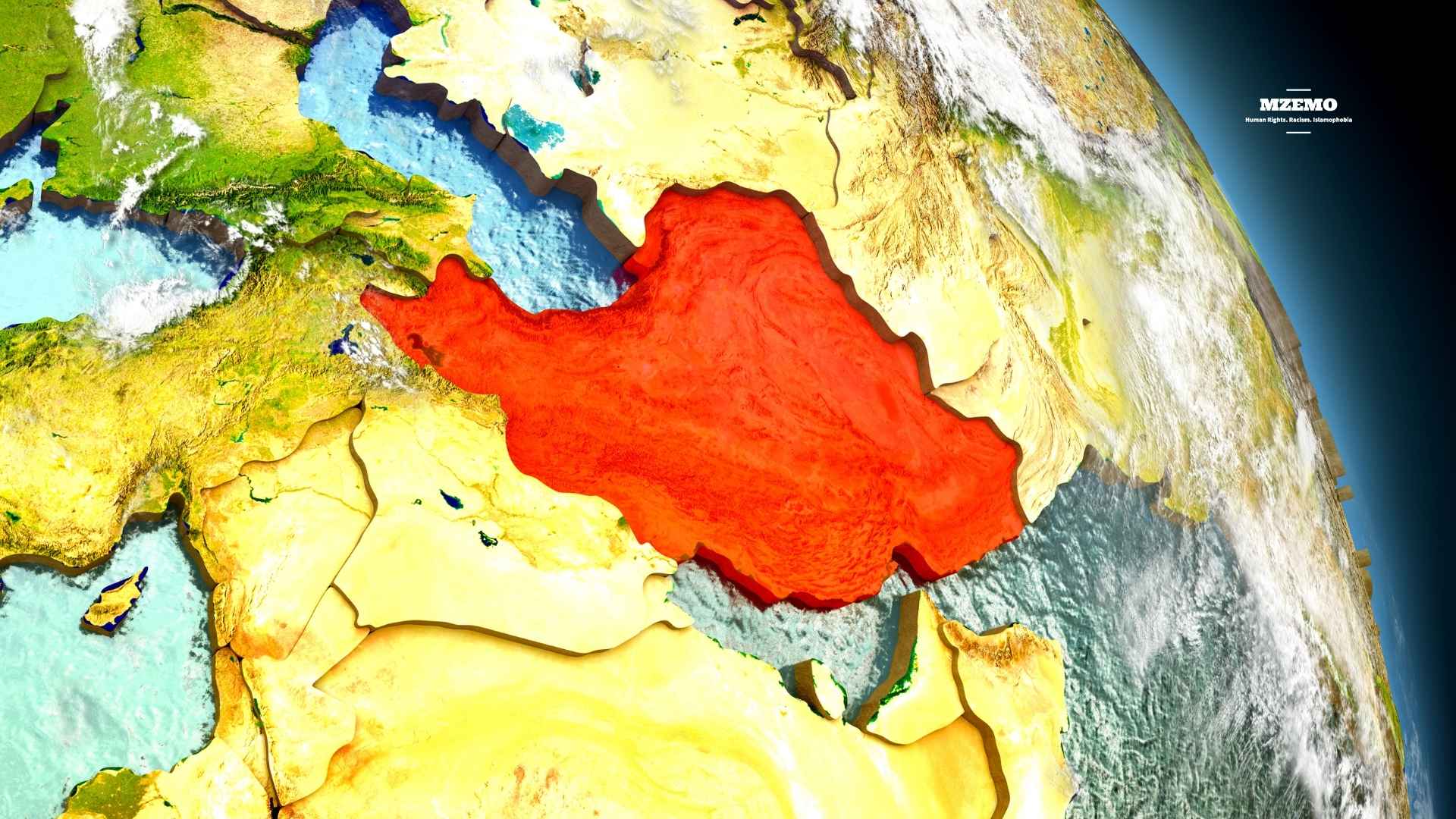
Across the globe, there are two dominating crisis headlines today: Israel’s blatant genocide in Gaza and the ongoing war between Israel-US and Iran. This war is undoubtedly imposed by Israel and the United States, labeling it necessary for peace.
Western governments and media houses frame their policies around the language of “security” and “stability”. There is a pattern of double standards that undermines international law, credibility, and humanity.
On one side stands Gaza, where more than 2.2 million Palestinians are being killed by Israel. It has produced one of the worst humanitarian catastrophes of the 21st Century. On the other hand, stands Iran, a country that is signatory to the Nuclear Non-Proliferation Treaty (NPT) yet faces sanctions, threats, and even attacks on its civilians.
Why are some countries given carte blanche and strategic exceptions while others face relentless punishment?
Gaza: A Genocide in Plain Sight
Since the beginning of Israel’s large-scale assault on Gaza, the humanitarian impact has been staggering. According to Palestinian health authorities and international humanitarian organizations, more than 80,000 Palestinians have been killed, with a large proportion of the victims being women and children.
Entire neighborhoods across Gaza have been reduced to rubble. The United Nations reports that the vast majority of Gaza’s population has been displaced, many of them forced to move multiple times as Israeli military operations expanded across the territory.
This is the purest form of genocide in modern human history. The scale of destruction, starvation, and forced displacement goes far beyond conventional warfare. However, not all media groups are showing the real picture. Western media is showing its unquestioned support for Israel even during the most heinous crimes against humanity.
Western Silence and Political Protection
The United States remains Israel’s closest international ally. According to data from the U.S. Congressional Research Service, Washington provides Israel with approximately $3.8 billion in annual military assistance under long term defense agreements.
Beyond military aid, Western governments have repeatedly shielded Israel from international accountability. In diplomatic arenas such as the United Nations Security Council, attempts to impose sanctions or demand ceasefires have often been blocked or diluted.
This pattern represents a profound contradiction: while Western leaders frequently emphasize human rights and international law, their response to the devastation in Gaza appears far more restrained than in other global conflicts.

Israel’s Nuclear Arsenal: The Middle East’s Open Secret
Another major source of controversy lies in the nuclear dimension of Middle Eastern politics.
Israel is widely believed by international experts to possess between 80 and 200 nuclear warheads, developed through its long-standing nuclear program centered around the Dimona facility in the Negev desert.
Yet Israel maintains a policy known as “nuclear ambiguity” — neither confirming nor denying the existence of its nuclear arsenal.
More importantly, Israel is not a signatory to the Nuclear Non-Proliferation Treaty (NPT), the global framework designed to prevent the spread of nuclear weapons.
Just because it operates outside the NPT system, Israel’s nuclear facilities are not subject to full international inspections by the International Atomic Energy Agency (IAEA).
Despite this reality, Western governments rarely criticize Israel’s nuclear capabilities or call for sanctions related to its weapons program.
Iran and the Nuclear Non-Proliferation Treaty
On the other hand, Iran’s nuclear program exists in a very different legal context.
Unlike Israel, Iran signed and ratified the Nuclear Non-Proliferation Treaty in 1970, which means it is legally permitted to pursue nuclear technology for peaceful purposes such as energy production and scientific research.
Under the NPT framework, Iran’s nuclear facilities are supposed to operate under international monitoring by the International Atomic Energy Agency (IAEA).
Nevertheless, Iran has faced decades of economic sanctions and intense political pressure from Western governments, which argue that its uranium enrichment activities could eventually lead to nuclear weapons development. However, Iranian officials insist that their nuclear program is intended solely for civilian purposes.
Attacks on Iran and the Broader Muslim World
Recent tensions have further escalated the crisis. Israel and the United States have carried out strikes targeting Iranian nuclear facilities, including sites associated with uranium enrichment. The assassination of Iran’s Supreme Leader Ayatollah Ali Khamenei, along with other high-ranking officials show how brutal these strikes are.
Just like in Gaza, Iran’s civilians are also being attacked. One such example is the recent bombing of a girls’ school in Iran in which more than a hundred innocent children and teachers were killed. Such attacks raise serious concerns among international security experts.
Moreover, striking nuclear infrastructure carries enormous risks, including the possibility of radioactive contamination and the potential collapse of global nuclear non-proliferation efforts. Some analysts argue that military attacks on nuclear facilities could actually push targeted states to accelerate weapons development rather than abandon it.
Ultimately, these strikes represent another example of selective enforcement of international norms.
From Gaza to Tehran: A Crisis of Global Credibility
The combined effect of these policies has produced a growing crisis of credibility for the international system.
International law is being applied selectively, enforced strictly against adversaries, while ignored when allies are involved.
From the ruins of Gaza to the nuclear facilities of Iran, the politics of power continue to shape the Middle East in profound ways.
For millions of people across the region, the question is not merely about military strategy or diplomatic rivalry. It is about whether international law truly applies equally to all nations — or whether global justice remains dependent on political alliances.
Until those questions are addressed, the perception of double standards will continue to fuel anger, instability, and distrust across the Middle East and beyond.
Crimes Against Humanity
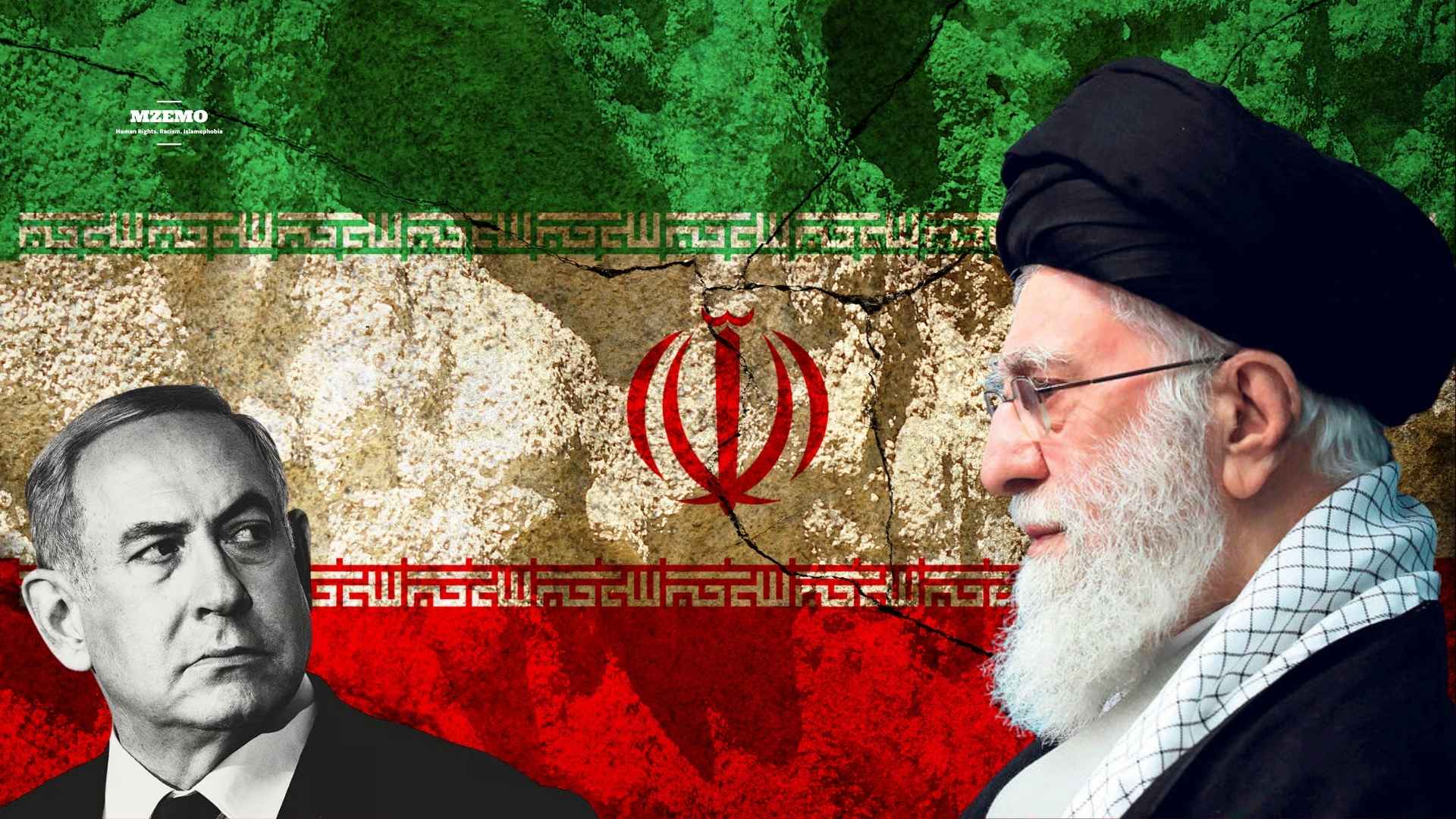
Shockwaves Across the Gulf: How the US–Israel Strike on Iran Could Redraw the Region
-
 Featured2 years ago
World passively watching as Israel perpetrates open-ended massacre in Gaza
-
Featured3 years ago
Argentina wins the World Cup; are there any other winners?
-
Featured2 years ago
Israel is Hiding Crucial Demographic Facts About Palestinians
-
Featured5 years ago
History of the Ottoman Empire
-
Featured3 years ago
Christian militia infiltrate Lebanon
-
Featured5 years ago
“Do Not Waste Water Even If You Were at a Running Stream” Prophet Muhammad
-
Featured2 years ago
Muhammed: The Greatest Man to walk on Earth
-
Featured4 years ago
World Leaders Remain Silent Over Human Rights Violations in the UAE