Featured
Ethnic Cleansing and Crimes Against Humanity in Ethiopia’s Western Tigray Zone

What is Happening in Ethiopia’s Western Tigray Zone?
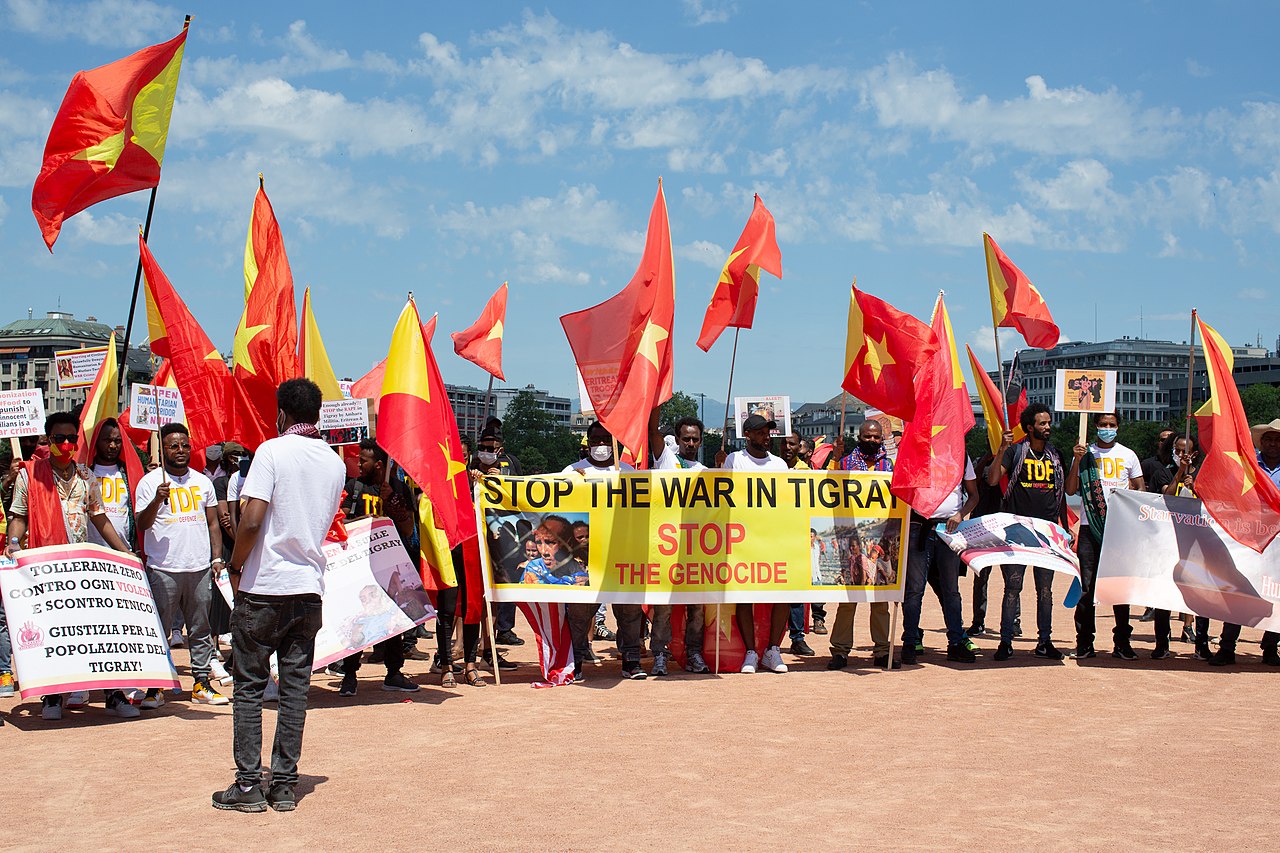
Many reports of ethnic cleansing and crimes against humanity have emerged in Ethiopia’s Western Tigray zone. The Ethiopian civil war is now entering its 16th month of brutal conflict. Under the rule of the Prime Minister of Ethiopia, Abiy Ahmed, the Ethiopian military, ethnic militias and Eritrean troops are fighting to oust the Tigray People’s Liberation Front (T.P.L.F.) from Western Tigray.
Mr Abiy tried diminishing the T.P.L.F.’s power and influence which has dominated Ethiopian politics for almost thirty years. The prime minister declared a state of emergency in November 2020 when Tigrayan fighters surged toward the capital in revolt against the government. Nevertheless, Mr Abiy forced the Tigrayans back to their northern homeland, but the conflict continued. Armed forces from the neighbouring Amhara region, who entered Tigray to support Mr Abiy, are “deliberately and efficiently rendering Western Tigray ethnically homogeneous through the organized use of force and intimidation”.
Also Read: Ethiopian Crisis: What is Behind the Worsening Humanitarian Crisis?
Killings, Rape and Crimes Against Humanity in Western Tigray Zone
Armed forces have been waging a campaign of ethnic cleansing against the Tigrayans. Furthermore, Ghent University has estimated that more than half a million people died in the war. Furthermore, more than two million people are displaced, pushing parts of the region into famine-like conditions. Ethiopian authorities have severely restricted access and independent scrutiny of the region, which has resulted in any reports of ethnic cleansing mainly kept concealed.
Furthermore, these widespread human rights violations include killings, rape, mass detentions, and forcible transfers. In April 2022, Amnesty International and Human Rights Watch (H.R.W.) stated in a joint report that these abuses amount to war crimes and crimes against humanity. This comprehensive report contains information from 427 interviews with survivors, family members and witnesses. In addition, the World Health Organization’s Director-General, Tedros Adhanom Ghebreyesus, an Ethiopian, stated that there is “nowhere on earth where the health of millions of people is more under threat than in the Tigray region”.
Also Read: Ethiopian Crisis: What is Behind the Worsening Humanitarian Crisis?
What is ‘Ethnic Cleansing’?
International human rights law for not formally define ‘ethnic cleansing‘. However, the United Nations Commission of Experts investigated violations of international humanitarian law in the former territory of Yugoslavia. During this investigation, ‘ethnic cleansing’ was described as a “purposeful policy designed by one ethnic or religious group to remove the civilian population of another ethnic or religious group from certain geographic areas by violent and terror-inspiring means.”
The United Nations consistently uses ‘ethnic cleansing’ in resolutions, reports, judgments and indictments of individuals accused before international courts and tribunals.
Ethnic Cleansing in Western Tigray Zone
Hundreds of Thousands Expelled From Their Homes in Western Tigray Zone
Amhara forces, militias, and recently appointed authorities began a coordinated campaign of ethnically targeted persecution against the Tigrayans in late 2020. Moreover, Tigrayans were instructed to leave through signs posted across the Western Tigray zone. Shockingly, 24-hour or 72-hour ultimatums to leave or be killed were issued to local civilians forcing thousands of Tigrayans into long-term overcrowded detention centres. Additionally, human rights groups believe that thousands remain in these centres facing life-threatening circumstances. There are reports of security forces using gang rape, abduction, sexual slavery and physical and verbal abuse against Tigrayans.
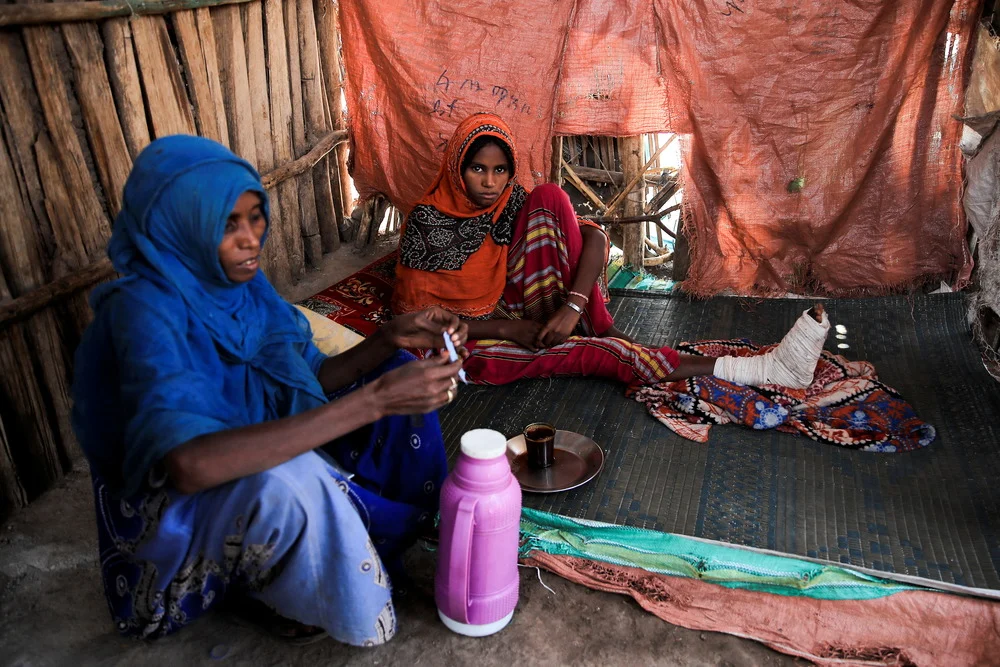
Ethiopian paramilitaries have systematically expelled several hundred thousand Tigrayan civilians from their homes. There are reports of unlawful killings, sexual violence, arbitrary mass detention, pillage, forcible transfer, and the denial of humanitarian assistance by Amhara forces. The map below shows the region of Western Tigray.
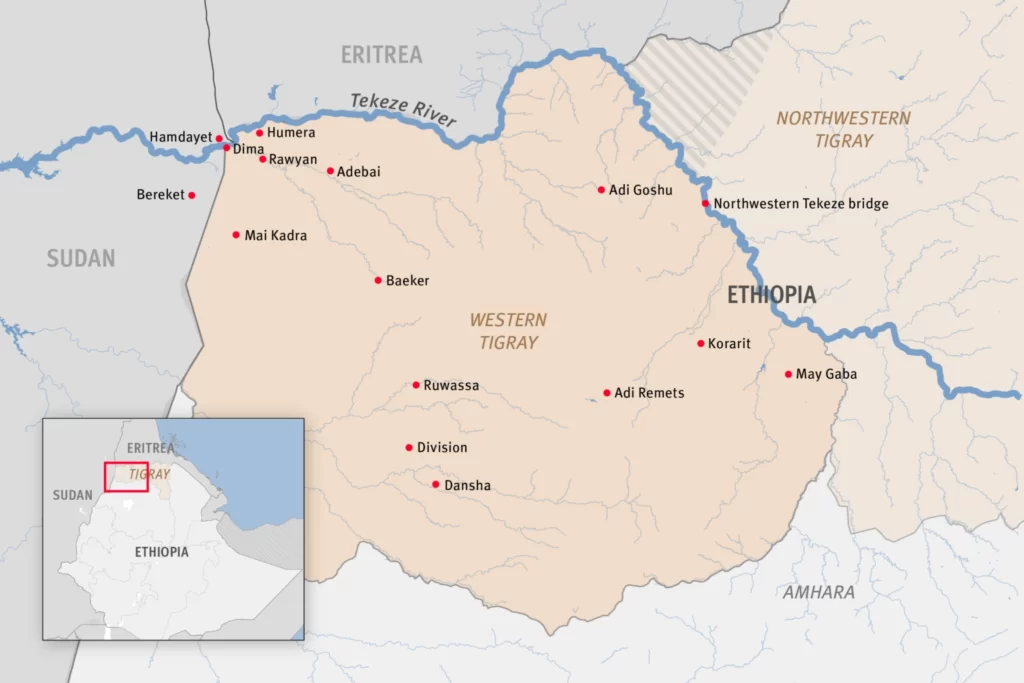
Moreover, human rights groups have highlighted the Ethiopian government’s complicity in these violations against the Tigrayan people in their recent investigations.
“Ethiopian authorities have steadfastly denied the shocking breadth of the crimes that have unfolded and have egregiously failed to address them”
Kenneth Roth, Director of Human Rights Watch.
Tigrinya Language Banned Across Western Tigray Zone
Since November 2020, there has been a ban on the Tigrinya language across the Western Tigray zone. Signs across the region tell locals that they must speak Amharic. This can be difficult for Tigrayans when dealing with administrative work or accessing essential services. Tigrinya music is prohibited, and Amhara forces physically beat those who use this language for any purpose.
New Identification Cards Issued and Personal Documents Confiscated
The Amhara region has selectively issued new identification cards across Western Tigray. Consequently, this has limited the rights of those who have not received a new card. Hence, many Tigrayans are refused identity cards, as authorities claim “they do not deserve it”. The new identification cards grant civilians free movement throughout the region. Additionally, they provide access to essential services and the right to submit complaints. Many locals have no access to life-saving health services and medicines due to these discriminatory restrictions imposed.
Also Read: Ethiopia: millions still cut-off from the urgent humanitarian aid.
Therefore, this is the Amhara forces’ way of forcibly removing the Tigrayan civilian population from the Western Tigray region. Hence, Amhara forces confiscated and destroyed many of the Tigrayans’ documents. This severely hinders Tigrayans’ ability to access services and continue to live everyday life in the region. Amhara forces are implementing these measures of ‘ethnic cleansing’ to support Mr Abiy in his pursuit of eliminating the T.P.L.F. and the Tigrayan ethnicity from the region.
Dozens of Civilians Killed by Suspected Crimes Against Humanity
The Ethiopian government has carried out many airstrikes killing thousands of people throughout the conflict. In January 2022, an airstrike hit a school compound at Dedebit, where thousands of displaced Tigrayans were staying. There were no signs of military targets at the compound, which strongly implies that this was not an accidental attack. The airstrike killed 57 civilians, mainly women, children and older adults, sleeping in tents.
The number of government airstrikes in Tigray increased dramatically in December 2021. Approximately 304 people died and 373 injured in attacks between November 2021 and February 2022. Any violations of the laws of war committed with deliberate or reckless criminal intent are classified as war crimes.
What Happens Next?
H.R.W. has held that the Ethiopian authorities should ensure that humanitarian organizations have immediate access to the region to deliver aid and essential services.
It is imperative to release all those arbitrarily detained and investigate and appropriately prosecute those responsible for abuses such as ethnic cleansing, war crimes and crimes against humanity. If the two parties reach a consensual agreement, then the African Union should deploy international peacekeeping forces to the region to ensure everyone’s safety.






Featured
Gaza on the Brink Again: How the Rafah Border Closure Is Pushing 2 Million People Toward Extreme Hunger


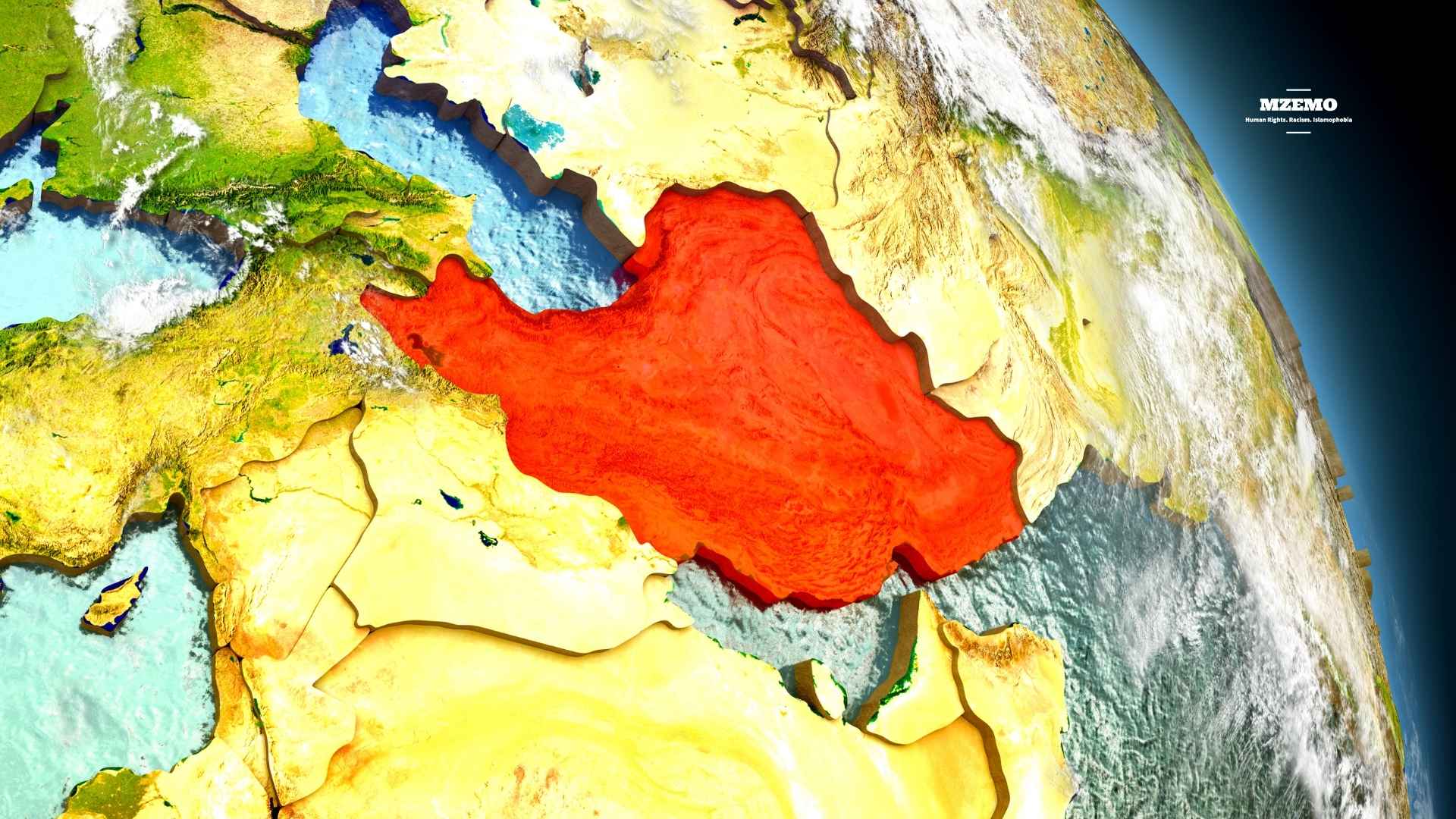
Across the globe, there are two dominating crisis headlines today: Israel’s blatant genocide in Gaza and the ongoing war between Israel-US and Iran. This war is undoubtedly imposed by Israel and the United States, labeling it necessary for peace.
Western governments and media houses frame their policies around the language of “security” and “stability”. There is a pattern of double standards that undermines international law, credibility, and humanity.
On one side stands Gaza, where more than 2.2 million Palestinians are being killed by Israel. It has produced one of the worst humanitarian catastrophes of the 21st Century. On the other hand, stands Iran, a country that is signatory to the Nuclear Non-Proliferation Treaty (NPT) yet faces sanctions, threats, and even attacks on its civilians.
Why are some countries given carte blanche and strategic exceptions while others face relentless punishment?
Gaza: A Genocide in Plain Sight
Since the beginning of Israel’s large-scale assault on Gaza, the humanitarian impact has been staggering. According to Palestinian health authorities and international humanitarian organizations, more than 80,000 Palestinians have been killed, with a large proportion of the victims being women and children.
Entire neighborhoods across Gaza have been reduced to rubble. The United Nations reports that the vast majority of Gaza’s population has been displaced, many of them forced to move multiple times as Israeli military operations expanded across the territory.
This is the purest form of genocide in modern human history. The scale of destruction, starvation, and forced displacement goes far beyond conventional warfare. However, not all media groups are showing the real picture. Western media is showing its unquestioned support for Israel even during the most heinous crimes against humanity.
Western Silence and Political Protection
The United States remains Israel’s closest international ally. According to data from the U.S. Congressional Research Service, Washington provides Israel with approximately $3.8 billion in annual military assistance under long term defense agreements.
Beyond military aid, Western governments have repeatedly shielded Israel from international accountability. In diplomatic arenas such as the United Nations Security Council, attempts to impose sanctions or demand ceasefires have often been blocked or diluted.
This pattern represents a profound contradiction: while Western leaders frequently emphasize human rights and international law, their response to the devastation in Gaza appears far more restrained than in other global conflicts.

Israel’s Nuclear Arsenal: The Middle East’s Open Secret
Another major source of controversy lies in the nuclear dimension of Middle Eastern politics.
Israel is widely believed by international experts to possess between 80 and 200 nuclear warheads, developed through its long-standing nuclear program centered around the Dimona facility in the Negev desert.
Yet Israel maintains a policy known as “nuclear ambiguity” — neither confirming nor denying the existence of its nuclear arsenal.
More importantly, Israel is not a signatory to the Nuclear Non-Proliferation Treaty (NPT), the global framework designed to prevent the spread of nuclear weapons.
Just because it operates outside the NPT system, Israel’s nuclear facilities are not subject to full international inspections by the International Atomic Energy Agency (IAEA).
Despite this reality, Western governments rarely criticize Israel’s nuclear capabilities or call for sanctions related to its weapons program.
Iran and the Nuclear Non-Proliferation Treaty
On the other hand, Iran’s nuclear program exists in a very different legal context.
Unlike Israel, Iran signed and ratified the Nuclear Non-Proliferation Treaty in 1970, which means it is legally permitted to pursue nuclear technology for peaceful purposes such as energy production and scientific research.
Under the NPT framework, Iran’s nuclear facilities are supposed to operate under international monitoring by the International Atomic Energy Agency (IAEA).
Nevertheless, Iran has faced decades of economic sanctions and intense political pressure from Western governments, which argue that its uranium enrichment activities could eventually lead to nuclear weapons development. However, Iranian officials insist that their nuclear program is intended solely for civilian purposes.
Attacks on Iran and the Broader Muslim World
Recent tensions have further escalated the crisis. Israel and the United States have carried out strikes targeting Iranian nuclear facilities, including sites associated with uranium enrichment. The assassination of Iran’s Supreme Leader Ayatollah Ali Khamenei, along with other high-ranking officials show how brutal these strikes are.
Just like in Gaza, Iran’s civilians are also being attacked. One such example is the recent bombing of a girls’ school in Iran in which more than a hundred innocent children and teachers were killed. Such attacks raise serious concerns among international security experts.
Moreover, striking nuclear infrastructure carries enormous risks, including the possibility of radioactive contamination and the potential collapse of global nuclear non-proliferation efforts. Some analysts argue that military attacks on nuclear facilities could actually push targeted states to accelerate weapons development rather than abandon it.
Ultimately, these strikes represent another example of selective enforcement of international norms.
From Gaza to Tehran: A Crisis of Global Credibility
The combined effect of these policies has produced a growing crisis of credibility for the international system.
International law is being applied selectively, enforced strictly against adversaries, while ignored when allies are involved.
From the ruins of Gaza to the nuclear facilities of Iran, the politics of power continue to shape the Middle East in profound ways.
For millions of people across the region, the question is not merely about military strategy or diplomatic rivalry. It is about whether international law truly applies equally to all nations — or whether global justice remains dependent on political alliances.
Until those questions are addressed, the perception of double standards will continue to fuel anger, instability, and distrust across the Middle East and beyond.
Crimes Against Humanity
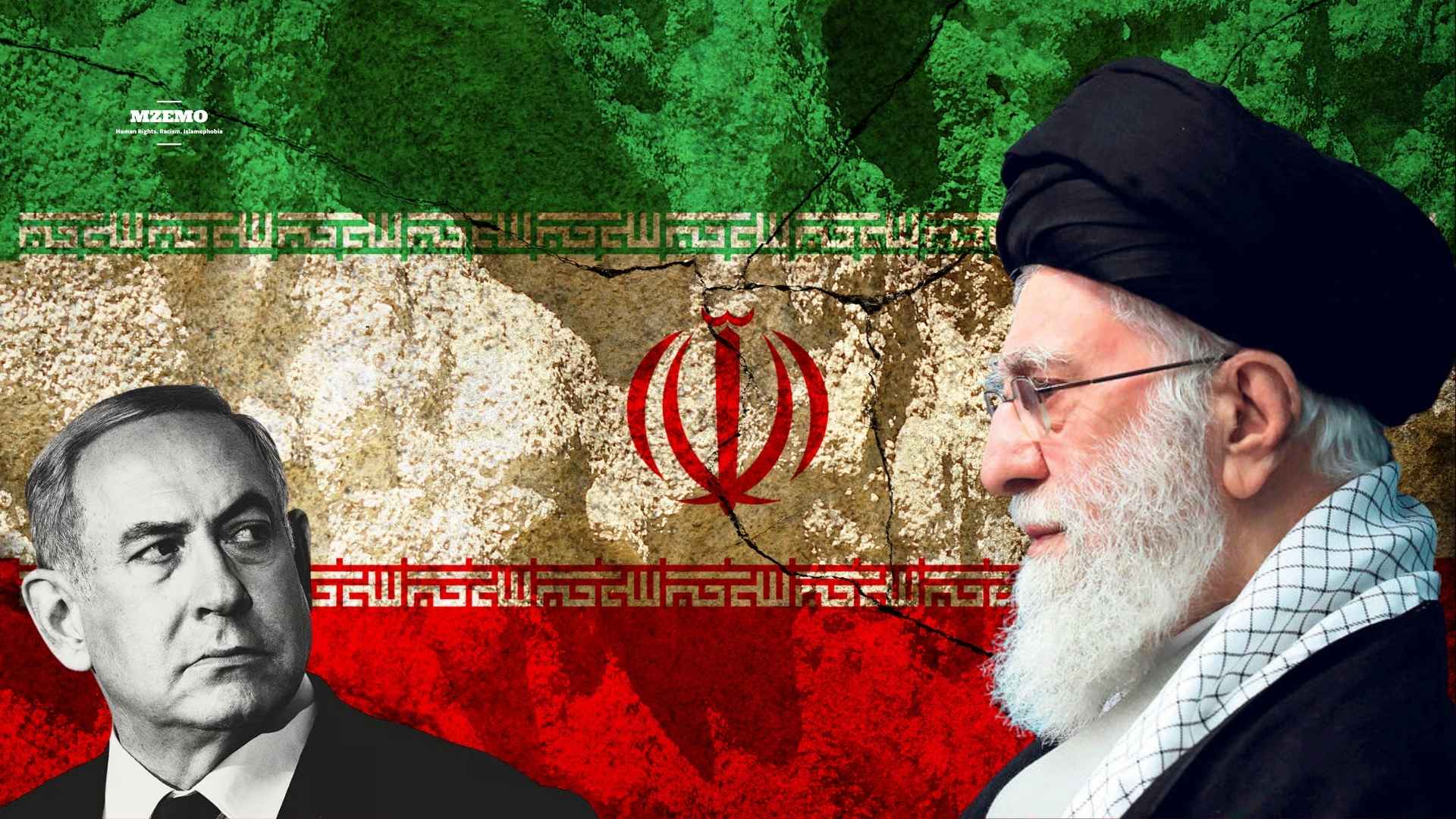
Shockwaves Across the Gulf: How the US–Israel Strike on Iran Could Redraw the Region
-
 Featured2 years ago
World passively watching as Israel perpetrates open-ended massacre in Gaza
-
Featured3 years ago
Argentina wins the World Cup; are there any other winners?
-
Featured2 years ago
Israel is Hiding Crucial Demographic Facts About Palestinians
-
Featured5 years ago
History of the Ottoman Empire
-
Featured3 years ago
Christian militia infiltrate Lebanon
-
Featured5 years ago
“Do Not Waste Water Even If You Were at a Running Stream” Prophet Muhammad
-
Featured2 years ago
Muhammed: The Greatest Man to walk on Earth
-
Featured4 years ago
World Leaders Remain Silent Over Human Rights Violations in the UAE