Connect with us

Featured

Ukraine Russia Crisis: Is the War Inevitable?

Published

on

A hand colored in Ukraine's flag colors.

A conflict is brewing at the crossroads of the Ukraine Russia border. Russia is accused of massing up military across the Ukrainian border, whereas Moscow calls it an act of deterrence, blaming the west for curating this crisis.

Kyiv, in contrast, says this is an act of aggression over the likely induction of Ukraine towards joining the NATO alliance.

So, what is the reality? What is the root of the Ukraine-Russia conflict? Why are the tensions escalating? And is a war now inevitable?

Ukraine Russia Crisis: What, How, & Why?

Ukraine gained independence after the collapse of the Soviet Union in 1991. But, today, the Crimea island, previously under Ukraina territory, is not controversially controlled by Russia. On the other hand, the Donbas region is the latest battleground where the current conflict is brewing.

On 26 January, 4 Ukrainian soldiers were killed by a group of pro-Russian separatists. The killing resulted in breaking a ceasefire agreement of 2020.

The situation has become quite precarious in the seventeen days that have followed. Thousands of soldiers from both sides have descended on the border, along with dozen of missile launchers and tanks. However, both countries deny stoking up tensions.

But what are the reasons behind the conflict?
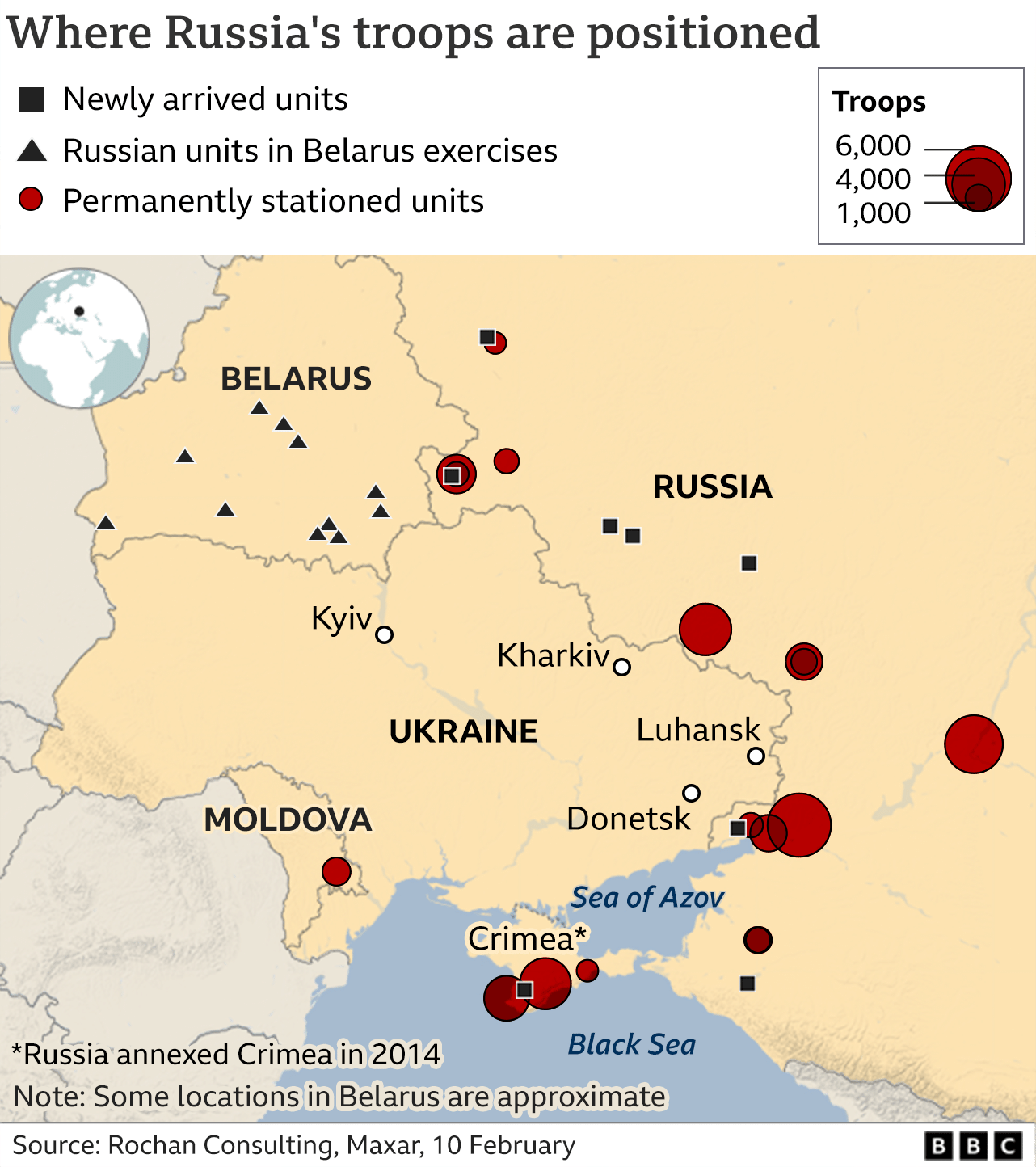
Map showing where the Russian troops are positioned.
Source: BBC

The answer is Ukraine’s demographic and geographic makeup. Ukraine is divided into an eastern region close culturally and historically to Russia, while the rest /of the country identifies itself as purely Ukrainian. The eastern region of the country is the hotbed of pro-Russian sentiment and rebellion.

The rebellions are supported by Russia and lay a vital role in keeping the conflict simmering.

How Widespread Will the War Be?

If the Russian army invades Ukraine, the risks of a major military invasion spiraling outside the Ukrainian border are stellar. In addition, the widespread war will instigate a refugee flow that will destabilize the neighboring countries, at the very least.

Given the history of Russian destabilization activity, chances of the special-operation forces trying to infiltrate the refugee flow in NATO countries will also mount up.

Military accidents also ascend a major risk to next-door countries. For example, if some of the Russian missiles fired at Ukraine destroy something in the nearby NATO countries, tensions can escalate between Russia and NATO.

According to Matthew Kroenig, if Russia succeeds in taking even a slice of Poland of Estonia, it would be a huge win for Putin. This big bright line crossed would break President Biden’s promise of defending every inch of NATO territory.

Such circumstances will test the true allegiance of NATO, and something Putin finds very interesting.

Ukraine Russia Crisis: Is There a Diplomatic Wayout?

Any diplomatic deal between the two nations would cover wider security issues and the looming war-like scenario in eastern Ukraine. Over the revival of the Minks Peace Agreement of 2014 & 2015, talks on solving the conflict have been taking place in Ukraine, France, Russia, and Germany.

Moscow has repeatedly insisted it has no plans to invade Ukraine. However, they have demanded that NATO and US not deploy weapons in Ukraine and pull back forces from eastern Europe. Nonetheless, Ukraine postulates have already given away too much to the separatists and Russia.

According to BBC, the following five situations could help deescalate the Ukraine tensions diplomatically:

  • The west could persuade President Putin to back down
  • Russia and Nato could agree on a new security deal
  • Russia and Ukraine could revive the Minsk agreement
  • The current stand-off could evolve into a status quo
  • Ukraine could become neutral like Finland

Furthermore, Olaf Scholz, Chancellor of Germany, met with Putin in Moscow a day after visiting Ukrainian President Volodymyr Zelenskyy in Kyiv to show solidarity.

Scholz urged Russia to “clearly deescalate the current tensions” on Monday. The Secretary of State reiterated Western unity in preparing to impose tough sanctions if Russia encroaches further into Ukraine, although he did not make specific recommendations.

“No one should doubt the determination and preparedness of the EU, NATO, Germany and the United States, for example, when it comes to what has to be done if there is military aggression against Ukraine,” 

Olaf Scholz 

Is the Ukraine Russia War Inevitable?

Since 2014, 13,000 civilians, 4,100 Ukrainian troops, and 5,650 separatists have been killed in the conflict. To put a full stop to the conflicts, the Ukrainian government pushes for NATO membership. However, this is where things are more complicated.

For Europe, this means influence on another level of the Russian border, but Putin views it as an existential threat. Moreover, Russia has invested billions of dollars in Ukraine, and above all, there is a significant population of pro-Russian civilians who want to secede from Ukraine.

Stakes are high, and the prospects for solutions are quite low. In contrast, the implications for the west, especially Europe, are also severe. To top it all off are the reports of a third world war.

Continue Reading
Click to comment

Leave a Reply

Your email address will not be published. Required fields are marked *

Featured

The Bombs Still Waiting Beneath Gaza’s Rubble

Published

on

The-Bombs-Still-Waiting-Beneath-Gazas-Rubble

A ceasefire can ultimately stop new bombs from falling, but it cannot make the weapons already buried beneath Gaza safe. Although it is a “broken ceasefire” that has been violated more than a hundred times by Israel, Palestinians still have hope. Whenever families return to their damaged homes, they will find more than broken concrete and twisted steel.

Israel said it carried out more than 40,000 airstrikes on Gaza by October 2024. Alarmingly, the UN Mine Action Service estimates that 5% to 10% of explosive munitions have failed to explode.

Gaza Has Become an Unmapped Minefield

Unexploded ordnance is extremely dangerous because it is hard to identify and may become less stable after impact. In Gaza, rather than lying in open air, numerous lethal weapons are buried inside collapsed apartment blocks, under roads, beside water systems, or beneath homes where displaced people are trying to live again.

A credible news agency, Reuters, documented a bomb more than a meter long on a rubbish heap in Gaza City. Moreover, a family in Nuseirat is unable to return because a device remained inside their home, and residents of Khan Younis are living above a suspected bomb buried beneath their building. UN teams have also found aircraft bombs, mortars, rockets, and improvised explosive devices on the surface, while warning that many more are likely to be deep under the rubble.

By October 2025, a UN-led database had recorded more than 53 deaths and hundreds of injuries from explosive remnants in Gaza. Aid organizations, such as UNRWA, believe the real total is higher because many incidents are never formally reported. Additionally, Humanity & Inclusion estimated that clearing surface contamination alone could take 20 to 30 years, while deeply buried weapons may remain a threat for generations.

Rubble Clearance Cannot Begin Blindly

As per the UN estimates, Gaza now contains an estimated 61 million tonnes of rubble. By April 2026, UNDP teams had removed about 287,000 tonnes, less than half of 1% of the total. The agency said the wider effort could take seven years or even more, and only if heavy machinery, fuel, and access are consistently available. Reconstruction needs have been placed at $71.4 billion over the coming decade.

These figures aptly show why unexploded weapons are inseparable from reconstruction. Before workers reopen a road, reach a water well, repair a hospital, or clear land for housing, specialists may need to survey the site. A bulldozer cannot safely enter simply because the fighting has stopped.

Near Khan Younis, a bulldozer struck a concealed explosive while clearing a road. The driver and a 15-year-old boy suffered severe burns and shrapnel wounds, and both lost sight in one eye.

The debris may also contain asbestos, contaminated dust, sewage, fuel, industrial chemicals, and human remains. Clearance is therefore a demining, environmental, and public-health operation, not merely a construction job.

Children and Returning Families Face the Greatest Risk

Children search damaged buildings for toys, clothing, wood, plastic, or scrap metal. A fuse, shell fragment, or small munition may look useful or harmless. So, as a precaution, warning posters can reduce some risk, but they cannot replace trained clearance teams.

Returning families face the same danger on a larger scale. Many enter homes without structural inspections, move debris by hand, and salvage whatever can be reused. Some extract steel bars from destroyed buildings to support tents or sell for income because construction materials remain scarce. That work brings innocent civilians into direct contact with debris that has not been systematically checked.

The threat will grow whenever more displaced people return to heavily damaged neighborhoods. Without large-scale clearance, Gaza risks inheriting the same decades-long danger seen in other countries where unexploded weapons continued killing civilians long after wars ended.

The Equipment Needed Has Been Restricted

As a professional practice, bomb disposal teams require detectors, armoured vehicles, protective clothing, firing cables, controlled explosives and specialised excavation equipment. But Israeli authorities rejected requests for more than 2,000 demining items between March and July 2024, including equipment needed for safe detonations and protected access. Aid groups said these restrictions and blockages prevented clearance work from beginning.

Gaza’s own capacity has also been reduced to almost nothing. Thirty-one members of the local police engineering division were killed, and another 22 were injured during the genocide. International teams need visas, security guarantees, and permission to bring equipment into the territory. Without strike records and technical information about the weapons used, specialists must work with incomplete maps.

Responsibility Cannot End With the Bombing

A UN-coordinated estimate placed the cost of clearing Gaza’s unexploded ordnance at about $500 million over ten years, assuming cooperation and unrestricted access. Later assessments suggested surface clearance may take even more than two or three decades.

That burden cannot be placed on innocent Palestinians alone. Israel holds information about its strikes and munitions. Governments that supplied weapons have technical expertise, records, and financial resources. On the other hand, donors discussing reconstruction must treat explosive clearance as a first requirement, not an optional project after roads and buildings are planned.

In a nutshell, Gaza cannot be rebuilt safely while bombs remain beneath homes, schools, hospitals and streets. The slow pace of genocide does not end the danger. Before families can return with confidence, the weapons still buried beneath the rubble must be mapped, removed, and destroyed.

Continue Reading

Featured

What Happens to Palestinian Refugees If UNRWA Finally Breaks?

Published

on

What-Happens-to-Palestinian-Refugees-If-UNRWA-Finally-Breaks

The United Nations Relief and Works Agency for Palestine Refugees in the Near East (UNRWA) was established to provide humanitarian support to the people of Palestine, especially in Gaza. However, this life-saving agency does not need to announce its collapse for Palestinian refugees to feel it. A clinic can shorten its critical hours, a school can lose teachers, and a family can suffer unimaginably due to the shortage of food, shelter, and life-saving medication.

On 30 June 2026, UN Secretary General António Guterres warned that this critical UN agency was approaching a “breaking point”. This is due to a funding gap of $100 million and restrictions by Israel. Due to this unfortunate happening, UNRWA had already reduced service hours by twenty percent. Moreover, they had cut local salaries and left 15% of international posts vacant. In 2025 alone, it received just $829 million against stated needs of $3.3 billion.

An Agency Created Because Displacement Was Never Resolved

UNRWA was established in 1949 after about 700,000 Palestinians were driven from or fled their homes during the Nakba. It was meant to provide much-needed humanitarian relief while the refugee question awaited a reliable solution. More than 75 years later, that solution has not arrived.

In fact, around 5.9 million Palestinians are registered with the agency across Gaza, the occupied West Bank, including East Jerusalem, Jordan, Lebanon, and Syria. UNRWA employs about 30,000 Palestinians and provides education, primary healthcare, relief, and emergency assistance. It is not a small charity that can be replaced by redirecting a few aid trucks. It is a regional humanitarian public-service system built over generations.

Its long existence is sometimes used against it, as though the agency created the refugee crisis. In fact, UNRWA remains because the Palestinian statehood issue remains unresolved. Closing it would only remove services, while the original injustice would continue.

Gaza Would Feel the Collapse First

Especially in Gaza, UNRWA has operated schools, clinics, warehouses, and distribution systems for decades. Its local staff know the limited communities they serve. During the genocide, its buildings became shelters, and its employees continued working while displaced and grieving.

So, if the agency breaks down, Gaza would lose far more than just food distribution. Primary healthcare would shrink. Vaccination, maternal care, and treatment for chronic illness would be largely interrupted. Sanitation and shelter support would weaken. Other humanitarian organizations would be expected to absorb an enormous caseload without UNRWA’s staff, facilities or local network.

Moreover, education would suffer just as deeply. UN officials warned that more than 660,000 children in Gaza could lose access to schooling if UNRWA collapsed. After years of bombing, displacement, and trauma, removing the main institution capable of rebuilding education would deepen the destruction of an entire innocent generation.

The Crisis Would Spread Across the Region

UNRWA is often discussed as though it exists only in Gaza. Its collapse would also be felt in Jordan, Lebanon, Syria, and the occupied West Bank.

When it comes to Lebanon, many Palestinian refugees face severe poverty and restrictions on employment. In Syria, years of internal and proxy wars have damaged camps and public services. On the other hand, in Jordan and the West Bank, UNRWA schools and clinics support large communities. Host governments would face extreme pressure to absorb hundreds of programs, yet most lack the money or capacity to do so.

Although international charities could take over isolated projects, they could not quickly reproduce a network operating across five territories. The likely result would be fragmented healthcare, overcrowded schools, lost jobs, and deeper instability.

A Financial Crisis Made Political

UNRWA’s funding problems cannot be separated from the campaign against the agency by Israel and its allies.

Israel accused several employees of involvement in the attacks of 7 October 2023. The UN investigated this matter as well. These allegations against individuals were used to attack an agency employing tens of thousands and serving millions. Several donors suspended funding; most later resumed it, but the financial damage remained.

To add fuel to the fire, Israel also passed legislation restricting UNRWA, barred official contact with it, and moved against its East Jerusalem presence. Unfortunately, in January 2026, Israeli bulldozers demolished buildings inside the agency’s East Jerusalem compound after the site had been seized. Resultantly, the UN condemned the demolition as a violation of international law.

Who Would Replace UNRWA?

Israel has notoriously said that other organizations can assume UNRWA’s work. However, what are the guarantees that the other organization wouldn’t be banned or completely obliterated in the name of revenge? No credible plan has shown how this could happen at the required scale.

When it comes to other humanitarian agencies, they have specialized mandates, but none combines UNRWA’s schools, clinics, registration systems, warehouses and Palestinian workforce. NGOs can provide emergency help, but they cannot instantly operate a regional education and healthcare system. Most importantly, the UN Security Council has called UNRWA the backbone of the humanitarian response in Gaza and warned against attempts to dismantle it.

If UNRWA disappeared, innocent civilians would suffer the most. Food, healthcare, schooling, shelter, and sanitation would still have to be provided. Ultimately, Palestinian families would bear the immediate consequences.

Closing UNRWA Would Not Close the Refugee Question

In a nutshell, UNRWA is not a substitute for Palestinian freedom, return, compensation, or statehood. It cannot negotiate a political settlement. Its schools and clinics manage the consequences of displacement rather than resolving its cause.

UNRWA may have been created as a temporary institution, but Palestinian exile was never temporary. If the agency finally breaks, the refugees will not vanish. Their needs will become more severe, the entire system more strained, and the region less stable.

The world would not have ended the Palestinian refugee crisis. It would simply have abandoned the people still living through it.

Continue Reading

Featured

Hormuz Gets Diplomacy While Gaza and Lebanon Keep Bleeding

Published

on

Hormuz-Gets-Diplomacy-While-Gaza-and-Lebanon-Keep-Bleeding

The latest US-Iran talks show how quickly the world can move when a crisis threatens oil, shipping, and regional markets. After the Strait of Hormuz became a flashpoint, Washington moved into negotiations. Although the attacks by Israel and the United States on Iran were unprovoked, the resulting ceasefire is a reflection of the enfeebled power of the United States and Israel.

However, one thing is evident: when the global economy feels pressure, urgency arrives. But that urgency is not being shown to Gaza and Lebanon. This is the central problem with the current regional diplomacy. The Strait of Hormuz is being treated as a global emergency, while Israel’s continued genocide in Gaza and violence in Lebanon is treated as a difficult-to-manage side issue.

Why Hormuz Became the Priority

The Strait of Hormuz is one of the world’s most important energy routes. Around one-fifth of global oil and natural gas normally passes through this narrow waterway between Iran and Oman. When the US-Israel escalation with Iran raised the risk of disruption, the concern was immediate because any closure or attack near Hormuz could affect energy prices, insurance costs, shipping schedules, and the wider global economy.

Following a ceasefire announcement, the US indicated it would waive sanctions on Iran for 60 days after the first talks under a new peace framework. The talks, held in Switzerland and mediated by Qatar and Pakistan, were described as part of a roadmap toward a final deal within 60 days. Moreover, they included a communications mechanism to help ensure the safe passage of commercial ships through Hormuz.

This does not simply mean the crisis is over. Iran and the US still disagree over a lot of issues, like nuclear inspections and the details of the deal. Gulf states remain worried about Iranian power, Israeli escalation, and the possibility of another breakdown. But the speed of the diplomatic response tells its own story. Hormuz became urgent because Hormuz affects global trade.

The Problem Is Not Diplomacy but Selective Diplomacy

Keeping Hormuz open matters due to the fact that millions of people could feel the economic shock of a major disruption. The problem is not that diplomats are trying to calm the waterway. The problem is that the same level of pressure is not applied when Israel keeps killing innocent Palestinians and Lebanese civilians.

This is where US diplomacy becomes morally exposed. Washington can move quickly when shipping lanes, oil prices, and Gulf allies are at risk. Yet when Gaza’s children are killed after a ceasefire, or when Lebanese families remain displaced from destroyed villages, the language becomes cautious, delayed, and full of exceptions for Israel.

Lebanon Shows the Limits of the Deal

Lebanon is supposed to be one of the places where regional de-escalation becomes visible. Although the interim US-Iran agreement called for ending hostilities, including in Lebanon, it is not being realized completely. Israel, however, has declared that it will not withdraw from southern Lebanon unless its unrealistic conditions are met.

This is why the Lebanon file remains so fragile. Despite withdrawing from Lebanon and providing the innocent people a sigh of relief, Israel is pushing forward. Israel has established what it calls a buffer zone about 10 km inside Lebanon, forcing local civilians from their homes and carrying out raids and demolitions in villages.

When it comes to the human cost, more than 1.2 million people were displaced during the fighting, about a fifth of Lebanon’s population. Lebanon’s National Council for Scientific Research indicated that more than 90,000 housing units were damaged or destroyed between March 2 and June 12. Other credible reports also highlighted that tens of thousands remain displaced because their homes are gone or their towns remain under Israeli military occupation.

Gaza Remains the Deepest Failure

Since the October 2025 ceasefire, Israeli attacks have killed more than 1,027 Palestinians and injured 3,280 others. Gaza’s Health Ministry highlighted that the total number of Palestinians killed since October 2023 has exceeded 73,041, with 173,402 wounded. These numbers do not describe a genocide moving toward peace. They describe a population still being punished while the world discusses arrangements elsewhere.

Gaza should have been discussed in the recent peace talks, too, but the world is moving towards a moral crisis. The destruction of Gaza, the blockade on aid, the brutal killing of innocent children, and the forced displacement of families are the reasons anger across the Muslim world remains so deep.

Israel Keeps Undermining Regional Peace

Any honest discussion of regional de-escalation must confront Israel’s role. The US wants Iran to lower tensions, the Gulf states want shipping security, and mediators want the fighting to stop. Yet Israel continues to act with carte blanche in Gaza and Lebanon.

There is a wide contradiction between the world’s policies. Israel is not treated as a spoiler in the same way as others are. Its attacks are framed as security needs, while Palestinian and Lebanese suffering is framed as an unfortunate fallout. This double standard is one reason ceasefire efforts keep failing in practice.

If Israel can continue bombing Gaza, occupy parts of southern Lebanon, and delay withdrawal without serious consequences, then regional calm remains fragile. It may hold for oil markets, but it will not hold for the people living under attack.

Ultimately, peace cannot be built by protecting tankers while ignoring tents, hospitals, and destroyed villages. A regional deal that treats shipping as urgent but civilian blood as negotiable is not peace. It is selective stability, built for markets before innocent people.

Continue Reading
Advertisement

Trending