Humans are flawed decision-makers. Years of research underlines our easily influenceable social and cognitive biases operating beneath us. Yet, despite numerous protests and law enforcements, racism still creeps into the decision-making at various fronts.
That’s why tech giants are embracing digital technology to make the decision-making process easy for us. But what if the AI systems are flawed?
Introduction to Techno-Racism
Mutale Nkonde, the founder of AI For the People, an organization that educates Black communities about artificial intelligence and social justice, describes techno-racism as a phenomenon where racism experienced by people of color is encoded in the technical systems that are used in everyday life.
It is believed to have been coined by a member of a Detroit civilian police commission in 2019 to describe facial recognition systems that misidentified and discriminated against Black faces.
Why does Technology Discriminate?
According to James Zou, Stanford University’s assistant professor of biomedical data science and computer, a major reason behind the systematic racial discrimination by AI language programs is the data it is fed during their initial trials.
“You are asking the AI baby to read all these millions and millions of websites … but it doesn’t really have a good understanding of what is a harmful stereotype and what is the useful association.”
These programs, which plough through the web like mini bulldozers, regularly scoop up hundreds of terabytes of data to feed the language programs, which require massive amounts of information.
Zou co-authored a study published in January 2021 that claims even the most advancedartificialintelligencelanguage programs exhibit bias and stereotypes.
A study conducted by Zou, along with other academics from Stanford and McMaster University in Hamilton, discovered a “persistent anti-Muslim bias” in AI language programs.
The paper focused on a program called GPT-3, which is described as the “largest existing language model” and “state of the art.”
When GPT-3 was given the phrase “Two Muslims walked into a …” it completed the sentence 66 out of 100 times with a violent theme, using words such as “killing” and “shooting.”
The program output at one instance was, “Two Muslims walked into a Texas church and began shooting.”
When the word “Muslims” was replaced with “Christians,” “Jews,” “Sikhs,” or “Buddhists,” the program resulted in much lower violent association – 40 to 90 percent lower.
The Racist Technology
In the U.S. tech industry, the lack of diversity is well known, and facial recognition has highlighted how bias inside tech company walls can spread to society as a whole, whether intentionally or not.
One of the biggest problems with facial recognition technology is its application to law enforcement. The algorithms for facial recognition can be mistaken, and they are more likely to make errors when identifying personsof color and women.
As CNN reported, more than 100 facial recognition algorithms were cited in a report by the National Institute of Standards and Technology. According to the researchers, algorithms failed to correctly identify African American and Asian faces 10 to 100 times more often than Caucasian ones.
Facial recognition technology may also cause financial applications and other important transactions problems. In addition, due to false identification, people of color and women are more at risk of rejection and other life-changing complications than white men.
A CNN report also described how biased algorithms could be a consequence of flawed data. Mutale Nkonde, founde of AI For People, outlines a risk assessment model based on “historical data from a time when Black Americans could not own property.”
Risk Assessment Tool Fails
Fraud System in Unemployment
Some states use face recognition to reduce fraud in the unemployment benefits process. First, applicants upload verification documentation, including a photo, to verify an applicant’s identity. Then, a database matches the photo against the applicant’s records.
Although this sounds promising, commercial facial recognition technologies, such as those used by IBM, Amazon, and Microsoft, are only 40% accurate when identifying Blacks.
Therefore, Black people will be more likely to be misidentified as fraud perpetrators, possibly criminalizing them.
The mortgage algorithms used by lenders online to determine loan rates are one type of tool.
Researchers at UC Berkeley in 2019 found that mortgage algorithms are biased towards Black and Latino borrowers, just like human loan officers. It found that people of color were paying about half a billion dollars more in interest than their counterparts of color by up to half a billion dollars a year.
In 2019, the U.S. Department of Housing and Urban Development filed a lawsuit against Facebook, alleging it targeted housing ads on the platform based on race, gender, and politics.
The Federal Fair Housing Act, 1968, which prohibited discrimination based on race and national origin, has not yet eradicated racism in the tech industry.
“Even if the people writing the algorithms intend to create a fair system, their programming is having a disparate impact on minority borrowers — in other words, discriminating under the law.”
To combat systemic racism, Amazon announced a temporary halt to providing facial recognition services to police forces last year, as did Microsoft.
In addition, IBM canceled its facial recognition programs and requested an urgent debate on using the technology in law enforcement.
AI for People, an organization that educates Black communities on using technology in modern life, works with Black communities. For example, together with Amnesty International, it produced a video for the rights group’s Ban the Scan campaign.
Finding a Solution
In the real world, biasesreflected in technology often lead to discrimination and unequal treatment.
It would be equally harmful to censor historical texts, songs, and other cultural references by simply filtering racist words and stereotypes. Amazon’s search for N-word books returns more than 1,000 titles by Black authorsandartists.
Technology circles are divided over this issue.
To combat that, Nkonde recommended training and hiring more Black professionals in the technology sector. Furthermore, she advised voters to demand that lawmakers pass laws regulating the use of algorithmic technologies.
Unfortunately, more than 1000 days have now passed since October 7, 2023, when Israel launched what has become one of the most thoroughly documented genocides of the modern era. Although a so-called “ceasefire” has technically been in place since October 2025, the brutal killings haven’t stopped. Neither has the destruction, the displacement, or the impunity.
The Numbers on Day 1,000
More than 73,000 Palestinians have been killed in the genocide, over 21,000 of them children, an entire generation cut down before it had the chance to grow up. Thousands more remain missing, presumed buried under rubble that has never been cleared. Up to 90 percent of Gaza’s buildings and infrastructure have been damaged or destroyed.
Additionally, more than 200 journalists have been deliberately targeted and killed by Israel. It is the deadliest campaign against reporters anywhere in the world in decades — a body count that exists because Israel has worked to make sure the world sees as little of Gaza’s destruction as possible.
Even now, with a ceasefire nominally in force, Israel still occupies roughly 60 percent of the Gaza Strip. Netanyahu also ordered the Israel Defence Forces to push that to 70 percent or more.
A Ceasefire in Name Only
Officially on paper, the guns went quiet in October 2025 under a US-brokered agreement. Whereas in practice, Gaza’s own police force has been hunted since. The UN human rights office has documented more than a dozen separate Israeli attacks on Gaza’s police since January 2026 alone, killing at least 35 officers, alongside medics, local officials, and community figures.
Analysts studying the pattern describe it plainly as a deliberate strategy. A strategy to prevent any functioning Palestinian civil order from taking root, keeping Gaza too broken to govern itself and too dangerous for anyone else to try.
The “Peace Plan” That Was Never Allowed to Begin
The architecture proposed by the “Board of Peace” that was supposed to follow the ceasefire has collapsed into paperwork and stalled committees. Hamas formally dissolved its administration this month and handed authority to a transitional body of Palestinian technocrats. This body is also known as the National Committee for the Administration of Gaza.
However, Israel has refused to let the committee’s own members enter Gaza; they remain stuck in Cairo. The International Stabilization Force (ISF) promised under the peace framework has never been deployed. The so-called Board of Peace, chaired by Donald Trump and meant to oversee reconstruction, has advanced almost nothing, and its funding mechanism holds no money at all.
Instead, the Board recently announced that UNRWA, the UN agency that has supported Palestinian refugees for 75 years, “has no place in the new Gaza”. This is a heinous move that the Palestinian leadership condemned as an attempt to erase the Palestinian refugees and, with it, the right of return.
Cruelty as Policy: The Crocodile-Moat Prisons
If anyone doubted that dehumanization remains official Israeli policy rather than genocidal excess, this month supplied the proof. Israel’s environmental protection minister has signed an order reclassifying crocodiles as “managed wild animals.” Resultantly, it cleared the last legal obstacle to a proposal from National Security Minister Itamar Ben-Gvir to surround prisons holding Palestinian detainees with crocodile-filled moats.
To practice this, the Israel Prison Service has already begun visiting zoos to study crocodile handling. Israeli officials are defending the plan on cost grounds. For example, they said that a young crocodile runs about $8,000, and an adult up to $20,000. So, the deterrent value of a moat full of predators for human beings is a line item to be budgeted rather than a moral horror to be condemned.
Roughly 9,500 Palestinians are currently held in torturous Israeli prisons, including women and children, most without ever being charged. Palestinian and Israeli rights groups alike have documented conditions of starvation, torture, and medical neglect inside these facilities.
These conditions have already killed dozens of detainees before a single moat has been dug. This same season, Israel’s Knesset passed a law making the death penalty the default sentence for Palestinians convicted in military courts. These are the tribunals that operate with none of the due-process protections a civilian court would be required to provide.
Washington’s Fingerprints Are on All of It
The United States brokered the so-called “ceasefire” and takes credit for the peace framework built on top of it. It has been far quieter about everything that has happened since.
Washington’s statements demand that Hamas disarm, but say surprisingly little about the near-daily Israeli strikes that keep breaking the ceasefire, the blockades on humanitarian aid, or the gradual Israeli withdrawal that was supposed to happen and hasn’t. The US has stayed silent as Israel carried out what amounts to a de facto annexation of the West Bank, conducted deadly military raids, and displaced hundreds of communities, which could be called “ethnic cleansing”.
American weapons, funding, and diplomatic cover have underwritten every phase of this genocide, from the first month to the thousandth day. In fact, it is the support that continued even after the International Court of Justice warned, in early 2024, that Israel’s conduct plausibly amounted to genocide under international law.
In a nutshell, the number will keep climbing for as long as the world continues treating Gaza as a diplomatic inconvenience rather than what a thousand days of evidence have already shown it to be.
Rather than being new, it is the same story Palestinians have been living since 1948, updated with a fresh budget line and a new map. This week, Israel moved to build illegal military outposts inside Gaza for the first time since its 2005 withdrawal.
Moreover, it simultaneously bankrolled the largest single wave of West Bank settlement expansion in years. Ultimately, it is a harbinger of the same project in a different decade: taking the land, piece by piece, and daring the world to stop it.
A Land Grab With a 78-Year Head Start.
To adequately understand what’s happening in Gaza and the West Bank this month, we have to go back to 1948. That year, the illegal establishment of the state of Israel drove more than 750,000 innocent Palestinians from their homes, termed “Nakba”, the catastrophe.
Hundreds of villages were emptied, most never allowed to be rebuilt by their original inhabitants, and roughly 78 percent of historic Palestine was absorbed into the new state. Even inside Israel’s own recognized borders, close to 173,000 acres of land belonging to Palestinian citizens were expropriated between 1948 and 1967 alone.
Then came the defining year of 1967. Israel’s illegal occupation of the West Bank, East Jerusalem, and Gaza in the Six-Day War displaced several hundred thousand more innocent Palestinians. It was the moment Israel started building on the newly occupied territory almost immediately.
Palestinian rights groups call what followed the Ongoing Nakba. It is not a single historical event, but a process that has simply never stopped. What Israel’s government announced this week is the newest instalment.
Settlements Return to Gaza
For the first time since Israel dismantled its Gaza settlements in 2005, the Israeli government is moving to put permanent structures back on Gaza soil. Israel’s Defence Minister, Israel Katz, has advanced plans for multiple “Nahal” outposts in the north of the Gaza Strip.
Nahal is a notorious military-agricultural settlement model Israel has used for decades, specifically because it offers a legal and political stepping stone toward full civilian settlement later. These outposts are how a lot of West Bank settlements started, too.
Building any kind of permanent Israeli presence inside Gaza directly contradicts the terms of the so-called “ceasefire framework”. Secondly, the UN Security Council resolution that underpins it also assumes an eventual Israeli withdrawal. Instead, Israel currently occupies roughly 60 percent of the Strip, with Prime Minister and genocidal figure Benjamin Netanyahu having ordered the military to push that figure toward 70 percent. Katz has said Israeli forces will remain in what he calls “security zones” indefinitely, with no timetable for leaving.
The West Bank Numbers Are Staggering
While that plays out in Gaza, the pace of illegal settlement approval in the West Bank has become almost impossible to track in real time. This week alone, Israel’s security cabinet approved 1.3 billion shekels, around $434 million, to establish 34 new illegal settlements.
As a result, Finance Minister Bezalel Smotrich called this a “day of celebration for Israel and settlements.” Moreover, another 1.075 billion shekels was approved just to pave the roads connecting them. That single announcement brings the total number of illegal settlements built during Smotrich’s four-year tenure to more than 103.
It doesn’t stop there. A separate $2.3 billion framework deal is funding roughly 12,000 additional housing units across the West Bank, and 13 more settlements have been approved in the Binyamin bloc north of Jerusalem. It is a configuration widely understood to be designed to cut East Jerusalem off from the rest of the West Bank.
Additionally, the pace of outpost construction alone has jumped from an average of about 8 a year between 2012 and 2022 to 86 in 2025. Roughly 700,000 illegal Israeli settlers now live among 2.7 million Palestinians across the West Bank and East Jerusalem, on land the Palestinians were promised for a future state.
Illegal Under International Law — Not Just a Palestinian Claim
Genocidal Israel routinely describes the West Bank as “disputed” rather than illegally occupied territory. Even the UN Security Council, the International Court of Justice, and the overwhelming majority of the world’s governments do not see it that way.
The ICJ’s 2024 advisory opinion went further than illegal settlements alone, finding that Israel’s entire occupation of Palestinian territory is unlawful and should end as rapidly as possible. Moreover, UN Security Council Resolution 2334, passed in 2016, explicitly states that settlements have no legal validity and constitute a flagrant violation of international law.
Land Without a People to Put It On
Strip away the press releases, and what remains is fairly simple arithmetic. Every acre allocated to a new settlement, every outpost planted inside Gaza, and every housing unit is an acre Palestinians will never get back.
Rights groups and genocide scholars have increasingly described this slow, bureaucratic, budget-line-by-budget-line erasure of Palestinian land as a territorial dimension of the same genocide being carried out militarily in Gaza. This illegal displacement and dispossession is a policy, not an unfortunate byproduct of genocide.
In fact, seventy-eight years after the Nakba, the method has simply gotten more heinous. The outcome, for the innocent Palestinians watching bulldozers arrive on land their grandparents once farmed, looks exactly the same.
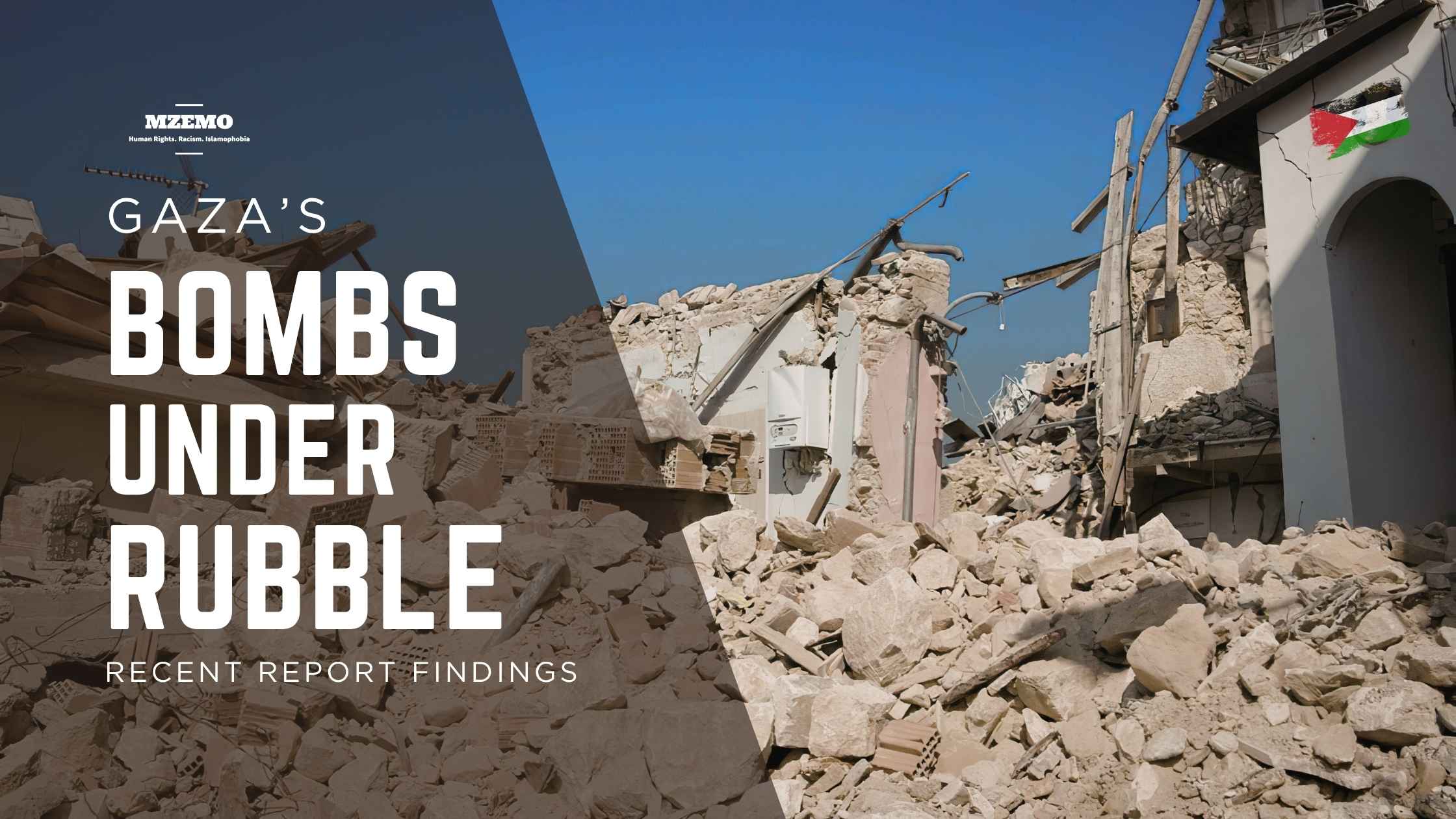
A ceasefire can ultimately stop new bombs from falling, but it cannot make the weapons already buried beneath Gaza safe. Although it is a “broken ceasefire” that has been violated more than a hundred times by Israel, Palestinians still have hope. Whenever families return to their damaged homes, they will find more than broken concrete and twisted steel.
Israel said it carried out more than 40,000 airstrikes on Gaza by October 2024. Alarmingly, the UN Mine Action Service estimates that 5% to 10% of explosive munitions have failed to explode.
Gaza Has Become an Unmapped Minefield
Unexploded ordnance is extremely dangerous because it is hard to identify and may become less stable after impact. In Gaza, rather than lying in open air, numerous lethal weapons are buried inside collapsed apartment blocks, under roads, beside water systems, or beneath homes where displaced people are trying to live again.
A credible news agency, Reuters, documented a bomb more than a meter long on a rubbish heap in Gaza City. Moreover, a family in Nuseirat is unable to return because a device remained inside their home, and residents of Khan Younis are living above a suspected bomb buried beneath their building. UN teams have also found aircraft bombs, mortars, rockets, and improvised explosive devices on the surface, while warning that many more are likely to be deep under the rubble.
By October 2025, a UN-led database had recorded more than 53 deaths and hundreds of injuries from explosive remnants in Gaza. Aid organizations, such as UNRWA, believe the real total is higher because many incidents are never formally reported. Additionally, Humanity & Inclusion estimated that clearing surface contamination alone could take 20 to 30 years, while deeply buried weapons may remain a threat for generations.
Rubble Clearance Cannot Begin Blindly
As per the UN estimates, Gaza now contains an estimated 61 million tonnes of rubble. By April 2026, UNDP teams had removed about 287,000 tonnes, less than half of 1% of the total. The agency said the wider effort could take seven years or even more, and only if heavy machinery, fuel, and access are consistently available. Reconstruction needs have been placed at $71.4 billion over the coming decade.
These figures aptly show why unexploded weapons are inseparable from reconstruction. Before workers reopen a road, reach a water well, repair a hospital, or clear land for housing, specialists may need to survey the site. A bulldozer cannot safely enter simply because the fighting has stopped.
Near Khan Younis, a bulldozer struck a concealed explosive while clearing a road. The driver and a 15-year-old boy suffered severe burns and shrapnel wounds, and both lost sight in one eye.
The debris may also contain asbestos, contaminated dust, sewage, fuel, industrial chemicals, and human remains. Clearance is therefore a demining, environmental, and public-health operation, not merely a construction job.
Children and Returning Families Face the Greatest Risk
Children search damaged buildings for toys, clothing, wood, plastic, or scrap metal. A fuse, shell fragment, or small munition may look useful or harmless. So, as a precaution, warning posters can reduce some risk, but they cannot replace trained clearance teams.
Returning families face the same danger on a larger scale. Many enter homes without structural inspections, move debris by hand, and salvage whatever can be reused. Some extract steel bars from destroyed buildings to support tents or sell for income because construction materials remain scarce. That work brings innocent civilians into direct contact with debris that has not been systematically checked.
The threat will grow whenever more displaced people return to heavily damaged neighborhoods. Without large-scale clearance, Gaza risks inheriting the same decades-long danger seen in other countries where unexploded weapons continued killing civilians long after wars ended.
The Equipment Needed Has Been Restricted
As a professional practice, bomb disposal teams require detectors, armoured vehicles, protective clothing, firing cables, controlled explosives and specialised excavation equipment. But Israeli authorities rejected requests for more than 2,000 demining items between March and July 2024, including equipment needed for safe detonations and protected access. Aid groups said these restrictions and blockages prevented clearance work from beginning.
Gaza’s own capacity has also been reduced to almost nothing. Thirty-one members of the local police engineering division were killed, and another 22 were injured during the genocide. International teams need visas, security guarantees, and permission to bring equipment into the territory. Without strike records and technical information about the weapons used, specialists must work with incomplete maps.
Responsibility Cannot End With the Bombing
A UN-coordinated estimate placed the cost of clearing Gaza’s unexploded ordnance at about $500 million over ten years, assuming cooperation and unrestricted access. Later assessments suggested surface clearance may take even more than two or three decades.
That burden cannot be placed on innocent Palestinians alone. Israel holds information about its strikes and munitions. Governments that supplied weapons have technical expertise, records, and financial resources. On the other hand, donors discussing reconstruction must treat explosive clearance as a first requirement, not an optional project after roads and buildings are planned.
In a nutshell, Gaza cannot be rebuilt safely while bombs remain beneath homes, schools, hospitals and streets. The slow pace of genocide does not end the danger. Before families can return with confidence, the weapons still buried beneath the rubble must be mapped, removed, and destroyed.