Featured
Pangolin Trafficking: The Illicit Trade Pushing Pangolins on the Verge of Extinction


Which do you think is the most trafficked animal in the world? Despite the craze for elephant tusk, leopard skin, and snake leather, the numbers in which Pangolians are being trafficked through international borders are pushing these little creatures on the verge of extinction. Researchers are worried that we are running out of time, and only strict actions today can save the enigmatic and imperiled Pangolians from vanishing from the face of the earth.
But what has triggered the trafficking of Pangolians which led the mammal to the brink of extinction? And what measures must be taken to prevent this harmless miniature dinosaur from disappearing?
Pangolin Trafficking: Demand and Crime
Countries like China and Vietnam are the epicenter of Pangolin demands mainly for their scales. Pangolians’ scale has a great significance and curing capability in traditional Chinese medicine. But trafficking is not only limited to the scales; Panglonia meat is also regarded as a luxury delicacy in Vietnam and China.
Over the last decade, more than one million Pangolins have been trafficked. Approximately 228 tones of Pangolin scales were confiscated between the years 2016 and 2019, where two-third of the entire seizer took place in the period of 2018-19. Furthermore, in an intelligence-led operation, 2020, Environmental Management Inspectorate, along with the police, rescued 38 dehydrates, starving, and sickly Pangolins from illegal traffickers.
The US departments of homeland security’s criminal investigation specialist, Devhandran Pillay, retrieved trafficked Pangolins and arrested 28 traffickers in the seizure, including international buyers and receivers. He said, “The department was requested to assist with digital forensic analysis on the cellphones of the four suspects. This was done, and the four were linked in the commission of the crime.”
Significance of Pangolin Trafficking

Pangolins, the most trafficked non-human mammal in the world, have lived on the earth for more than 84-million years, giving them the name ‘artichokes with legs‘ or miniature dinosaurs. A pangolin’s scale is composed of keratin, just like a human’s fingernail. Yet, despite extensive trafficking from Africa to Asia, the elusive scaly mammals were rarely in the extinction animal discussion until a few years back.
According to Wildlife Justice Commission, Pangolins made the headline only after the global Covid-19 outbreak, under the spotlight of speculation of correlation between the coronavirus and pangolin trafficking. The commission highlighted the increasing demand for Pangolin scale and meat from Asia, as ever investigation discovers staggering quantities of Pangolin scales. The Chinese government protects pangolins at the highest level. They are no longer on the list of approved ingredients for traditional Chinese medicine, but there still remain problem areas.
Pangolin Trafficking: An Organized Crime

Pangolin has been hunted and sold for the purpose of food, openly in the bush market of many African countries. Still, the high demand for these mammals from Asia has given rise to organized crime syndicates with networks across borders. The significant and often overlooked cause of trafficking is joblessness and poverty. Zimbabwe, Mozambique, Botswana, and Namibia home most Pangolin traffickers, places where job opportunities are scarce. The high-value market of Pangolin trafficking lures the traffickers into organized crime, but at the end of the day, they are hunting not to make a fortune but just to put food on the plate.
As Pangolins are becoming rare, their demand in hiking off the roof, which have made Pangolin trafficking an organized crime, including the poor hunters in Africa who hunt and sell each Pangolin for as little as $10, to the overseas illicit trading market where the price can get up to a grand or two. Thus, just like drugs, the illegal trading of Pangolin has shot up the cost of the rarest species of scaly anteater.
How to Tackle the International Crime Against Pangolians?
Launched in 2019, the Pangolin Crisis Fund was created to save the species of Pangolin from getting extinct due to the illicit trading of its meat, scales, and other body parts. Currently working against illegal trafficking of Pangolin’s over the border, PCF is operating in Asia, the largest buyer, and Africa, the largest supplier.
The only way to tackle the global underground trafficking of Pangolins is through international approaches because, despite numerous laws and restrictions, Pangolins are trafficked across borders with ease. The strategies to deal with and halt such trafficking should be flexible enough to match the trade’s nature because no single country can globally impact the illicit trade.
People have to know more about Pangolin and its significance on a global scale. Scaling up the awareness about Pangolin amongst the poverty-stricken traffickers can help protect further exploitation of these endangered animals.


Featured
Israel’s Election Deadlock: Netanyahu’s Political Future and the Fight for Palestinian Rights


During the much-awaited elections, Israel has voted, but the future of its government remains unresolved. The recent Israeli elections denied Genocidal Prime Minister Benjamin Netanyahu’s allies a clear parliamentary majority. While parties representing Palestinian citizens achieved an unprecedented result. Yet millions of Palestinians in Gaza and the occupied West Bank had no ballot in an election whose consequences will reach deeply into their daily lives.
Let’s dig into more details of the 2026 Israeli elections and their impacts on Palestinian life and statehood.
Israel’s 2026 Elections End Without a Clear Majority
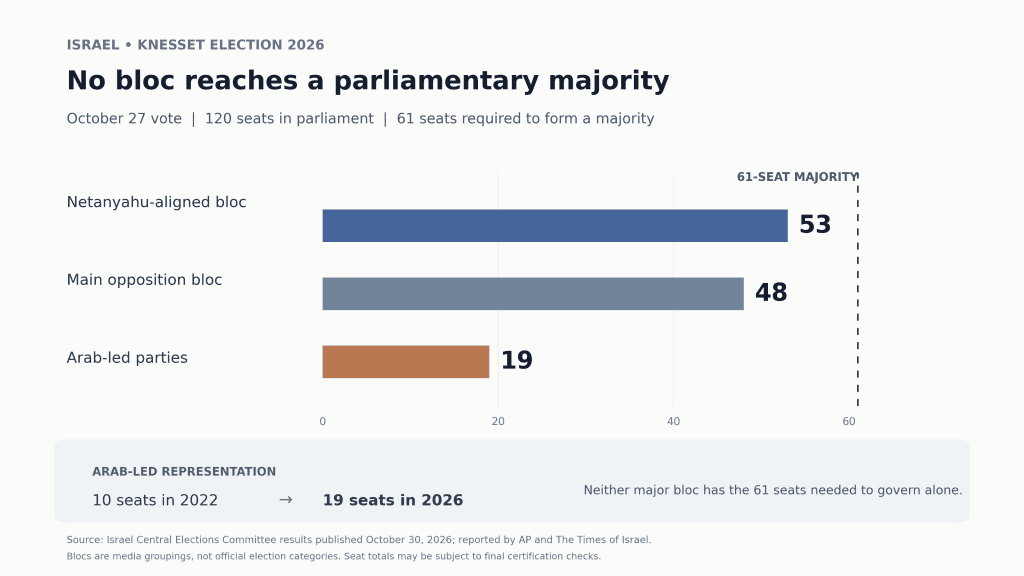
The final election results, released on October 30, gave Netanyahu’s bloc 53 seats in the 120-member Knesset, eight short of the 61 needed to govern. The main opposition grouping, led by former military chief Gadi Eisenkot, received 48, while Arab-led parties secured 19.
Netanyahu’s Likud remained the largest individual party with 27 seats. On the other hand, Eisenkot’s Yashar won 21, and turnout reached around 80%, the highest in decades.
The result leaves several routes to government formation. Negotiations could involve cooperation across existing blocs, support from Arab-led lawmakers, or renewed elections if successive attempts fail. Genocidal criminal Netanyahu remains prime minister while the constitutional process continues.
Palestinian Citizens Secure a Historic 19 Seats
The most striking and unprecedented change came from Palestinian citizens, whose political representation rose sharply. The Joint List won 11 seats and Ra’am eight, exceeding the previous Arab-led parliamentary high of 15 in 2020.
Ultimately, their electoral success was not simply a contest between Netanyahu and Eisenkot. Voters and community leaders also described concerns over violent crime, discrimination, public investment and equality, alongside the destruction in Gaza and the future of Palestinian statehood.
However, parliamentary numbers do not automatically translate into governing influence. Joint List leader Yousef Jabareen expressed willingness to support an Eisenkot-led minority administration from outside, while Ra’am leader Mansour Abbas indicated greater openness to participation.
Eisenkot had ruled out an alliance with Arab-led parties during the campaign. Right-wing opposition leader Avigdor Lieberman subsequently rejected such cooperation.
Palestinian votes have become central to the parliamentary balance, while their representatives still face barriers to joining a government.
Different Leaders, Shared Opposition to Palestinian Statehood
Although Netanyahu and Eisenkot differ over settlement policy, their positions on Palestinian self-determination have significant similarities.
Both oppose establishing an independent Palestinian state and insist that Israel retain overarching and illegal security control between the Jordan River and Mediterranean Sea. Both have said Israeli forces should not withdraw fully from Gaza.
Netanyahu’s governing partners include politicians advocating annexation of occupied West Bank territory. His administrations have overseen extensive settlement growth, including hundreds of unauthorized outposts.
Apparently, Eisenkot is opposing unauthorized settlement construction, settler violence, and development in the sensitive E1 area, which could separate East Jerusalem from much of the West Bank.
These differences matter a lot for communities threatened by land seizures or restricted movement. They do not, however, amount to a commitment to Palestinian sovereignty.
So, the election raises questions about actual policies, not only the identity of the next prime minister.
Netanyahu’s ICC Arrest Warrant Keeps Accountability in Focus
On November 21, 2024, the International Criminal Court issued arrest warrants for genocidal criminal Netanyahu and former defence minister Yoav Gallant.
Judges found reasonable grounds to believe they bore responsibility for alleged genocidal war crimes and crimes against humanity, including starvation as a method of warfare, persecution, and murder.
Separate proceedings brought by South Africa before the International Court of Justice concern evidence of genocide in Gaza. Consequently, the ICJ has ordered provisional measures against the genocide.
Millions of Palestinians Remain Excluded From the Ballot
Millions living under illegal Israeli control in Gaza and the occupied West Bank cannot contribute to the election that most affects their lives. Most Palestinians in occupied East Jerusalem also lack parliamentary voting rights because they do not hold Israeli citizenship.
Yet decisions made by Israeli governments shape military operations, settlement development, border access, and the movement of innocent Palestinians and essential supplies.
Amnesty International highlighted this voting-rights disparity before the election.
Unfortunately, the humanitarian consequences are substantial. The October UN investigation reported 34,176 Palestinians still displaced in the West Bank following brutal military operations that began in January 2025.
The recent military lockdown in Hebron, which displaced thousands more, illustrates how political decisions reach directly into Palestinian homes and neighborhoods.
What Comes Next for Israel and Palestinian Rights?
Election results are due to be presented to genocidal President Isaac Herzog on November 4, followed by consultations on government formation. The new Knesset is scheduled to convene on November 10.
For Palestinians, the meaningful measure of any administration will be its actions. Whether the ceasefire violations in Gaza stop or not? Whether Israeli leadership understands the sensitivity of the issue of Palestinian statehood or not? And whether civilians are protected, restrictions eased, settlements addressed, and international legal obligations respected.
-
 Featured3 years ago
World passively watching as Israel perpetrates open-ended massacre in Gaza
-
Featured4 years ago
Argentina wins the World Cup; are there any other winners?
-
Featured3 years ago
Israel is Hiding Crucial Demographic Facts About Palestinians
-
Featured5 years ago
History of the Ottoman Empire
-
Featured4 years ago
Christian militia infiltrate Lebanon
-
Featured6 years ago
“Do Not Waste Water Even If You Were at a Running Stream” Prophet Muhammad
-
Featured3 years ago
Muhammed: The Greatest Man to walk on Earth
-
Featured4 years ago
World Leaders Remain Silent Over Human Rights Violations in the UAE