Featured
Palestinian Folklore


The term heritage and folklore are used to express a set of popular legacies that are culturally authentic and characterize a particular culture. Heritage is divided into tangible heritage such as ancient and archaeological buildings, and intangible heritage consisting of a collection of literature and folk stories along with an artistic heritage of songs and dances.
What makes Palestinian heritage distinct from others? And what are the reasons why preserving this heritage is part of the Palestinian struggle?
Palestinian heritage is a cumulative result of Palestine’s long history
Palestine is one of the oldest centers of human presence in the world, as the Palestinian city of Jericho dates back more than 7 thousand years BC and is believed to be the oldest city in the world.
Palestine has its own holiness in the three heavenly religions as well as being the eternal hub of geopolitical conflicts between kingdoms and empires, right up to the conflict between its people and the Israeli occupation.
Palestinian heritage is also an essential part of this conflict. Because heritage is part of the Palestinian identity that the occupation has been trying to obliterate since it began its settlement project in Palestine.
Palestinian folk fashion
The clothing design is a direct reflection of the country’s climatic conditions and meets the social and spiritual convictions and beliefs of its inhabitants.
Palestinian women’s fashion
We will find traditional women’s clothing in most areas consists of a loose dress and long sleeves with a headdress, these dresses are characterized by hand-colored embroidery, the differences are the shape in terms of drawings and the quality of the fabrics used in knitting, and the difference is the way the headdress and its colors.
Heritage men’s fashion in Palestine
In men’s fashion also we will find a similarity between the clothes of the Levant in general, where Qambaz is the traditional costume of most of Palestine. It consists of a dress made of Brocade and it’s open from the front, often colored in black and white, as the man puts a belt on his waist to install Qambaz. It is now considered a traditional costume that is used for parties, weddings, and Dabke groups.
The men’s headdress is also among the most famous costumes in the Levant and the Arabian Gulf, but distinguishing the forms of this headdress is not easy because each region has a specific inscription and color in addition to the different names (Hatta, kufiya, Silak, Shammakh). While the Palestinian Hatta is more than a headscarf, it is a symbol of the Palestinian struggle.
The Palestinian Hatta is the most widespread symbol of resistance

Palestinian kufiyah has been associated with the Palestinian popular struggle since the beginning of the twentieth century when the Palestinian people began to resist the threat of Jewish immigration and successive attacks on the Palestinian shrines under the British occupation.
We recall from these incidents, the Buraq revolution of 1929 and the Great Palestinian revolution of 1936 where Palestinian militants were masked by the use of kufiyah. This caused the British occupation to issue a warrant for the arrest of anyone who places kufiyah. the leadership of the Palestinian revolution ordered that all Palestinian people wear kufiyah, including civilians.
The late Palestinian President Yasser Arafat also played an important role in establishing this symbol through his insistence on wearing kufiya and the Palestinian headband with military uniforms, as well as being the most visible symbol of the Palestinian cause around the world.
Palestinian Kufiya day
Palestinian kufiya is characterized by white and black color with large inscriptions. the real value of kufiya is represented in the Palestinian people’s struggle march which occurs on the 15th of November of each year, which is the date of the declaration of independence of Palestine in 1988
In the end… There are many elements of Palestinian heritage that the Palestinian people seek to preserve. Some of these symbols have acquired Heritage status for their value in the Palestinian struggle, despite their modernity. Perhaps the most prominent of these is the “Hanzala”, a caricature created by the late Palestinian painter Naji al-Ali, in addition to the key that expresses adherence to the right of return.
Also, it shouldn’t be forgotten the collective efforts to preserve Palestinian heritage through the organization of exhibitions and concerts, as well as individual efforts in research and documentation.
Featured
Israel’s Election Deadlock: Netanyahu’s Political Future and the Fight for Palestinian Rights

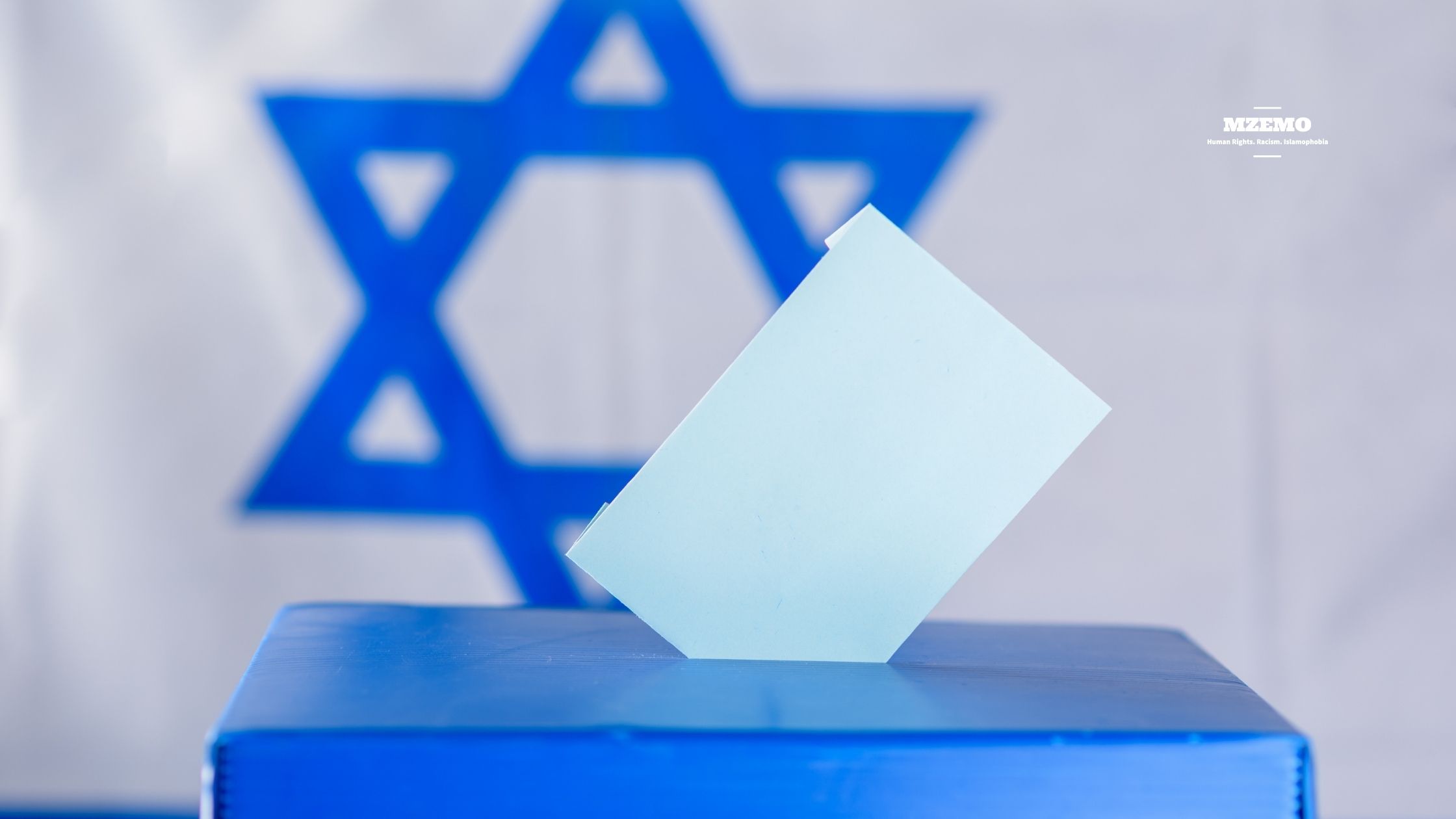
During the much-awaited elections, Israel has voted, but the future of its government remains unresolved. The recent Israeli elections denied Genocidal Prime Minister Benjamin Netanyahu’s allies a clear parliamentary majority. While parties representing Palestinian citizens achieved an unprecedented result. Yet millions of Palestinians in Gaza and the occupied West Bank had no ballot in an election whose consequences will reach deeply into their daily lives.
Let’s dig into more details of the 2026 Israeli elections and their impacts on Palestinian life and statehood.
Israel’s 2026 Elections End Without a Clear Majority
The final election results, released on October 30, gave Netanyahu’s bloc 53 seats in the 120-member Knesset, eight short of the 61 needed to govern. The main opposition grouping, led by former military chief Gadi Eisenkot, received 48, while Arab-led parties secured 19.
Netanyahu’s Likud remained the largest individual party with 27 seats. On the other hand, Eisenkot’s Yashar won 21, and turnout reached around 80%, the highest in decades.
The result leaves several routes to government formation. Negotiations could involve cooperation across existing blocs, support from Arab-led lawmakers, or renewed elections if successive attempts fail. Genocidal criminal Netanyahu remains prime minister while the constitutional process continues.
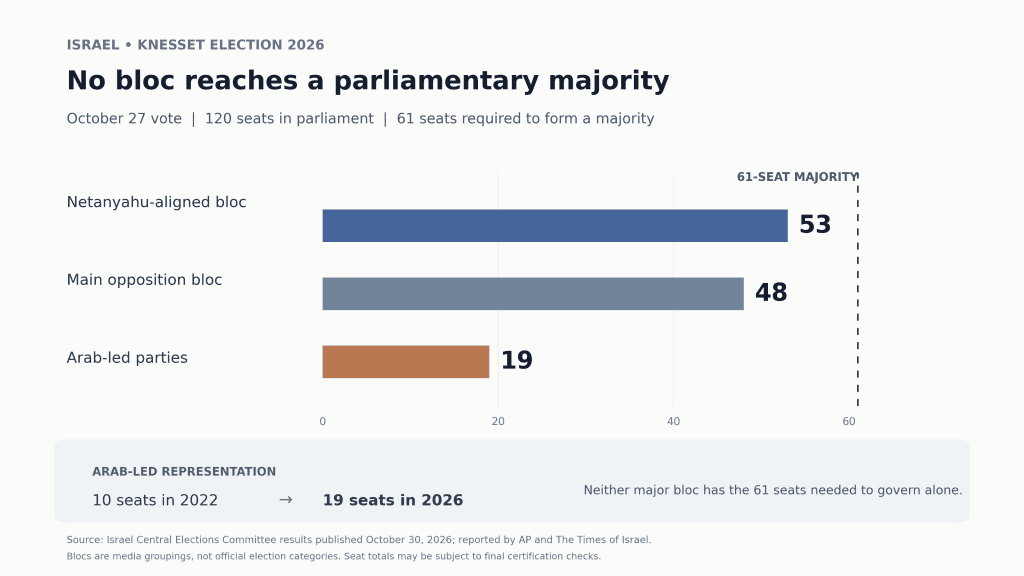
Palestinian Citizens Secure a Historic 19 Seats
The most striking and unprecedented change came from Palestinian citizens, whose political representation rose sharply. The Joint List won 11 seats and Ra’am eight, exceeding the previous Arab-led parliamentary high of 15 in 2020.
Ultimately, their electoral success was not simply a contest between Netanyahu and Eisenkot. Voters and community leaders also described concerns over violent crime, discrimination, public investment and equality, alongside the destruction in Gaza and the future of Palestinian statehood.
However, parliamentary numbers do not automatically translate into governing influence. Joint List leader Yousef Jabareen expressed willingness to support an Eisenkot-led minority administration from outside, while Ra’am leader Mansour Abbas indicated greater openness to participation.
Eisenkot had ruled out an alliance with Arab-led parties during the campaign. Right-wing opposition leader Avigdor Lieberman subsequently rejected such cooperation.
Palestinian votes have become central to the parliamentary balance, while their representatives still face barriers to joining a government.
Different Leaders, Shared Opposition to Palestinian Statehood
Although Netanyahu and Eisenkot differ over settlement policy, their positions on Palestinian self-determination have significant similarities.
Both oppose establishing an independent Palestinian state and insist that Israel retain overarching and illegal security control between the Jordan River and Mediterranean Sea. Both have said Israeli forces should not withdraw fully from Gaza.
Netanyahu’s governing partners include politicians advocating annexation of occupied West Bank territory. His administrations have overseen extensive settlement growth, including hundreds of unauthorized outposts.
Apparently, Eisenkot is opposing unauthorized settlement construction, settler violence, and development in the sensitive E1 area, which could separate East Jerusalem from much of the West Bank.
These differences matter a lot for communities threatened by land seizures or restricted movement. They do not, however, amount to a commitment to Palestinian sovereignty.
So, the election raises questions about actual policies, not only the identity of the next prime minister.
Netanyahu’s ICC Arrest Warrant Keeps Accountability in Focus
On November 21, 2024, the International Criminal Court issued arrest warrants for genocidal criminal Netanyahu and former defence minister Yoav Gallant.
Judges found reasonable grounds to believe they bore responsibility for alleged genocidal war crimes and crimes against humanity, including starvation as a method of warfare, persecution, and murder.
Separate proceedings brought by South Africa before the International Court of Justice concern evidence of genocide in Gaza. Consequently, the ICJ has ordered provisional measures against the genocide.
Millions of Palestinians Remain Excluded From the Ballot
Millions living under illegal Israeli control in Gaza and the occupied West Bank cannot contribute to the election that most affects their lives. Most Palestinians in occupied East Jerusalem also lack parliamentary voting rights because they do not hold Israeli citizenship.
Yet decisions made by Israeli governments shape military operations, settlement development, border access, and the movement of innocent Palestinians and essential supplies.
Amnesty International highlighted this voting-rights disparity before the election.
Unfortunately, the humanitarian consequences are substantial. The October UN investigation reported 34,176 Palestinians still displaced in the West Bank following brutal military operations that began in January 2025.
The recent military lockdown in Hebron, which displaced thousands more, illustrates how political decisions reach directly into Palestinian homes and neighborhoods.
What Comes Next for Israel and Palestinian Rights?
Election results are due to be presented to genocidal President Isaac Herzog on November 4, followed by consultations on government formation. The new Knesset is scheduled to convene on November 10.
For Palestinians, the meaningful measure of any administration will be its actions. Whether the ceasefire violations in Gaza stop or not? Whether Israeli leadership understands the sensitivity of the issue of Palestinian statehood or not? And whether civilians are protected, restrictions eased, settlements addressed, and international legal obligations respected.
-
 Featured3 years ago
World passively watching as Israel perpetrates open-ended massacre in Gaza
-
Featured4 years ago
Argentina wins the World Cup; are there any other winners?
-
Featured3 years ago
Israel is Hiding Crucial Demographic Facts About Palestinians
-
Featured5 years ago
History of the Ottoman Empire
-
Featured4 years ago
Christian militia infiltrate Lebanon
-
Featured6 years ago
“Do Not Waste Water Even If You Were at a Running Stream” Prophet Muhammad
-
Featured3 years ago
Muhammed: The Greatest Man to walk on Earth
-
Featured4 years ago
World Leaders Remain Silent Over Human Rights Violations in the UAE