Connect with us

Featured

How to Deal with Teenagers?

Published

on

Teenage is a dangerous stage in the human age, yet Islam has come with a number of morals that protect from its spoils and evils.

In this article, we will be introducing a story from a mother that narrates her story with her teenage boy. This story will spot the light on many issues that face lots of parents with their children at this dangerous age.

In the end, the answer will be concluded according to the Islamic virtues and morals. In which we will be learning the right ways to deal with the youth in this dangerous stage of age

Story

I send you my question and my complaint, and I ask you to give me an extended answer: –

I am a married woman, God gave me one son, who is now fourteen years old, and I have 4 daughters. My husband is in prison due to debt and may spend years before he gets out. My problem is with my son who has started to disobey me and started making friendships with bad companions. Due to the absence of his father: we were forced unanimously-by his father and uncles – to give him a phone; because his school was far away; and because when he comes down to pray, he is always late home, and ask him to come back home. Also, so that his uncles can check on him constantly

Then my son asked for a phone with a camera and Bluetooth, I refused and insisted. But his uncles gave him money to buy a cell phone with a camera. Since then, I’ve begun suffering. After a while I discovered bad clips on his phone, I spoke to his father and consulted some good people who gave advice about taking the phone away from him.

Some of them said that taking the phone away from their son will make the boy lose confidence in himself, which is wrong, so we gave him back his phone. My son has locked his phone with a lock. Then he began to evade prayers, lie in the simplest things until he became famous for lying among family members and our relatives.

As far as we seek to get closer to him, as far as he departs from us. His uncles were cooperating with me, but they live far away from us. They can’t keep an eye on him at all, yet his uncle always tells me: leave him and help him to trust in himself. I hope that you will guide me, guide me, and pray for me and my son that God will fix and guide him.

By following the Islamic techniques in raising children most of the teenager’s problems would haven’t exist.

How to prepare your child to be a good teenager

Teenage indicates the approach of puberty. This stage is a dangerous stage, and Islamic law has very wise provisions to prevent danger before it occurs:

  • Raising kids on good morals and memorizing the Qur’an at an early age.

This would purify his heart, especially if he memorized the book of Allah before becoming a teenager. And there is no doubt that he will choose to go to mosques instead of bad places.

  •  Teaching children to start praying at the age of seven, and make sure he is doing it right at ten.

Muslims say in prayers what is in the Qur’an. Praying cleans the heart and actions of the young man by obeying Allah. And praying is easier if the kid performs prayer in the mosque with his father, brother, or uncle.

  • Separate children rooms from age 10.

It is at this age, the penchant between both gender begins, and this provision will cut off the opportunities for friction that generate lust.

  •  Choose a good company.

If parents take good care of their children’s company and choose it well. It will save them great time and effort, for a good company will only lead to good acts, and a bad companion will lead him to evil.

  • Encourage marriage.

Our Prophet Muhammad peace be upon him addressed them youth. So, addressing them youth has a clear indication that marriage will preserve their gaze from being released in Haram, and to preserve their vulgarity to be placed in Haram.

  • A void time waster and fill their time with good skills and sports

Empty time means empty mind, therefore, whatever the circumstances are give them something useful to do.

What we mentioned earlier shows the extent of the parent’s tolerance for the condition of their child in the period of teenage, or puberty, and according to their negligence and lack of it. The Muslim may do his best to guide his child and the result is not satisfactory, and this is no sin on him since the guidance is in the hands of Allah Almighty.

Continue Reading

Featured

Hebron Under Siege: Thousands Displaced as Israel Tightens Its Grip on the West Bank

Published

on

Hebron-Under-Siege-Thousands-Displaced-as-Israel-Tightens-Its-Grip-on-the-West-Bank

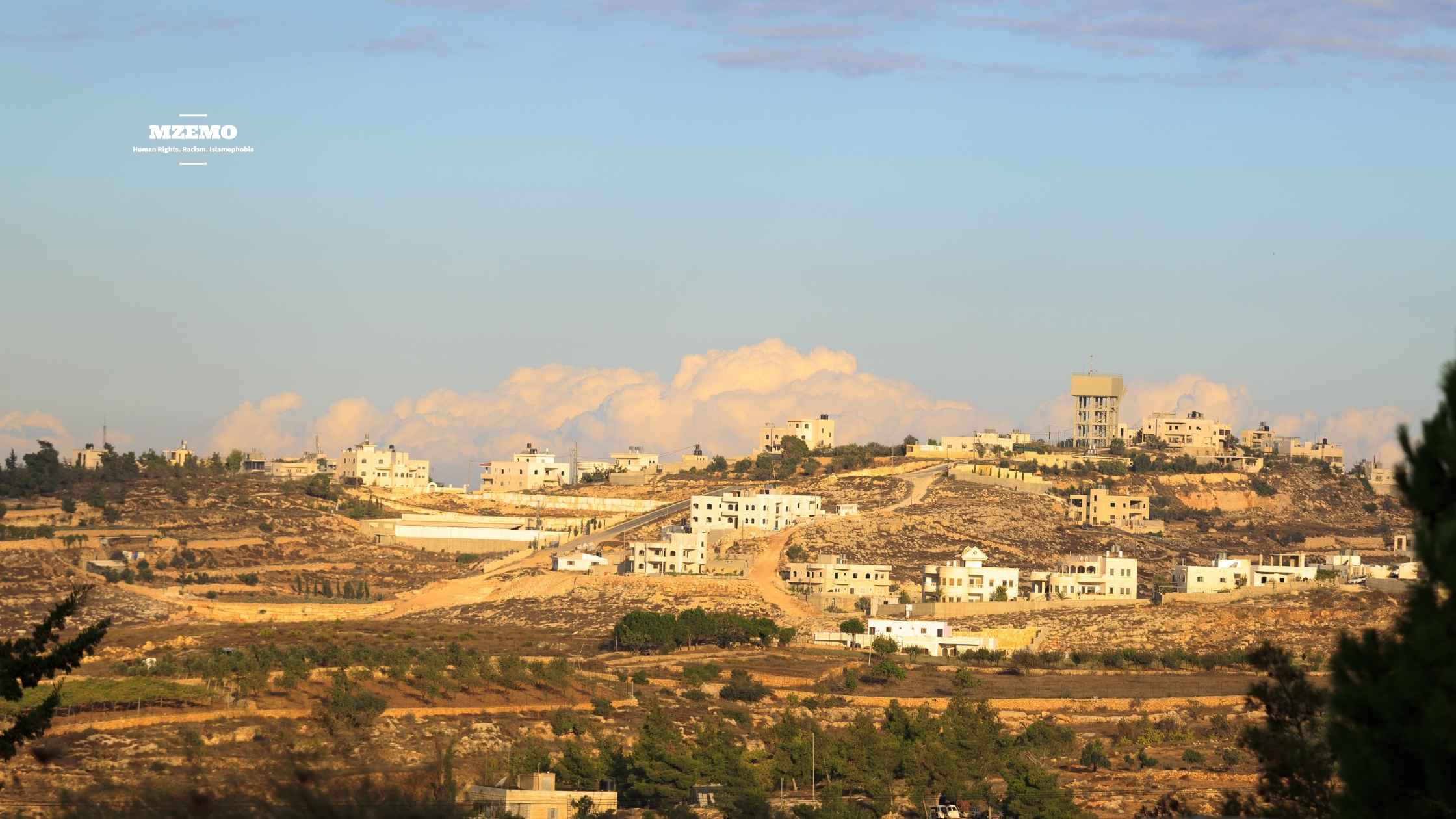
For a Palestinian family in Hebron, the distance between home and safety can now be an Israeli military checkpoint. Since October 23, Israeli troops have illegally sealed neighborhoods, ordered evacuations, and conducted raids across the occupied West Bank city.

By the end of October 2026, more than 3000 residents have been displaced, while thousands have lost access to their homes over an alleged attack they did not commit.

How Hebron’s October Lockdown Began

On October 23, two Israeli soldiers died at a checkpoint near Hebron. Israeli forces launched an extensive operation, imposing road closures and searching homes.

Israel covers this genocidal operation by describing it as a targeted effort, but in reality, it is actually targeted at innocent Palestinians. The residents are not being provided with exit routes to completely cut them off from the world.

The restrictions reached considerably further than the suspects’ homes. Residents of Ein Deir Bahah and Jildah were instructed through loudspeakers to evacuate. Soldiers also took over vacated houses for military use. By October 29, nearly every main entrance to Hebron remained closed, with limited exceptions for essential supplies and municipal vehicles.

On October 31, credible reports described renewed military restrictions in Ein Deir Bahah, deepening uncertainty over when families could return.

Thousands Displaced, Homes and Businesses Demolished

The latest UN humanitarian assessment recorded displacement from an area covering roughly 350 dunums. Most families had to seek shelter with relatives, while the number remaining inside closed neighborhoods remains unclear. Temporary shelter, however, offers little certainty about work, belongings or the possibility of returning home.

In Farsh al Hawa, Israeli authorities demolished an inhabited three-storey building, more than five commercial structures and a water cistern, citing permit violations and security concerns. The demolitions directly displaced a family of seven, including three children, while affecting another 51 people. Some destroyed premises supported families’ livelihoods. Water tanks, vehicles and goods were also reportedly damaged or confiscated.

Ultimately, a Gaza-like situation is being created in Hebron by the Israeli military.

Hebron Was Already a City Divided by Checkpoints

The latest operation was imposed on a city with decades of restrictions. Under the 1997 Hebron Protocol, roughly 80% of Hebron, known as H1, came under Palestinian Authority administration. However, Israel retains control over H2 and much of H1 as well.

An April 2026 UN survey counted 101 movement obstacles in H2, including illegal Israeli checkpoints and road barriers. Access to some neighborhoods has long depended on residency registration and restricted hours. The surroundings of the Ibrahimi Mosque, central to Hebron’s religious heritage, have likewise been shaped by these divisions.

UN Raises the Alarm Over Collective Punishment

UN human rights chief Volker Türk called for this illegal operation to end on October 26, warning that sweeping measures appeared punitive and raised concerns about disproportionate force. Threats to clear entire neighborhoods also raised concerns about ethnic cleansing. Although his warning was not a court verdict, it demanded urgent scrutiny.

In fact, international humanitarian law prohibits collective punishment. Civilians cannot be penalized simply because other people committed an attack.

Moreover, the wider West Bank context is troubling. UN monitors recorded 397 settler attacks causing casualties or property damage during October 2026, the highest monthly total since their records began in 2006.

The International Court of Justice’s July 2024 advisory opinion also found Israel’s continued presence in occupied Palestinian territory unlawful.

For Hebron’s Families, Return Is the Real Test

Israel wants to illegally grab all the Palestinian land, as it has been doing since the Nakba.

Reopening Israeli checkpoints will not instantly restore the lost days of schooling, interrupted treatment, or ruined Palestinian businesses. Displaced families need safe access to their homes with peace and tranquility.

Hebron’s latest ordeal shows how an absurd Israeli operation described as temporary can place an entire community’s ordinary life on hold. Palestinian civilians deserve safety, freedom of movement, and dignity. Their rights cannot be made conditional on the next Israeli military announcement.

Continue Reading

Featured

Israel’s Election Deadlock: Netanyahu’s Political Future and the Fight for Palestinian Rights

Published

on

Israels-Election-Deadlock-Netanyahus-Political-Future-and-the-Fight-for-Palestinian-Rights

During the much-awaited elections, Israel has voted, but the future of its government remains unresolved. The recent Israeli elections denied Genocidal Prime Minister Benjamin Netanyahu’s allies a clear parliamentary majority. While parties representing Palestinian citizens achieved an unprecedented result. Yet millions of Palestinians in Gaza and the occupied West Bank had no ballot in an election whose consequences will reach deeply into their daily lives.

Let’s dig into more details of the 2026 Israeli elections and their impacts on Palestinian life and statehood.

Israel’s 2026 Elections End Without a Clear Majority

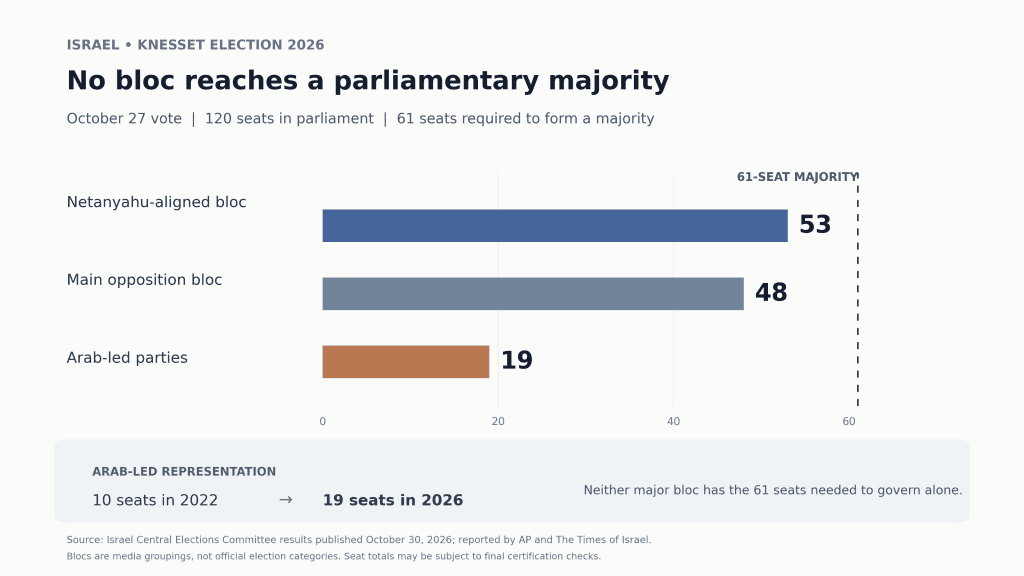
The final election results, released on October 30, gave Netanyahu’s bloc 53 seats in the 120-member Knesset, eight short of the 61 needed to govern. The main opposition grouping, led by former military chief Gadi Eisenkot, received 48, while Arab-led parties secured 19.

Netanyahu’s Likud remained the largest individual party with 27 seats. On the other hand, Eisenkot’s Yashar won 21, and turnout reached around 80%, the highest in decades.

The result leaves several routes to government formation. Negotiations could involve cooperation across existing blocs, support from Arab-led lawmakers, or renewed elections if successive attempts fail. Genocidal criminal Netanyahu remains prime minister while the constitutional process continues.
Palestinian Citizens Secure a Historic 19 Seats

The most striking and unprecedented change came from Palestinian citizens, whose political representation rose sharply. The Joint List won 11 seats and Ra’am eight, exceeding the previous Arab-led parliamentary high of 15 in 2020.

Ultimately, their electoral success was not simply a contest between Netanyahu and Eisenkot. Voters and community leaders also described concerns over violent crime, discrimination, public investment and equality, alongside the destruction in Gaza and the future of Palestinian statehood.

However, parliamentary numbers do not automatically translate into governing influence. Joint List leader Yousef Jabareen expressed willingness to support an Eisenkot-led minority administration from outside, while Ra’am leader Mansour Abbas indicated greater openness to participation.

Eisenkot had ruled out an alliance with Arab-led parties during the campaign. Right-wing opposition leader Avigdor Lieberman subsequently rejected such cooperation.

Palestinian votes have become central to the parliamentary balance, while their representatives still face barriers to joining a government.

Different Leaders, Shared Opposition to Palestinian Statehood

Although Netanyahu and Eisenkot differ over settlement policy, their positions on Palestinian self-determination have significant similarities.

Both oppose establishing an independent Palestinian state and insist that Israel retain overarching and illegal security control between the Jordan River and Mediterranean Sea. Both have said Israeli forces should not withdraw fully from Gaza.

Netanyahu’s governing partners include politicians advocating annexation of occupied West Bank territory. His administrations have overseen extensive settlement growth, including hundreds of unauthorized outposts.

Apparently, Eisenkot is opposing unauthorized settlement construction, settler violence, and development in the sensitive E1 area, which could separate East Jerusalem from much of the West Bank.

These differences matter a lot for communities threatened by land seizures or restricted movement. They do not, however, amount to a commitment to Palestinian sovereignty.

So, the election raises questions about actual policies, not only the identity of the next prime minister.

Netanyahu’s ICC Arrest Warrant Keeps Accountability in Focus

On November 21, 2024, the International Criminal Court issued arrest warrants for genocidal criminal Netanyahu and former defence minister Yoav Gallant.

Judges found reasonable grounds to believe they bore responsibility for alleged genocidal war crimes and crimes against humanity, including starvation as a method of warfare, persecution, and murder.

Separate proceedings brought by South Africa before the International Court of Justice concern evidence of genocide in Gaza. Consequently, the ICJ has ordered provisional measures against the genocide.

Millions of Palestinians Remain Excluded From the Ballot

Millions living under illegal Israeli control in Gaza and the occupied West Bank cannot contribute to the election that most affects their lives. Most Palestinians in occupied East Jerusalem also lack parliamentary voting rights because they do not hold Israeli citizenship.

Yet decisions made by Israeli governments shape military operations, settlement development, border access, and the movement of innocent Palestinians and essential supplies.

Amnesty International highlighted this voting-rights disparity before the election.

Unfortunately, the humanitarian consequences are substantial. The October UN investigation reported 34,176 Palestinians still displaced in the West Bank following brutal military operations that began in January 2025.

The recent military lockdown in Hebron, which displaced thousands more, illustrates how political decisions reach directly into Palestinian homes and neighborhoods.

What Comes Next for Israel and Palestinian Rights?

Election results are due to be presented to genocidal President Isaac Herzog on November 4, followed by consultations on government formation. The new Knesset is scheduled to convene on November 10.

For Palestinians, the meaningful measure of any administration will be its actions. Whether the ceasefire violations in Gaza stop or not? Whether Israeli leadership understands the sensitivity of the issue of Palestinian statehood or not? And whether civilians are protected, restrictions eased, settlements addressed, and international legal obligations respected.
Continue Reading

Featured

Beyond Gaza: How Israel’s Expanding Wars Are Devastating the Middle East

Published

on

Beyond-Gaza-How-Israels-Expanding-Wars-Are-Devastating-the-Middle-East

In Southern Lebanon, families can see the hills surrounding their villages but cannot go home. Israeli soldiers still occupy nearby ground, and houses continue to disappear beneath explosives and bulldozers. When it comes to Syria, farmers face Israeli checkpoints on familiar land. Farther east, Iran is living with the consequences of an unprovoked conflict that was launched by Israel and the United States together.

Though the conflicts differ, they raise one urgent question: How far might Gaza’s genocide, destruction, and displacement spread?

Gaza’s Genocide Has Become a Regional Warning

The scale of devastation in Gaza provides the clearest reason to take that question seriously. Israel’s military campaign has devastated hospitals and homes and repeatedly displaced innocent Palestinian families. Even the October 2025 ceasefire has not brought an end to these lethal, genocidal attacks.

The United Nations Commission of Inquiry’s findings addressed killings, serious harm and the deliberate creation of destructive living conditions, alongside evidence of genocidal intent.

Israel is looking to grab regional power. To make a greater Israel, it can cross any boundaries. The current Middle East war and the situation in Gaza and the West Bank are manifestations of Israel’s heinous designs to obliterate the region.

Lebanon’s Yellow Line Leaves Villages Beyond Reach

Unfortunately, Southern Lebanon offers the most disturbing comparison. Israel’s renewed invasion and bombardment during this year is a reflection of how far it can reach. The ensuing fighting displaced more than 1.2 million people in Lebanon.

However, a June framework for phased Israeli withdrawal promised a path towards restoring Lebanese control. Instead, troops retained positions behind a so-called Yellow Line, a term also used for Israeli-controlled territory in Gaza. An investigation also documented continued demolitions and described around 50 frontline villages left devastated.

In West Zawtar, about 70 families had returned by early October, despite damaged homes and missing services. From across the valley, residents watched Israeli forces demolish buildings in East Zawtar. Their farmers struggled to access olive groves, while surveillance drones circled overhead. It is unfortunate to see how a supposed model for withdrawal had become a landscape of uncertainty.

Syria Faces Raids, Detentions and a New Occupation

In Syria, Israel expanded its military presence after Bashar al-Assad’s government fell in December 2024. Troops entered the UN-monitored buffer zone beside the occupied Golan Heights and illegally established positions farther into southern Syria.

Residents of Quneitra and Daraa now describe raids, restricted roads, detentions, and damaged farmland. Syrians also protested incursions near the Golan Heights after reports of bulldozed olive groves and new checkpoints by Israel. For farming families, restricted fields eventually mean lost livelihoods.

A September UN investigation report identified 49 Syrians, including two children, illegally detained by Israeli forces and transferred across the border. Investigators warned that some actions could constitute war crimes. Israel says its deployment is temporary, necessary for security, and carries no territorial ambition. Syrian authorities and the UN dispute the legitimacy of the incursions.

Iran’s War Spreads Its Costs Beyond the Battlefield

On February 28, 2026, Israel and the United States jointly launched numerous strikes against Iran, beginning an unprovoked conflict that has shaken the wider region. Iranian counterattacks followed against US assets and infrastructure in Gulf countries, while fighting intensified in Lebanon.

The consequences reach well beyond the armed forces as Iranian families have endured casualties, damaged infrastructure and mounting economic pressure. International shipping through the Strait of Hormuz has been largely disrupted, pushing energy prices higher and exposing households throughout the region to rising costs.

This was eventually an unprovoked war on Iran, started by Israel and supported by the United States. After igniting the flames, Israel wants to gradually get away from this but is still passively supporting the wider conflict between Iran and the United States.

Yemen and Saudi Arabia Are Drawn Deeper Into the Crisis

The Israel-led war’s ripple effects now extend across the Arabian Peninsula. Israel has previously struck Houthi-controlled targets in Yemen, while the Houthis have attacked Israel and commercial shipping. Their separate conflict with Saudi-backed Yemeni forces also began long before the February 2026 assault on Iran.

By October, renewed Houthi missile and drone attacks had prompted Saudi interceptions and emergency alerts. Threats to airports and energy infrastructure are escalating. The renewed fighting also jeopardizes the Bab al-Mandeb shipping route and threatens families in Yemen, already exhausted by years of war.

Though Israel does not directly wage these conflicts, its military confrontation with Iran and allied groups is part of the escalation reshaping this fragile region.

In a nutshell, the evidence from Lebanon and Syria warrants independent investigation, just as the genocide findings in Gaza demand action rather than indifference.

In fact, for families waiting beside demolished villages or fleeing another round of airstrikes, the immediate demand is simpler: safety, the right to return, and a future that is not repeatedly erased by war.

Continue Reading
Advertisement

Trending