Featured
Mahsa Amini: Iranian Women Are Leading an Extraordinary Revolution

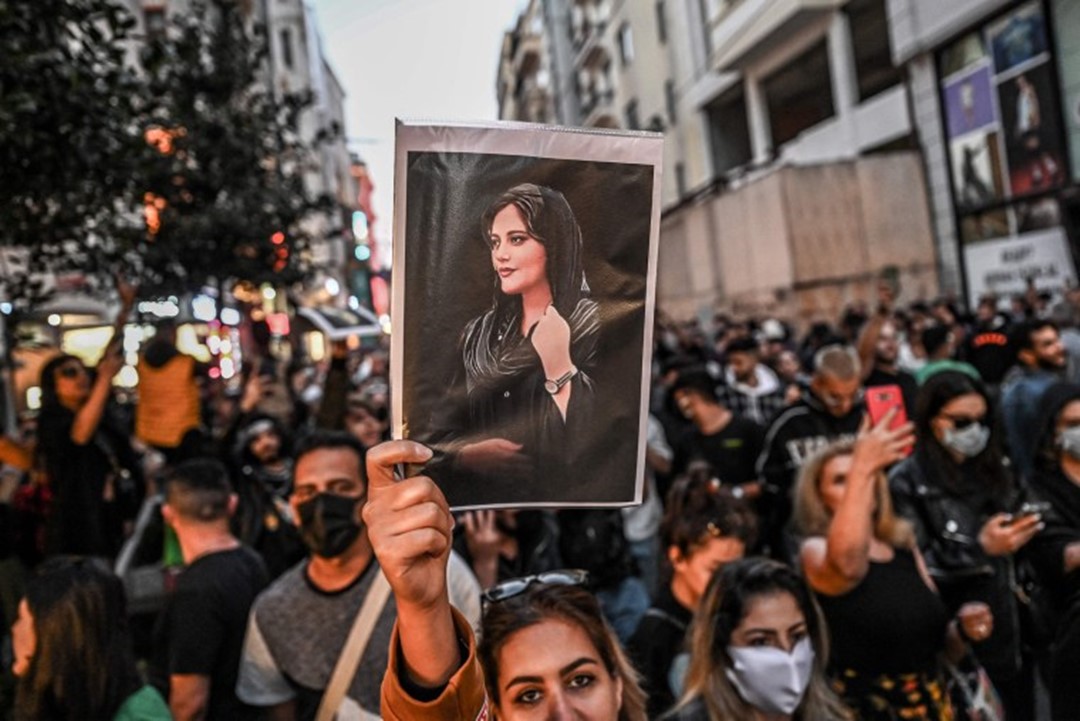
The Death of Mahsa Amini Ignited an Unprecedented Wave of Protests Across Iran
On the 16th of September 2022, Mahsa Amini, a 22-year-old Kurdish-Iranian woman, died in the custody of Iran’s morality police following her arrest for improper wear of hijab. Both Mahsa and her brother were beaten at the time of her arrest.
Iran’s morality police routinely arbitrarily detain women who do not comply with their discriminatory and compulsory veiling laws. The death of Mahsa Amini was the powder keg moment that ignited this most recent uprising resulting in seven weeks of protests. This has been the most significant threat the theocratic Iranian regime has witnessed since the 1979 revolution.
It is becoming apparent that this isn’t about reform; it’s about outright regime change. In the eyes of the Islamic Republic, the compulsory hijab is not just a mere piece of cloth. The hijab is one of the critical pillars of the ideology of this regime.
Women are protesting on the streets, removing their hijabs and setting them on fire while cutting their hair in protest. Many have been arrested and sent to psychological re-education centres, beaten, raped, and murdered. The most unprecedented part of these protests is that they’ve been led by women. This shows how courageous Iranian women are in leading an extraordinary revolution.
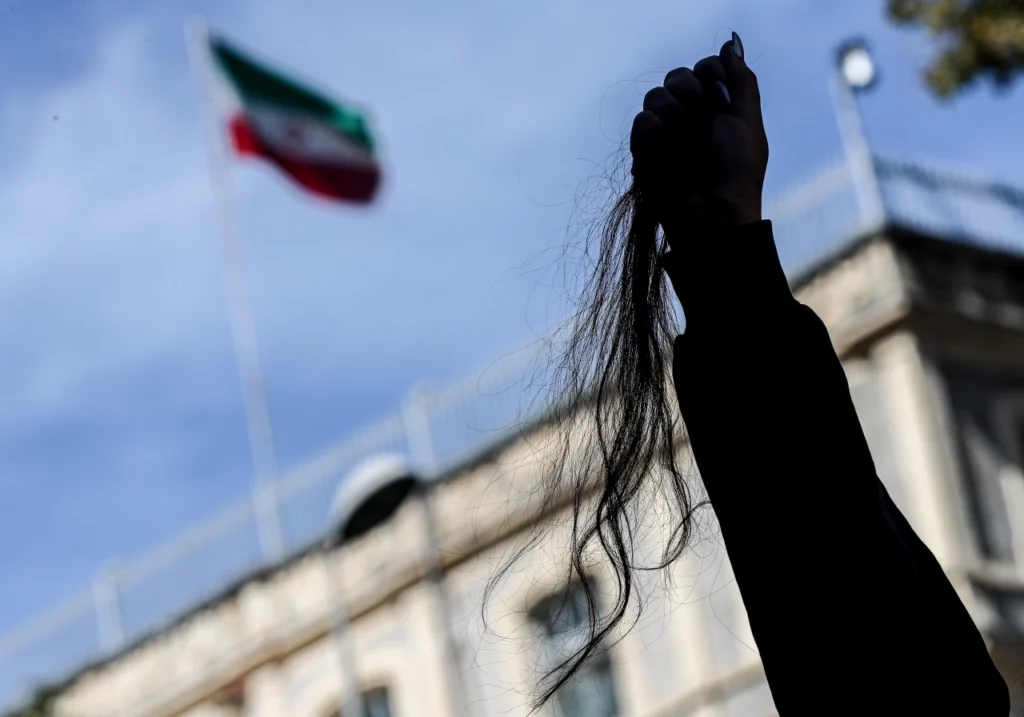
Hundreds Have Been Brutally Murdered By Iranian Police After Masha Amini’s Death
The Islamic Republic does not allow its citizens the right to freedom of peaceful assembly and association. This right is guaranteed under Article 20 of the Universal Declaration of Human Rights.
Instead, the Islamic Republic kills protesters with batons and bullets. As of the 8th of November 2022, the death toll from the Islamic Republic’s crackdown on Iran’s 2022 protests increased to 304 people, including 41 children and 24 women. Repressive regimes lack transparency, so the actual number of protesters killed often goes vastly underreported.
Read also: Death of Mahsa Amini: How Governments Deny Women’s Right to Choice?
A Long History of Women’s Resistance in Iran
Mahsa Amini’s death follows decades of women’s resistance in Iran. Women played a critical role in Iranian society by establishing women’s associations, joining protests and supporting strikes. This is the first time since the inception of the theocracy in 1979 that people openly and fearlessly oppose Supreme Leader Ali Khamenei. Challenging Iran’s supreme leader is one of the most significant revolutions in modern-day history.
Following the Islamic Revolution in 1979, Iranian women launched massive protests after hearing rumours regarding a mandatory hijab mandate. These protests were influential as they postponed its enactment. However, the mandate was eventually instated in 1983. Women showed their strength in actively protesting against the regime.
Comparatively, in recent times the enormous bravery of women like Sepideh Rashno, Mahsa Amini and Nika Shakarami against Iran’s restrictions on women’s rights has sparked a catalyst for change. The Iranian authorities have consistently dealt with waves of mass protests. Including those held in November 2019, January 2020, July 2021, August 2021, November 2021 and May 2022, with a militarized response.
The Establishment of the “Woman-Life-Freedom” Movement
Following the death of Mahsa Amini, Iran has seen the rise of the “Women, Life, Freedom Movement”. This is a widespread protest that has now entered its fourth week. The movement’s slogan is a declaration of opposition to the Islamic Republic, a regime built on anti-woman, pro-martyrdom, and repressive ideologies.
Thousands of Iranians protest against the Islamic regime’s repressive treatment and continuous human rights violations. Iranians are speaking up against the regime carrying signs saying “Death to the dictator”. Young schoolgirls chanted, “we don’t want the Islamic Republic.” In recent weeks, Iranians have been actively fighting against security forces while tearing down billboards and burning pictures of the founder of the Islamic Republic, Ayatollah Khomeini.
Although the protests initially started over the frustration of the mandatory hijab, they developed into representing a much broader movement of overthrowing the entire regime. These restrictions have intensified under President Raisi, who took office in August 2021, leading to further tension among Iranians.
According to the World Economic Forum’s 2022 Global Gender Gap Report, Iran ranks 143 of 146 countries. The Islamic Republic exemplifies why countries with gender-discriminatory laws experience the most significant turmoil, compromising international peace and security.
The Islamic Republic Detained Thousands of Protesters and Activists
Thousands of protesters and human rights activists are now facing unfair trials, with some facing the risk of the death penalty for protesting against Mahsa Amini’s death.
Human Rights Watch has reported on security forces’ unlawful use of excessive or lethal force. Moreover, on October 31, 2022, the Tehran Province’s judiciary held that it had issued approximately 1,000 indictments against protesters and activists.
Furthermore, the Iranian authorities have subjected detainees to various forms of physical and psychological torture and other ill-treatment. Two female detainees arrested in Kurdistan reported that Iranian police tortured them with batons, electric shocks, sexual and verbal assault, and threats.
“Iran’s vicious security apparatus is using every tactic in its book, including lethal force against protesters, arresting and slandering human rights defenders and journalists, and sham trials to crush widespread dissent,”
Tara Sepehri Far, senior Iran researcher at Human Rights Watch.
Iranian authorities have arrested 308 university students and 44 children. Security forces have targeted universities with excessive use of force and arbitrarily detained students.
According to the Human Rights Activists News Agency, the protests have reached 133 cities and 129 universities, as well as several secondary schools.
International Response to Iran’s Uprisings
Solidarity protests in support of Iranian women’s rights have erupted across Europe, the United States, and parts of the Middle East.
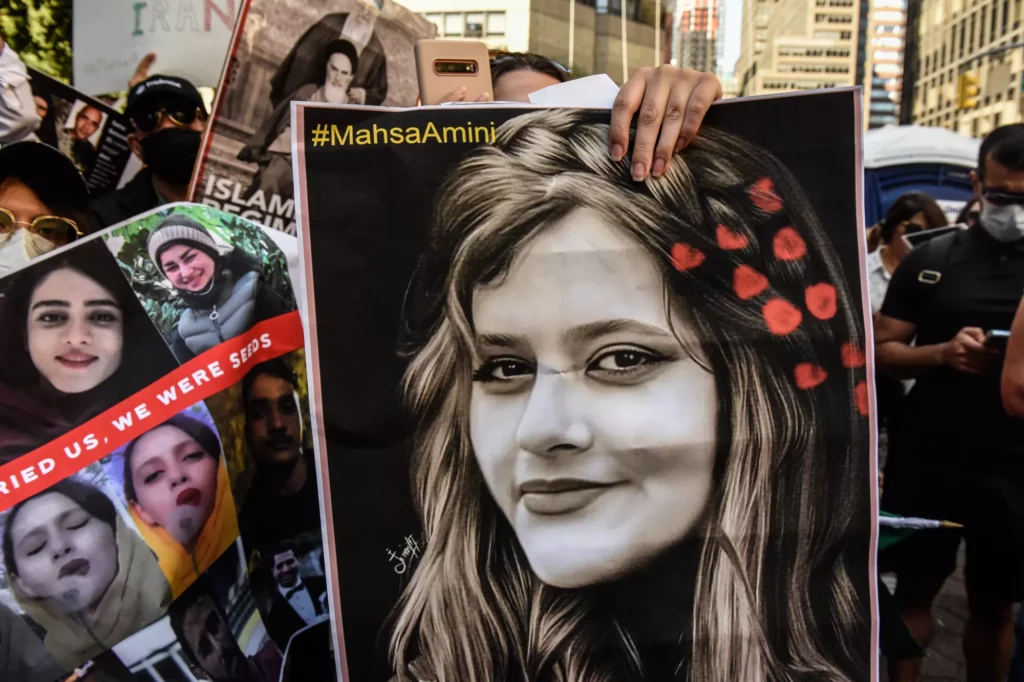
According to Amnesty International, more than one million people across 218 countries have signed their petition. This petition demanded an establishment of an independent UN mechanism to conduct an investigation in Iran. Therefore, this would ensure Iran faces the consequences for committing some of the most serious crimes listed under international law.
Failing to establish accountability encourages impunity, further emboldening the Iranian authorities to continue to intensify human rights violations. The United Nations Human Rights Council should urgently hold a special session on Iran.
Read also: The US and Israel are Weaponizing Iran Protests.
Concluding Thoughts
The protests over Mahsa’s death and the officials’ refusal to be held accountable have resulted in frustration and resentment over the political status quo. This has increased demands for democracy.
It takes immense courage and bravery for any woman to participate in this extraordinary revolution happening in Iran. Young girls risk arrest, school expulsion, and death when exercising their freedom of expression.
The world’s silence on this issue enables continued human rights abuses in Iran. The international community must stand up against the Islamic Republic and demand its adherence to binding human rights obligations.
Politics, money and states’ interests continue to come before human rights. The United Nations has repeatedly failed to adequately address human rights violations committed by authoritarian regimes. Despite this, we must rebuild our trust in this global governance mechanism. The United Nations intends to protect states regardless of geographical borders, race, religion, ethnicity, gender or social class.
This begs the question; will the United Nations stand with the women of Iran in upholding their human rights?






Featured
Gaza on the Brink Again: How the Rafah Border Closure Is Pushing 2 Million People Toward Extreme Hunger


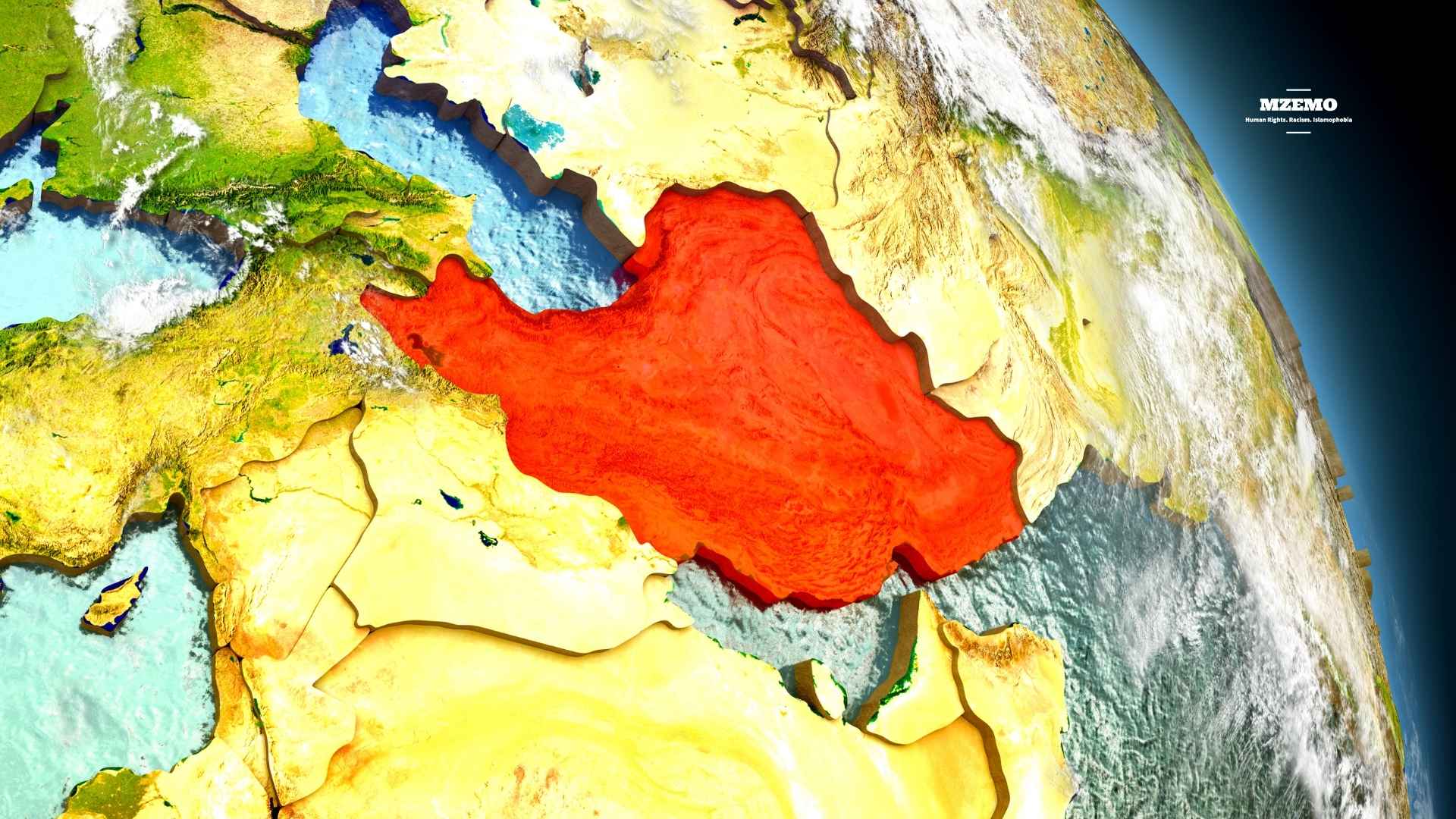
Across the globe, there are two dominating crisis headlines today: Israel’s blatant genocide in Gaza and the ongoing war between Israel-US and Iran. This war is undoubtedly imposed by Israel and the United States, labeling it necessary for peace.
Western governments and media houses frame their policies around the language of “security” and “stability”. There is a pattern of double standards that undermines international law, credibility, and humanity.
On one side stands Gaza, where more than 2.2 million Palestinians are being killed by Israel. It has produced one of the worst humanitarian catastrophes of the 21st Century. On the other hand, stands Iran, a country that is signatory to the Nuclear Non-Proliferation Treaty (NPT) yet faces sanctions, threats, and even attacks on its civilians.
Why are some countries given carte blanche and strategic exceptions while others face relentless punishment?
Gaza: A Genocide in Plain Sight
Since the beginning of Israel’s large-scale assault on Gaza, the humanitarian impact has been staggering. According to Palestinian health authorities and international humanitarian organizations, more than 80,000 Palestinians have been killed, with a large proportion of the victims being women and children.
Entire neighborhoods across Gaza have been reduced to rubble. The United Nations reports that the vast majority of Gaza’s population has been displaced, many of them forced to move multiple times as Israeli military operations expanded across the territory.
This is the purest form of genocide in modern human history. The scale of destruction, starvation, and forced displacement goes far beyond conventional warfare. However, not all media groups are showing the real picture. Western media is showing its unquestioned support for Israel even during the most heinous crimes against humanity.
Western Silence and Political Protection
The United States remains Israel’s closest international ally. According to data from the U.S. Congressional Research Service, Washington provides Israel with approximately $3.8 billion in annual military assistance under long term defense agreements.
Beyond military aid, Western governments have repeatedly shielded Israel from international accountability. In diplomatic arenas such as the United Nations Security Council, attempts to impose sanctions or demand ceasefires have often been blocked or diluted.
This pattern represents a profound contradiction: while Western leaders frequently emphasize human rights and international law, their response to the devastation in Gaza appears far more restrained than in other global conflicts.

Israel’s Nuclear Arsenal: The Middle East’s Open Secret
Another major source of controversy lies in the nuclear dimension of Middle Eastern politics.
Israel is widely believed by international experts to possess between 80 and 200 nuclear warheads, developed through its long-standing nuclear program centered around the Dimona facility in the Negev desert.
Yet Israel maintains a policy known as “nuclear ambiguity” — neither confirming nor denying the existence of its nuclear arsenal.
More importantly, Israel is not a signatory to the Nuclear Non-Proliferation Treaty (NPT), the global framework designed to prevent the spread of nuclear weapons.
Just because it operates outside the NPT system, Israel’s nuclear facilities are not subject to full international inspections by the International Atomic Energy Agency (IAEA).
Despite this reality, Western governments rarely criticize Israel’s nuclear capabilities or call for sanctions related to its weapons program.
Iran and the Nuclear Non-Proliferation Treaty
On the other hand, Iran’s nuclear program exists in a very different legal context.
Unlike Israel, Iran signed and ratified the Nuclear Non-Proliferation Treaty in 1970, which means it is legally permitted to pursue nuclear technology for peaceful purposes such as energy production and scientific research.
Under the NPT framework, Iran’s nuclear facilities are supposed to operate under international monitoring by the International Atomic Energy Agency (IAEA).
Nevertheless, Iran has faced decades of economic sanctions and intense political pressure from Western governments, which argue that its uranium enrichment activities could eventually lead to nuclear weapons development. However, Iranian officials insist that their nuclear program is intended solely for civilian purposes.
Attacks on Iran and the Broader Muslim World
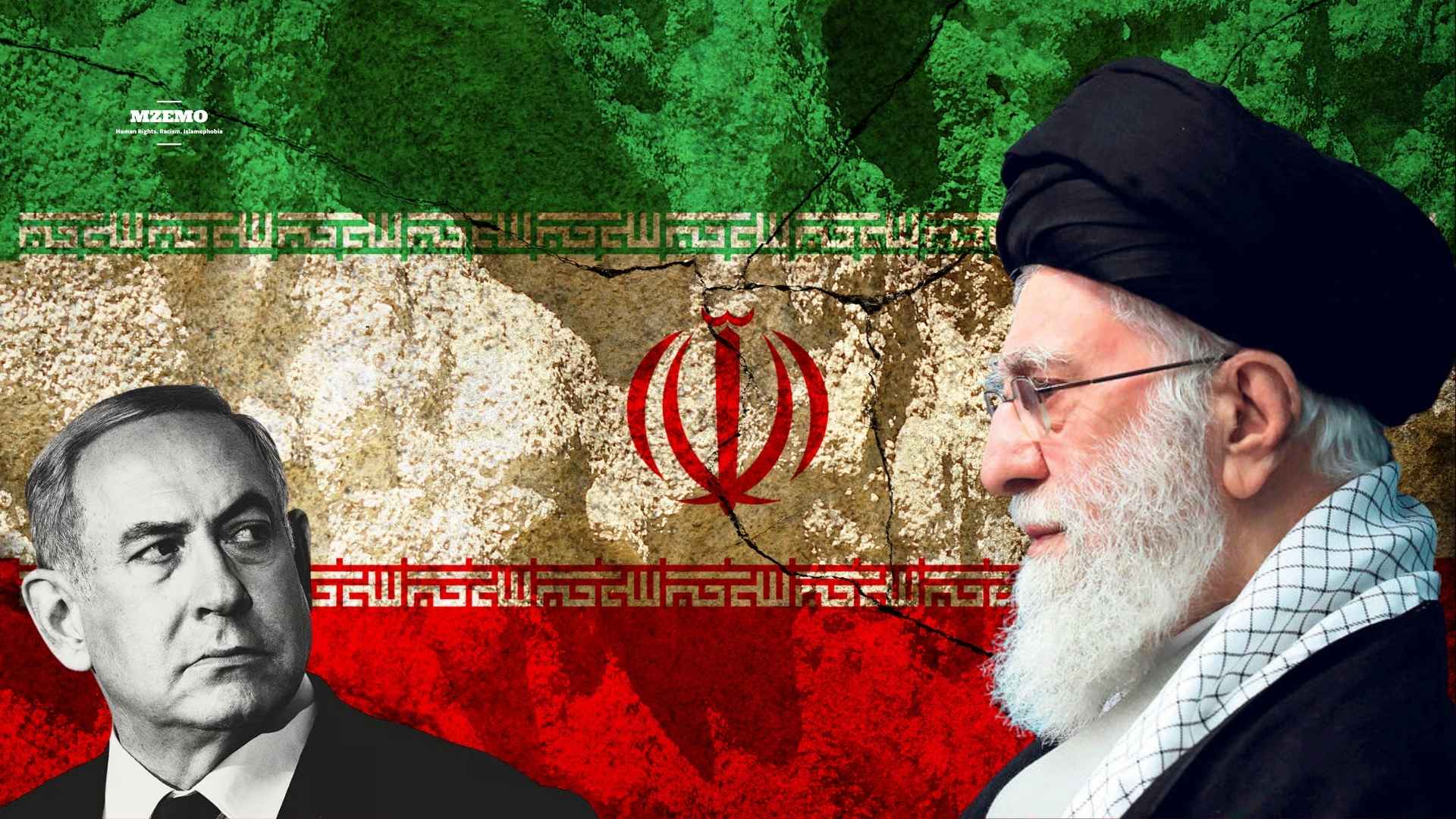
Recent tensions have further escalated the crisis. Israel and the United States have carried out strikes targeting Iranian nuclear facilities, including sites associated with uranium enrichment. The assassination of Iran’s Supreme Leader Ayatollah Ali Khamenei, along with other high-ranking officials show how brutal these strikes are.
Just like in Gaza, Iran’s civilians are also being attacked. One such example is the recent bombing of a girls’ school in Iran in which more than a hundred innocent children and teachers were killed. Such attacks raise serious concerns among international security experts.
Moreover, striking nuclear infrastructure carries enormous risks, including the possibility of radioactive contamination and the potential collapse of global nuclear non-proliferation efforts. Some analysts argue that military attacks on nuclear facilities could actually push targeted states to accelerate weapons development rather than abandon it.
Ultimately, these strikes represent another example of selective enforcement of international norms.
From Gaza to Tehran: A Crisis of Global Credibility
The combined effect of these policies has produced a growing crisis of credibility for the international system.
International law is being applied selectively, enforced strictly against adversaries, while ignored when allies are involved.
From the ruins of Gaza to the nuclear facilities of Iran, the politics of power continue to shape the Middle East in profound ways.
For millions of people across the region, the question is not merely about military strategy or diplomatic rivalry. It is about whether international law truly applies equally to all nations — or whether global justice remains dependent on political alliances.
Until those questions are addressed, the perception of double standards will continue to fuel anger, instability, and distrust across the Middle East and beyond.
Crimes Against Humanity
Shockwaves Across the Gulf: How the US–Israel Strike on Iran Could Redraw the Region
-
 Featured2 years ago
World passively watching as Israel perpetrates open-ended massacre in Gaza
-
Featured3 years ago
Argentina wins the World Cup; are there any other winners?
-
Featured2 years ago
Israel is Hiding Crucial Demographic Facts About Palestinians
-
Featured5 years ago
History of the Ottoman Empire
-
Featured3 years ago
Christian militia infiltrate Lebanon
-
Featured5 years ago
“Do Not Waste Water Even If You Were at a Running Stream” Prophet Muhammad
-
Featured2 years ago
Muhammed: The Greatest Man to walk on Earth
-
Featured4 years ago
World Leaders Remain Silent Over Human Rights Violations in the UAE