Featured
Global Condemnation of India Over Anti-Islam Hate Speech

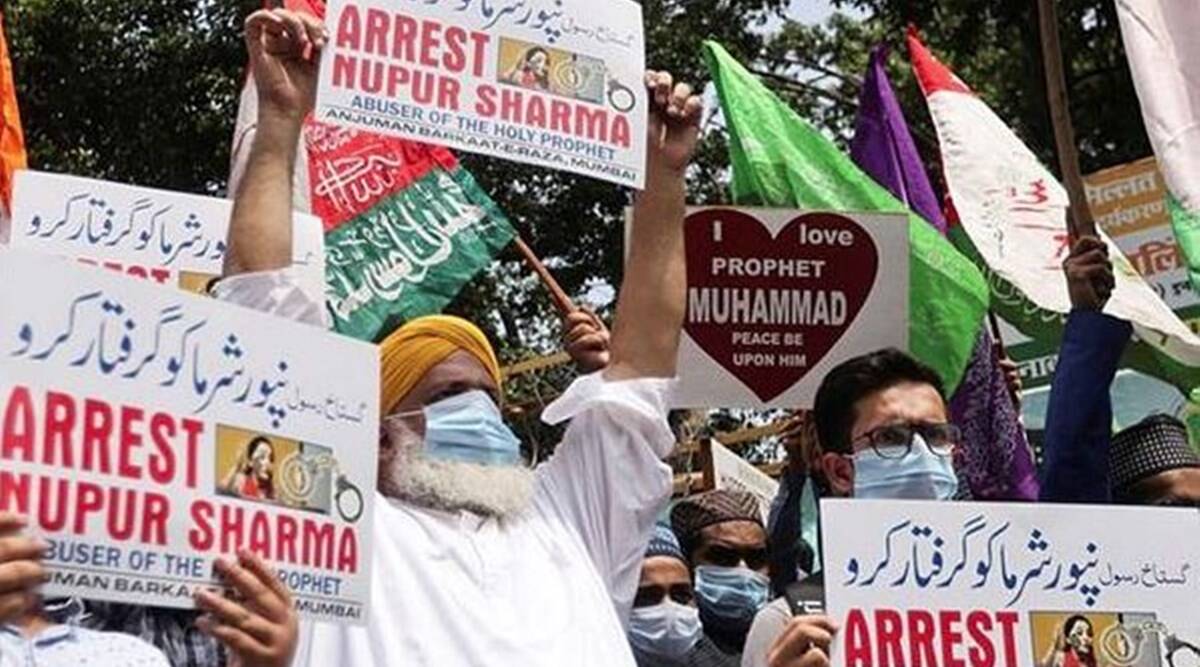
India has been trying hard to pacify the global condemnation and anger of Islamic countries after two senior officials of ruling BJP party has made islamophobic and derogatory remarks against the most cherished figure in Islam-Prophet Muhammad.
Key Points:
- Two high rank officials of India’s ruling party made derogatory remarks against Islam and its most cherished figure, Prophet Muhammad.
- An International condemnation has started over anti-hate speech against Islam. Muslim countries summoned Indian ambassadors to protest against such remarks and called for Indian prime minister to denounce the comments.
- Domestic protests began with slogans and demands to take strict action against the two officials involved and made their arrest.
Nupur Sharma, national spokesperson of ruling Bharatiya Janata Party (BJP) and Delhi media head Naveen Kumar Jindal made insulting comments at a TV debate and Twitter respectively against Muslim worship and Prophet Muhammad. Their comments went viral worldwide with a chorus of diplomatic anger, particularly in Islamic countries.
A Global Outcry
Governments from Saudi Arabia, Iran, Qatar, Kuwait, Afghanistan, Jordan, Indonesia, libya, Oman and Pakistan condemn these comments.
Qatar summoned the Indian ambassador and demanded an apology from the Indian government. Qatar outright rejected and condemned controversial remarks against Prophet Muhammad and expressed the utter disappointment by the State of Qatar.
Similarly, Kuwait also summoned the Indian ambassador and rejected and condemned categorical remarks.
While Pakistan’s prime minister, Shehbaz Sharif says that these comments represent persecution of Muslims and trembling religious freedom in India.
Later, Saudi Arabia and Iran also expressed their annoyance with India against such blasphemous remarks against the messanger of Islam.
UAE and Maldives became the latest partners of India who expressed their denunciation and rejection of the inflammatory comments by the BJP officials. UAE underscores the importance of “preserving and respecting the religious symbols and not violating them, as well as confronting hate speech and violence”.
Response from Indian Governement
In response, BJP sacked both of its officials for their wrongdoing and released a statement saying that it “strongly denounces insults of any religious personalities,”. Kuwait, Qatar and saudi Arabia welcome this action.
India on its part is struggling hard to contain damaging fallouts. There is a widespread condemnation and anger from the gulf, which is also a major trading and energy partner of India. The Government of India says that the comments are made by “fringe elements” and the government has nothing to do with the derogatory remarks. BJP also said “strong action has already been taken against those who made the derogatory remarks”.
Meanwhile Organisation of Islamic Cooperation (OIC) also condemned the insulting comments and presented such incidents in the background of already rising islamophobia. OIC said that such remarks took place in a “context of intensifying hatred and abuse towards Islam in India and systematic practices against Muslims”.
However, spokesperson of foreign ministry of India, Arindam Bagchi “categorically rejected” the comments from OIC’s secretariat. He called them “unwanted” and “narrow-minded”. The ministry said that India accords “highest respect to all religions”.
Deep Rooted Polarisation
Ms. Sharma’s and Mr. Jindal’s remarks represented the deep rooted polarisation in India. As, Muslims in India has been facing anti-muslim critics against them since many years over their food, dress, marriage rights, citizenship status and religious places. Hate speech and attacks on Muslims have been rising continuously.
Violence against Muslims has become very rampant, repeated and tragically very normal and accepted.
While the BJP is condemning the insulting remarks, some of the BJP supporters called the action of suspending Ms. Nupur and Mr. Jindal as a “cowardly” act.
It is shocking and damaging for a country whose persons appointed on positions of responsibility and accountability are indulged in such irresponsible behaviour.
A country whose foundations are based on diversity and secularism can not tolerate communal hatred for long.
Peace must be maintained. Policies and laws should promote equality and freedom to all its citizens irrespective of religion, caste, race, gender and place. It should not be a personal concern of what one should wear and eat, whom one should follow, marry and make reverence or not reverence at all.
People with such a huge population and remarkable diversity can only remain in peace when there exists a respect and tolerance for each other’s religious symbols, choices and freedom of expression.
Outrage in India Over the Insulting Remarks
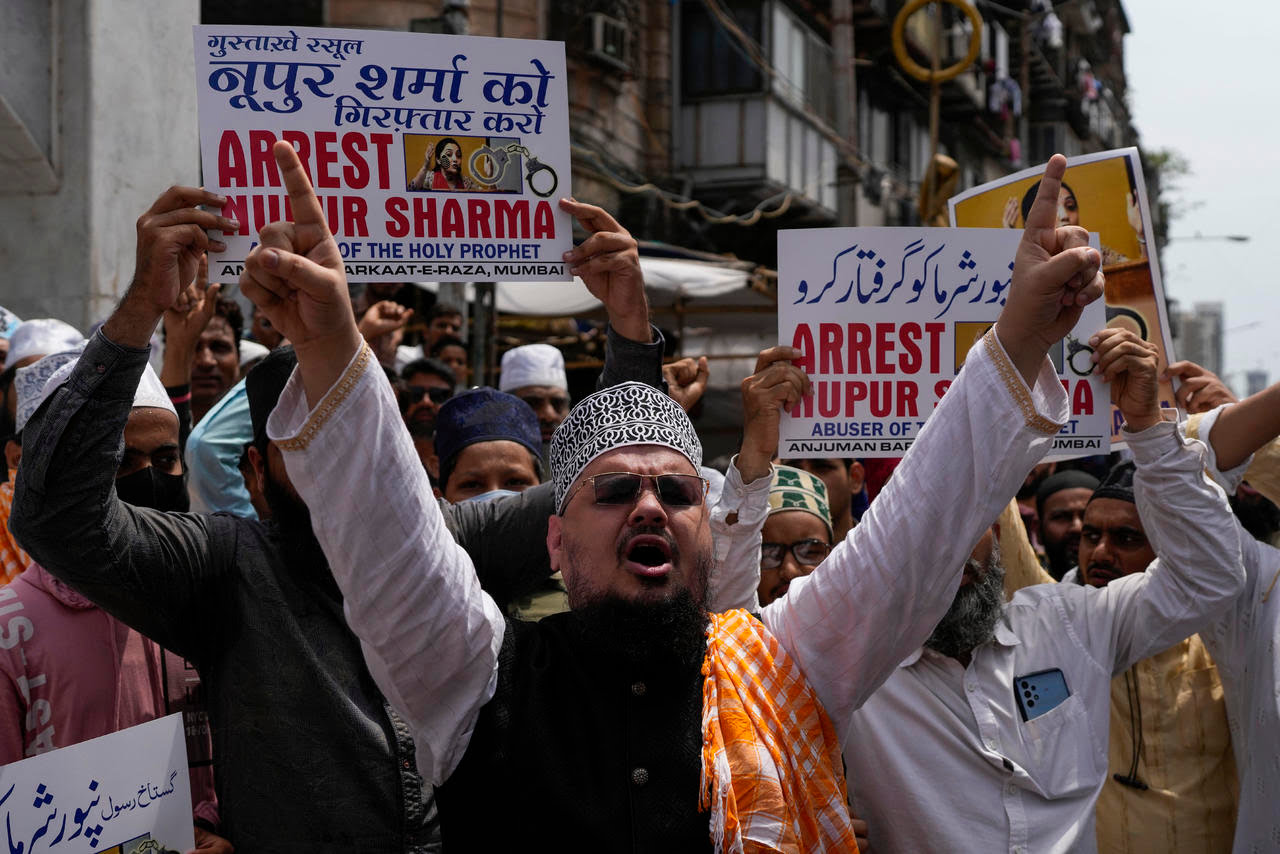
Source: Rafiq Maqbool
Indian Muslims shouting slogans against the insulting references made against Islam and Prophet Muhammad in a protest held in Mumbai, India.
India is facing a domestic outrage too against the insult of Islam. Many Indian cities are witnessing the protests on streets like in Lucknow and Mumbai.
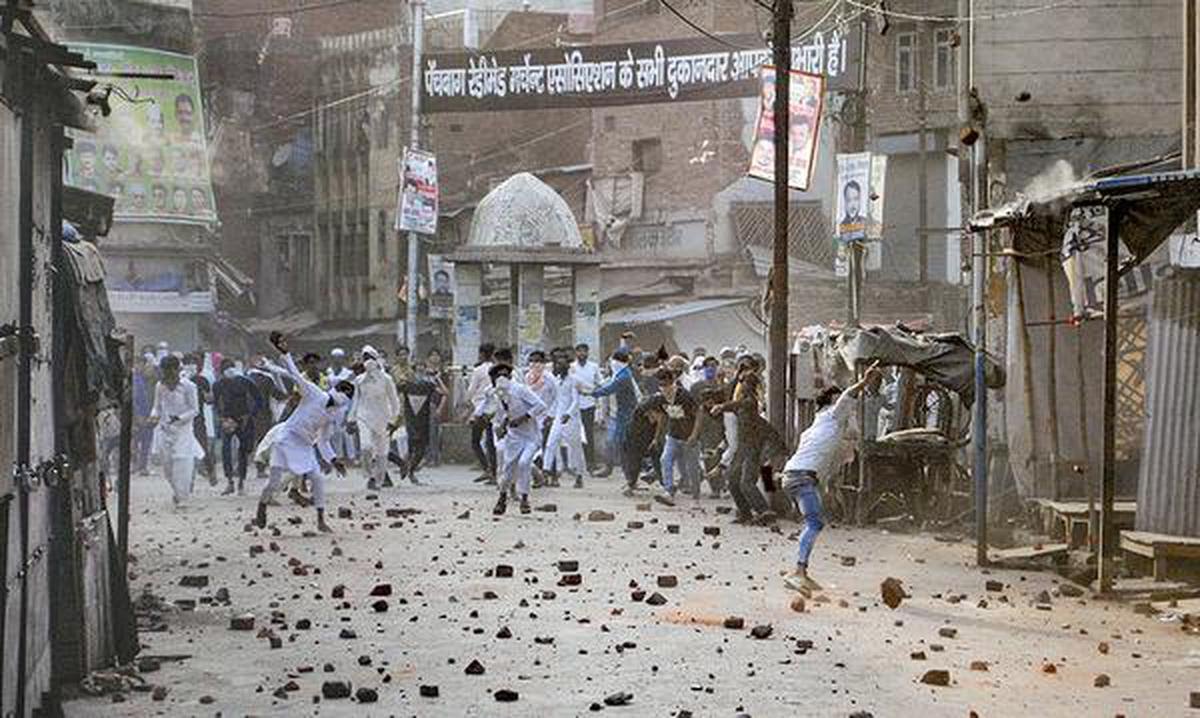
Source: PTI
Stone pelting and violence took place in Lucknow city. Police have arrested 18 people so far.
Meanwhile Ms. Sharma apologised for her comments. She unconditionally withdrew her remarks. She said in a statement released on Twitter that it was never her intention to hurt the religious feelings of anyone.

Possible Fallouts for Indian Trade Relations
India can witness a heightened clash between its strategic partnership with gulf nations for trade and energy and increasing marginalisation and overseeing of hardships of over 200 million Muslim population.
This incident has spurred the traction in gulf nations to boycott Indian products.
Oman’s grand mufti Sheikh Al-Khalili,the chief jurist of Islamic matters, called for complete boycott of Indian products and considered the obscene remarks by Ms. Nupur as a “war against every Muslim.”
Supermarkets in Kuwait begin to remove Indian products from their shelves out of protest.
Undoubtedly, it is not in favour of India when it shared a very cordial relations with energy rich gulf nations for decades. India’s trade with the Gulf Cooperation Council (GCC) stood at a whopping $90 billion. Around 6.5 million Indian population resides and work in these gulf nations. India receives handsome remittances from the gulf region.
Present government on its part invested hugely to promote and strengthen the relations with the gulf countries which are major energy suppliers of India.
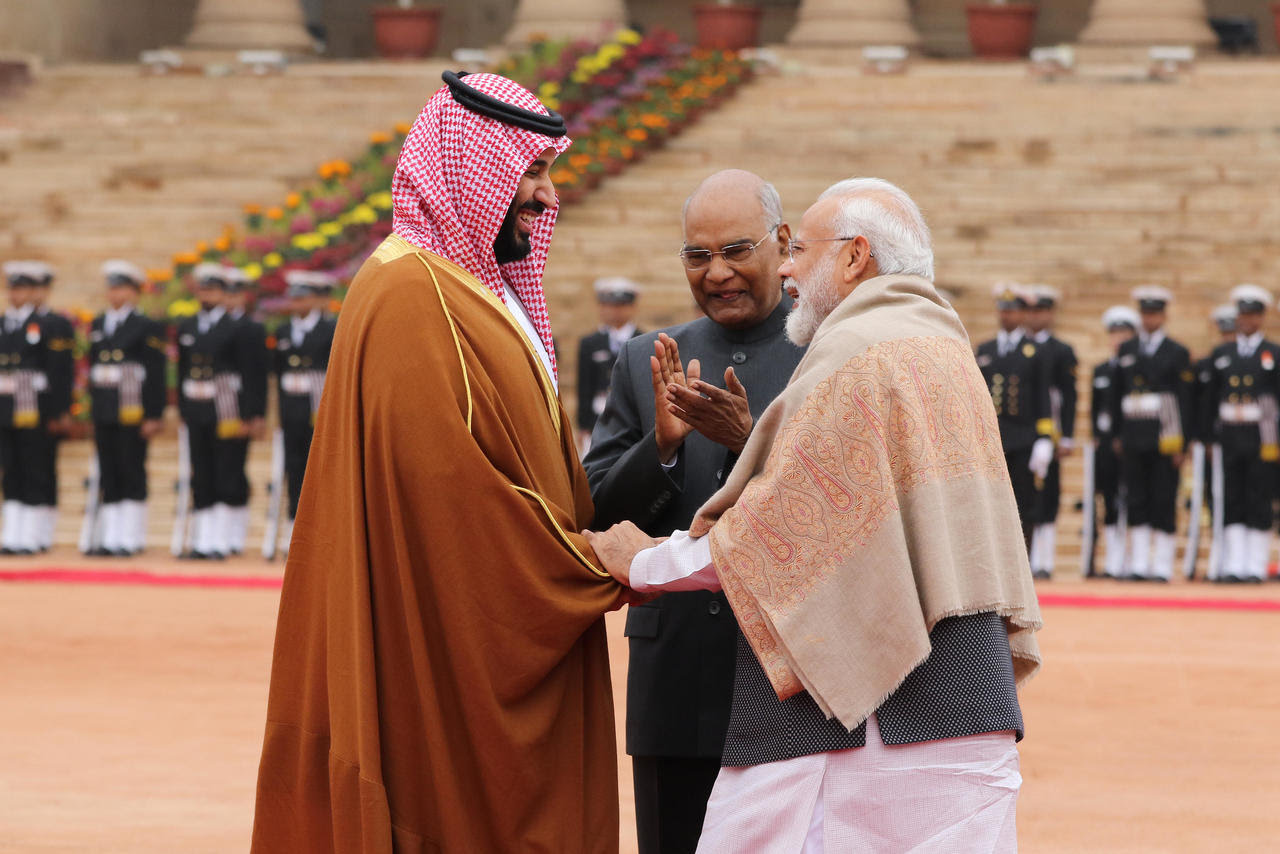
Even countries of Saudi Arabia, UAE and Bahrain accorded highest civilian awards to the current Prime minister of India, Mr. Narendra Modi.
Such incidents put a dent on such peaceful relations among countries and to their people. Of course, India would never want to strain relationships with countries having billions of dollars worth of business ties.
In such a case, India must show its resilience against all such miscreants. It must show its seriousness and ensure non-occurrence of such islamophobic incidents on its land.
Muslims must not confront islamophobia behaviour and practices that are contrary to human and moral values.
Featured
Gaza on the Brink Again: How the Rafah Border Closure Is Pushing 2 Million People Toward Extreme Hunger


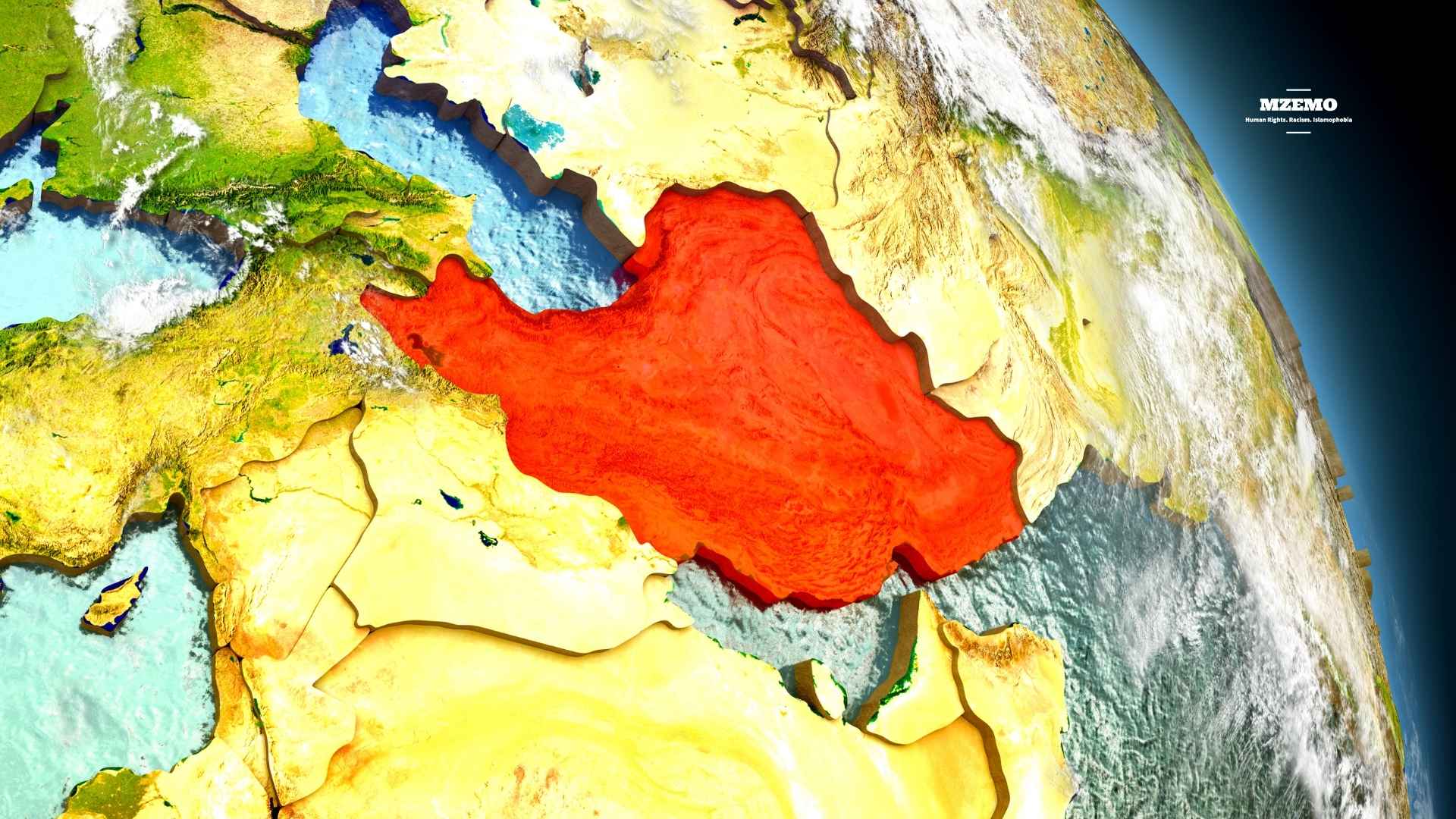
Across the globe, there are two dominating crisis headlines today: Israel’s blatant genocide in Gaza and the ongoing war between Israel-US and Iran. This war is undoubtedly imposed by Israel and the United States, labeling it necessary for peace.
Western governments and media houses frame their policies around the language of “security” and “stability”. There is a pattern of double standards that undermines international law, credibility, and humanity.
On one side stands Gaza, where more than 2.2 million Palestinians are being killed by Israel. It has produced one of the worst humanitarian catastrophes of the 21st Century. On the other hand, stands Iran, a country that is signatory to the Nuclear Non-Proliferation Treaty (NPT) yet faces sanctions, threats, and even attacks on its civilians.
Why are some countries given carte blanche and strategic exceptions while others face relentless punishment?
Gaza: A Genocide in Plain Sight
Since the beginning of Israel’s large-scale assault on Gaza, the humanitarian impact has been staggering. According to Palestinian health authorities and international humanitarian organizations, more than 80,000 Palestinians have been killed, with a large proportion of the victims being women and children.
Entire neighborhoods across Gaza have been reduced to rubble. The United Nations reports that the vast majority of Gaza’s population has been displaced, many of them forced to move multiple times as Israeli military operations expanded across the territory.
This is the purest form of genocide in modern human history. The scale of destruction, starvation, and forced displacement goes far beyond conventional warfare. However, not all media groups are showing the real picture. Western media is showing its unquestioned support for Israel even during the most heinous crimes against humanity.
Western Silence and Political Protection
The United States remains Israel’s closest international ally. According to data from the U.S. Congressional Research Service, Washington provides Israel with approximately $3.8 billion in annual military assistance under long term defense agreements.
Beyond military aid, Western governments have repeatedly shielded Israel from international accountability. In diplomatic arenas such as the United Nations Security Council, attempts to impose sanctions or demand ceasefires have often been blocked or diluted.
This pattern represents a profound contradiction: while Western leaders frequently emphasize human rights and international law, their response to the devastation in Gaza appears far more restrained than in other global conflicts.

Israel’s Nuclear Arsenal: The Middle East’s Open Secret
Another major source of controversy lies in the nuclear dimension of Middle Eastern politics.
Israel is widely believed by international experts to possess between 80 and 200 nuclear warheads, developed through its long-standing nuclear program centered around the Dimona facility in the Negev desert.
Yet Israel maintains a policy known as “nuclear ambiguity” — neither confirming nor denying the existence of its nuclear arsenal.
More importantly, Israel is not a signatory to the Nuclear Non-Proliferation Treaty (NPT), the global framework designed to prevent the spread of nuclear weapons.
Just because it operates outside the NPT system, Israel’s nuclear facilities are not subject to full international inspections by the International Atomic Energy Agency (IAEA).
Despite this reality, Western governments rarely criticize Israel’s nuclear capabilities or call for sanctions related to its weapons program.
Iran and the Nuclear Non-Proliferation Treaty
On the other hand, Iran’s nuclear program exists in a very different legal context.
Unlike Israel, Iran signed and ratified the Nuclear Non-Proliferation Treaty in 1970, which means it is legally permitted to pursue nuclear technology for peaceful purposes such as energy production and scientific research.
Under the NPT framework, Iran’s nuclear facilities are supposed to operate under international monitoring by the International Atomic Energy Agency (IAEA).
Nevertheless, Iran has faced decades of economic sanctions and intense political pressure from Western governments, which argue that its uranium enrichment activities could eventually lead to nuclear weapons development. However, Iranian officials insist that their nuclear program is intended solely for civilian purposes.
Attacks on Iran and the Broader Muslim World
Recent tensions have further escalated the crisis. Israel and the United States have carried out strikes targeting Iranian nuclear facilities, including sites associated with uranium enrichment. The assassination of Iran’s Supreme Leader Ayatollah Ali Khamenei, along with other high-ranking officials show how brutal these strikes are.
Just like in Gaza, Iran’s civilians are also being attacked. One such example is the recent bombing of a girls’ school in Iran in which more than a hundred innocent children and teachers were killed. Such attacks raise serious concerns among international security experts.
Moreover, striking nuclear infrastructure carries enormous risks, including the possibility of radioactive contamination and the potential collapse of global nuclear non-proliferation efforts. Some analysts argue that military attacks on nuclear facilities could actually push targeted states to accelerate weapons development rather than abandon it.
Ultimately, these strikes represent another example of selective enforcement of international norms.
From Gaza to Tehran: A Crisis of Global Credibility
The combined effect of these policies has produced a growing crisis of credibility for the international system.
International law is being applied selectively, enforced strictly against adversaries, while ignored when allies are involved.
From the ruins of Gaza to the nuclear facilities of Iran, the politics of power continue to shape the Middle East in profound ways.
For millions of people across the region, the question is not merely about military strategy or diplomatic rivalry. It is about whether international law truly applies equally to all nations — or whether global justice remains dependent on political alliances.
Until those questions are addressed, the perception of double standards will continue to fuel anger, instability, and distrust across the Middle East and beyond.
Crimes Against Humanity
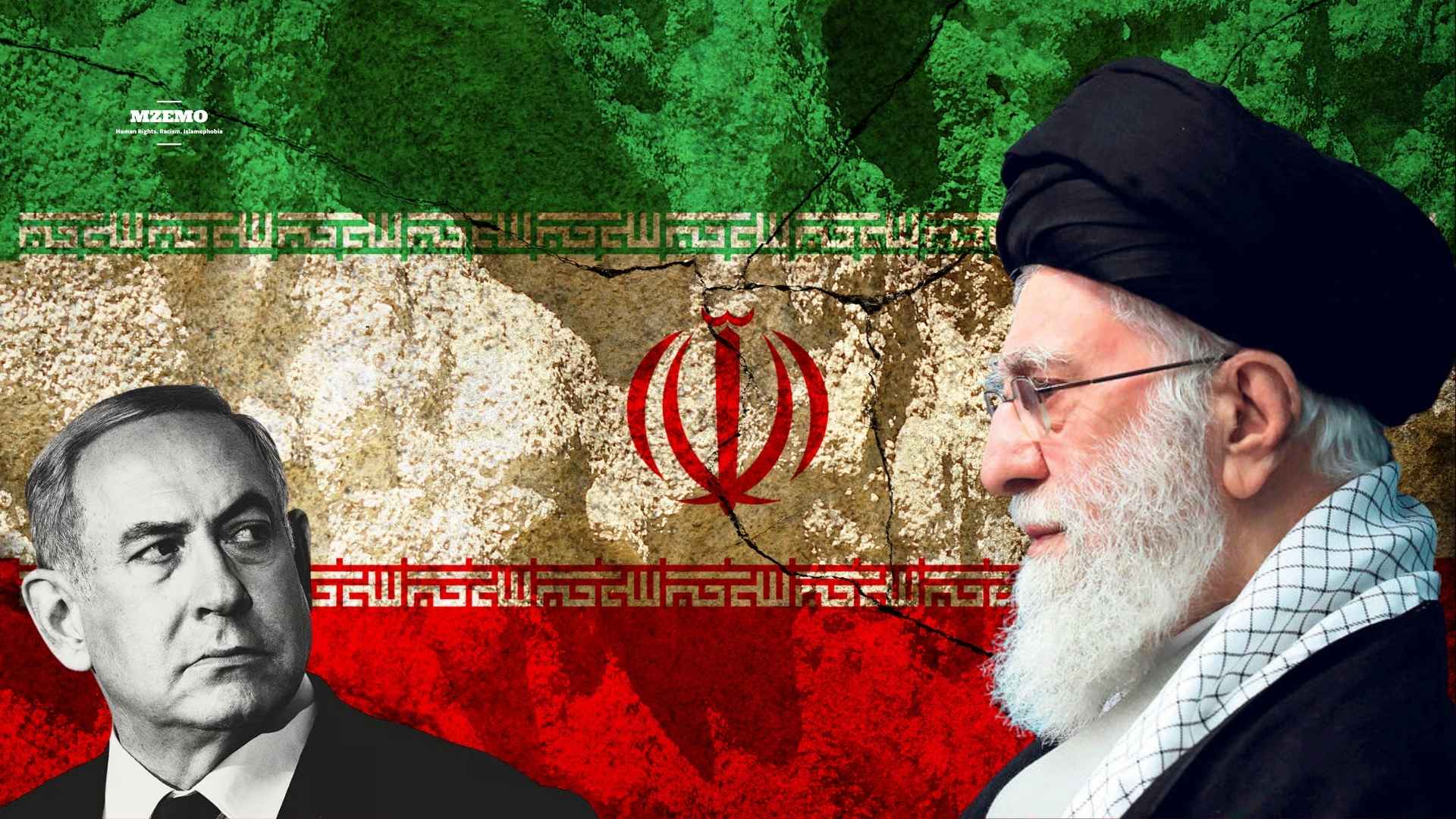
Shockwaves Across the Gulf: How the US–Israel Strike on Iran Could Redraw the Region
-
 Featured2 years ago
World passively watching as Israel perpetrates open-ended massacre in Gaza
-
Featured3 years ago
Argentina wins the World Cup; are there any other winners?
-
Featured2 years ago
Israel is Hiding Crucial Demographic Facts About Palestinians
-
Featured5 years ago
History of the Ottoman Empire
-
Featured3 years ago
Christian militia infiltrate Lebanon
-
Featured5 years ago
“Do Not Waste Water Even If You Were at a Running Stream” Prophet Muhammad
-
Featured2 years ago
Muhammed: The Greatest Man to walk on Earth
-
Featured4 years ago
World Leaders Remain Silent Over Human Rights Violations in the UAE